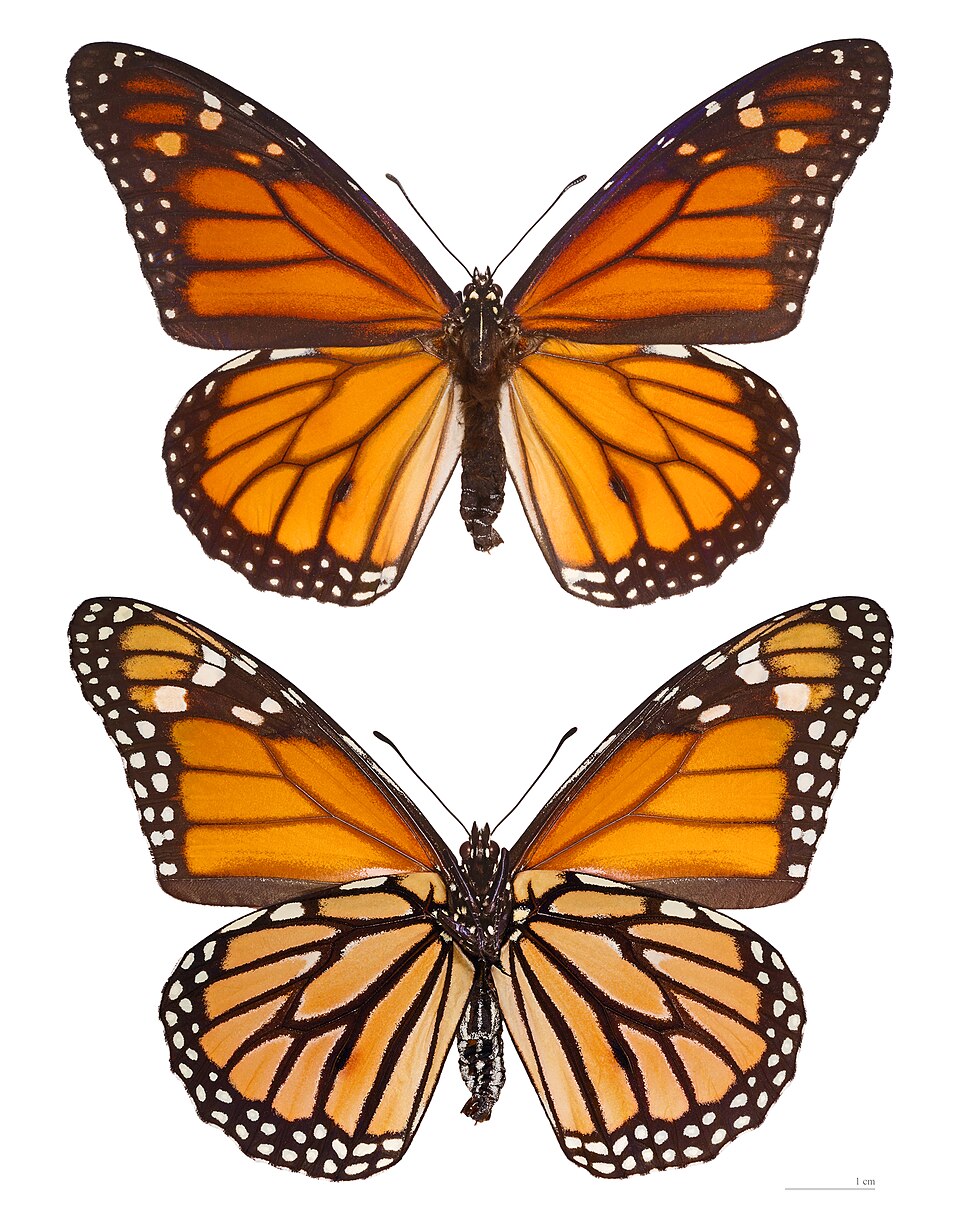
The wings of the monarch owe their bright orange color to a pigment, lipochrome, stored in microscopic scales, while the black of the veins and borders comes from melanin. This contrast first serves as a warning signal intended for predators: it announces the toxicity of the insect, which accumulates cardiotonic glycosides from milkweed consumed in the caterpillar state.
Pigments and structures: two sources of color
Each monarch wing is covered with thousands of tiny scales interlocking like tiles, each measuring only a fraction of a millimeter. Some contain pigments which absorb part of the light spectrum and reflect the orange or black that we perceive. Other scales have little or no pigment: their color arises from the physical structure of the cuticle, whose nanometric veins diffract light and produce iridescent reflections that change depending on the angle of view, a structural color phenomenon well documented in many lepidoptera.
Beyond the toxicity signal, this scale architecture plays a thermal role: the dark wings absorb more solar heat, which helps the monarch to warm up its flight muscles before taking off, an important issue for a species that migrates thousands of kilometers between North America and Mexico. Colored patterns are also involved in recognition between partners, with monarchs distinguishing conspecifics by color and wing pattern as much as by chemical signals.
Fragile scales that should never be touched
These scales are not permanently fixed: they come off at the slightest contact, like fine colored dust that remains on the fingers. This is not trivial, because a partially stripped wing partially loses its signal and thermoregulation functions, which can compromise the insect's flight. It is therefore recommended to never handle a butterfly by its wings and to observe the monarch without touching it.