
A US nuclear-related test, an earthquake in Egypt and a flood of shrimp in Tunisian markets: what is happening in the Mediterranean?

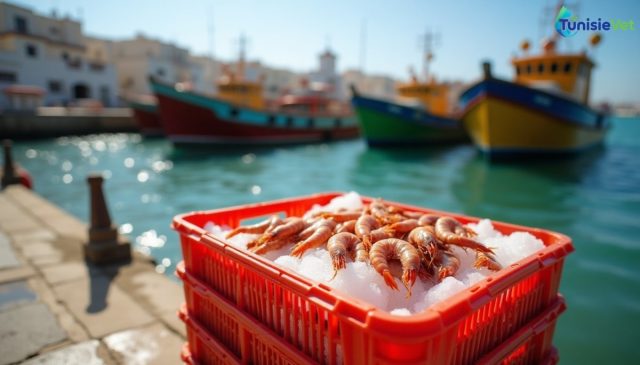
Tunisia's hottest summer in decades, a Mediterranean Sea breaking temperature records, shrimp selling for around 6 dinars a kilo in some markets, and more than 350 trawlers working the Gulf of Gabès… In the background: a tense export dispute with Italy, and a US nuclear-related test preceded by an earthquake in Egypt several weeks earlier.
Is this just an exceptional fishing season? Or is climate change starting to reshape marine life in Tunisia? And why are large quantities of shrimp suddenly available at prices consumers never expected?
To understand what is happening, we need to pull the threads together: the climate, the shrimp species, the fishing season and the trade figures — then go back to the events that sparked the debate.
🔴 1. It starts in the United States… an underground test that raises questions
On 30 September 2026, the US National Nuclear Security Administration (NNSA) announced an underground test in Nevada, as part of a programme to improve the detection of nuclear explosions and the verification of non-proliferation.
One detail matters, though: the test used chemical explosives. It was not a declared nuclear explosion.
Even so, the timing of the announcement drew wide attention, especially as reports circulated about seismic activity in the Arab region, followed by large quantities of shrimp appearing on Tunisian markets in October.
So are these events connected?
The timeline alone settles one key point: the earthquake recorded in the Gulf of Suez, Egypt, on 3 August 2026 — magnitude around 5.5 according to circulating reports — happened about 58 days BEFORE the US test.
A test announced in September cannot have caused an earthquake that occurred in August.
As for linking the US test to the shrimp glut in Tunisia, no published scientific evidence supports it. That does not end the inquiry into the environmental factors that can genuinely affect marine life.
Which brings us to the most important thread of the story: summer 2026 was climatically exceptional, and the Mediterranean also recorded unusual heat.
🌡️ 2. A record summer in Tunisia… and an exceptional Mediterranean
According to Tunisia's National Institute of Meteorology, summer 2026 was the hottest in the country since 1950, with an anomaly of about 2.9 °C above the climate normal.
And the heat was not limited to land.
According to Mercator Ocean International, the average sea surface temperature of the Mediterranean reached about 28.27 °C in August 2026 — a record for that month in the organisation's reference series.
In September, the average stood at around 27.34 °C, the highest September value since the series began in 1993.
These figures confirm that the Mediterranean went through exceptional thermal conditions in 2026.
But what does that have to do with shrimp?
Water temperature affects the growth of marine organisms, their reproduction and their geographic distribution. Warm conditions can help some species spread, while harming others or pushing them to move elsewhere.
In the Gulf of Gabès, several non-native shrimp species have been present for years, including the one known scientifically as Penaeus aztecus.
A scientific study published in 2021 documented the spread of this species in the region since it first appeared in Tunisian waters in 2018.

Photo : Public domain (Wikimedia Commons)
This raises an important environmental hypothesis: did the warm sea conditions change the growth, reproduction or distribution of some shrimp species — with the autumn fishing campaign then boosting the quantities reaching the markets?
The hypothesis fits what we know about the effect of heat on marine ecosystems, and fisheries officials themselves have cited warmer waters and the spread of certain species among the explanations for the current abundance.
But measuring how much heat actually contributed to the 2026 catch requires comparing Gulf of Gabès temperatures and catch volumes, species by species, over previous years.
🦐 3. Shrimp floods the markets… and prices drop to around 6 dinars!
In October 2026, falling shrimp prices became a talking point in markets and on social media.
According to a report by the Italian news agency ANSA published on 23 October, prices fell in some cases to around 6 dinars per kilo.
In a Tunisian report from the same period, a fisheries official quoted by the media said that more than 350 trawlers were taking part in the campaign, with tens of tonnes of shrimp reaching the markets every day.
Prices were also reported for 13 to 15 kg crates selling for 70 to 90 dinars — roughly 4.67 to 6.92 dinars per kilo, depending on the weight and price of the crate.
These figures help explain what happened economically.
When hundreds of boats resume fishing at around the same time and large volumes reach the markets within a few days, supply can outstrip what buyers will absorb at the usual price.
Shrimp is also a fairly perishable product, which pushes fishers and traders to sell quickly rather than store it for long.
The more product is offered in a short time, the stronger the pressure on prices.
But does that alone explain the 2026 glut?
Not necessarily. The fishing season comes round every year, so we also need to look at which species are caught, sea conditions, and the actual size of the catch compared with previous years.
📊 4. How much shrimp does Tunisia produce? The figures behind the sector
According to the Food and Agriculture Organization of the United Nations (FAO), landings of two major shrimp species in Tunisia in 2020 were approximately:
| Species | Recorded quantity |
|---|---|
| Deep-water rose shrimp (Parapenaeus longirostris) | 3,500 tonnes |
| Caramote prawn (Melicertus kerathurus) | 1,300 tonnes |
| Total | 4,800 tonnes |

Photo : Calapito — Public domain (Wikimedia Commons)
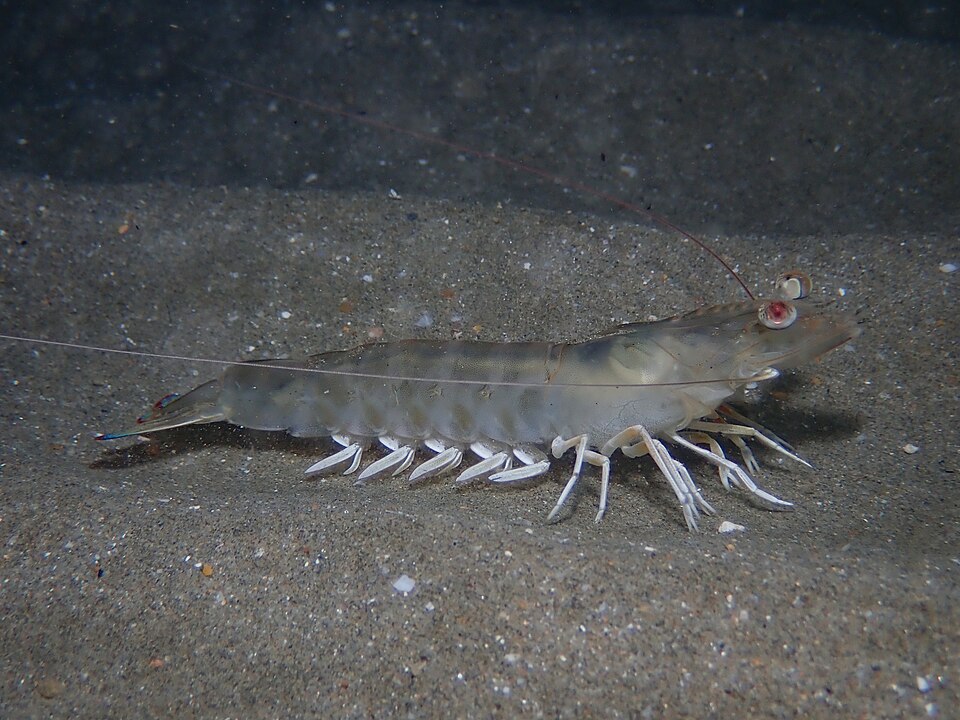
Photo : jujurenoult — CC BY 4.0 (Wikimedia Commons)
These two species alone therefore accounted for about 4,800 tonnes that year.
Shrimp is an important economic resource, not a marginal product of Tunisian fisheries.
Note, however, that these figures are for 2020 and do not represent the 2026 catch.
To illustrate the effect of a possible increase: if a reference quantity of 4,800 tonnes rose by 10%, it would reach 5,280 tonnes — an extra 480 tonnes.
This calculation illustrates the effect of greater supply; it is not evidence that shrimp catches actually rose by 10% in 2026.
Recent statistics comparing catches by species between October 2023 and 2026 are still needed to measure the real scale of change.
🦐 5. Have the shrimp species on the market changed?
This is one of the key points for understanding price differences.
In Tunisian markets, the word "kroufat" (shrimp) covers several species that differ in size, commercial value and habitat.
The main ones include:
- Deep-water rose shrimp: a well-known Mediterranean species of economic importance to Tunisian fisheries.
- Caramote prawn: another species caught and sold in Tunisia, with different commercial characteristics.
- Giant red shrimp: a high-value species whose catches are subject to quotas.
- Northern brown shrimp (Penaeus aztecus): a non-native species whose spread in the Gulf of Gabès since 2018 has been documented by a scientific study.
There is also another species, the speckled shrimp (Metapenaeus monoceros), long known in the region.
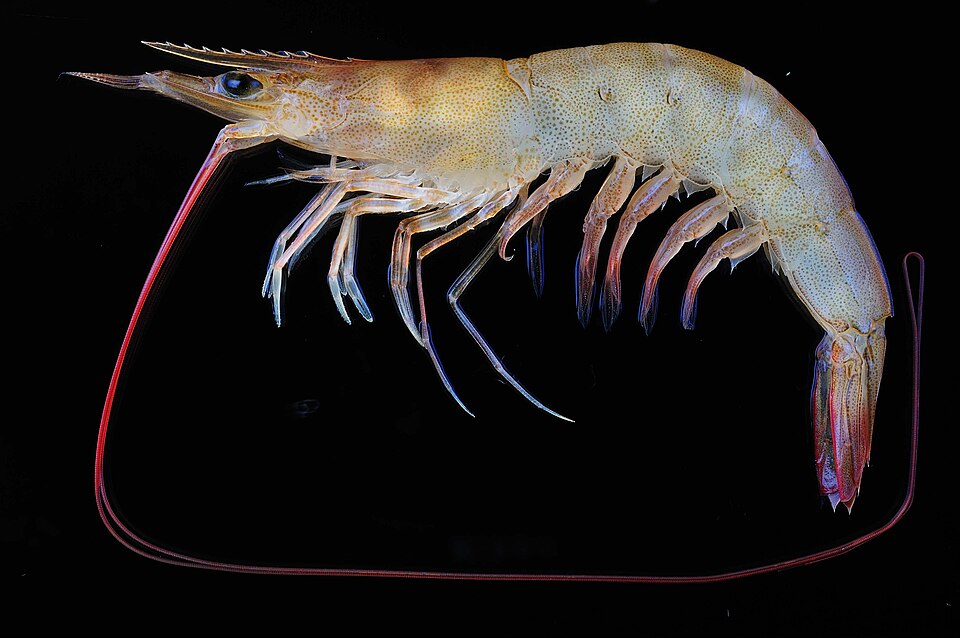
Photo : Chan T. Y. & Lin C. W. — CC BY 4.0 (Wikimedia Commons)
This diversity means that the price seen at the market does not necessarily reflect the price of the same species sold in previous years.
If a cheaper species makes up a larger share of the total volume on offer, the average market price can fall even if not every species gets cheaper to the same degree.
Identifying which shrimp species were most abundant in October 2026 is therefore essential to understanding the price drop — not just counting total tonnage.
🇮🇹 6. The Italian file… 50.96 tonnes against a 36-tonne quota
Beyond the climate, there is a real trade issue involving the giant red shrimp (Aristaeomorpha foliacea).
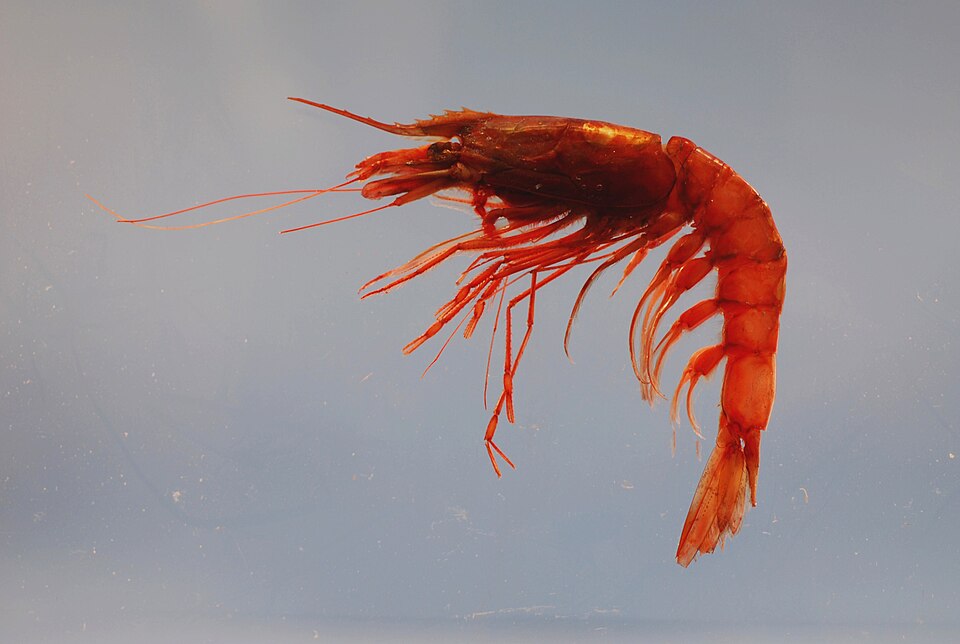
Photo : SEFSC Pascagoula Laboratory; Collection of Brandi Noble, NOAA/NMFS/SEFSC. — Public domain (Wikimedia Commons)
Under the quotas set for this species, Tunisia's share was:
| Year | Quota |
|---|---|
| 2023 | 39 tonnes |
| 2024 | 38 tonnes |
| 2025 | 37 tonnes |
| 2026 | 36 tonnes |
Published information on the Italian file indicates that the quantities recorded on Tunisian catch certificates in 2026 reached about 50.96 tonnes, against a quota of 36 tonnes.
The arithmetic:
- Recorded quantity: 50.96 tonnes.
- Quota: 36 tonnes.
- Difference: 14.96 tonnes.
- Overrun: about 41.6% above the quota.
These figures matter because they point to a dispute over compliance with the quota for one specific species.
But exceeding a quota does not automatically mean that Italy rejected the entire surplus and sent it back to Tunisia.
And this file concerns the giant red shrimp — not all the shrimp species selling cheaply in Tunisian markets.
The Italian file alone therefore cannot explain the price drop across all shrimp species.
🔬 7. Is today's shrimp contaminated?
As images of huge quantities spread and prices fell, questions arose about possible chemical or radioactive contamination.
But suspicion must be distinguished from evidence.
As of 26 October 2026, we found no published laboratory results showing that the shrimp currently sold in Tunisian markets is radioactively or chemically contaminated.
A low price or a different colour is not enough to prove contamination either.
Proving radioactive contamination requires specialised laboratory measurements; chemical contamination requires targeted tests, for example for heavy metals or related pollutants.
Product safety also depends on fishing methods, storage, transport and an unbroken cold chain.
The TunSea association stated, in a release published on 25 October, that the circulating claims of radioactive contamination are not based on any published scientific evidence or reliable analysis.
In other words, contamination has not been established on the available evidence — which does not exempt the relevant authorities from publishing health test results and explaining them to consumers.
🌍 8. Has the world seen similar crises?
Yes. Crustacean markets in various countries have gone through periods of low prices caused by higher production and accumulating stocks.
In other cases, restrictions were imposed on some shrimp exports because of food-safety control failures or residues of banned substances.
But these cases differ from one another.
A price drop caused by abundance is not the same as a shipment rejected for contamination. And foreign precedents cannot prove that what is happening in Tunisia today is due to pollution or hazardous substances.
The takeaway: an abundance of crustaceans can result from intertwined economic and environmental factors, and pinning down the cause requires data on production, species, prices and health controls.
🔮 9. What could happen in 2027?
If the environmental conditions that help some species spread persist, and if abundant autumn catches recur, further periods of low prices are possible in the coming years.
But nothing is guaranteed.
Warmer seas do not benefit all species equally, and can shift their distribution or affect their reproduction and survival rates.
Prices also depend on local demand, export opportunities, catch volumes, transport and storage costs, and when the product reaches the markets.
The effect of greater supply can be illustrated with a few calculations based on a reference quantity of 4,800 tonnes:
| Scenario | Resulting quantity |
|---|---|
| No increase | 4,800 tonnes |
| 5% increase | 5,040 tonnes |
| 10% increase | 5,280 tonnes |
| 20% increase | 5,760 tonnes |
These are arithmetic scenarios, not official forecasts of Tunisia's 2027 production.
An accurate forecast of the catch would require recent data on marine stocks, temperature, species and landings.
🔴 Bottom line: what do the numbers say?
Putting the available evidence together, several facts emerge:
- Tunisia had a record-hot summer in 2026, and the Mediterranean recorded exceptional sea surface temperatures.
- Non-native shrimp species live in the Gulf of Gabès, and scientific studies have documented the spread of some of them for years.
- October's shrimp abundance coincided with the resumption of the fishing campaign, involving more than 350 boats according to published statements.
- Some batches sold for around 6 dinars per kilo.
- There is a dispute over the giant red shrimp quota, but no sufficient evidence that the entire over-quota amount was sent back onto the Tunisian market.
- We found no published analyses proving that the shrimp currently on sale is radioactively or chemically contaminated.
The explanation best supported by current evidence is a combination of abundant catches concentrated in a short period and differences between shrimp species, at a time when the sea experienced exceptional heat that may affect some species.
But measuring how much heat contributed to the higher volumes, or proving that catches rose by a specific percentage in 2026, requires comparing monthly catch data by species with Gulf of Gabès temperatures over previous years.
As for the US test and the earthquake in Egypt, there is no evidence linking them to the shrimp glut.
Ultimately, this is not just about lower prices. It is a chance to understand how marine life is changing in the Gulf of Gabès, and how those changes affect fishers, traders and consumers.
The more accurate the data on species, volumes and temperature, the more this phenomenon can move from a subject of controversy to a clear scientific and economic case.
Main sources
- Tunisian National Institute of Meteorology: summer 2026 data.
- Mercator Ocean International and Copernicus Marine: Mediterranean sea surface temperature data.
- Food and Agriculture Organization of the United Nations (FAO): Tunisian marine fisheries data.
- Scientific study published in 2021 on the spread of Penaeus aztecus in the Gulf of Gabès.
- Italian news agency ANSA and Tunisian media reports on shrimp abundance and prices in October 2026.
- Quota documents for the giant red shrimp, and the TunSea association's statement on radioactive contamination claims.
🎬 Watch the video
Leave a comment
Be the first to comment on this article.
