
Presentation
The crab spider is a large group of spiders from the family Thomisidae, recognizable by their sideways gait that resembles that of a crab. These spiders are characterized by elongated, sturdy front legs used to capture prey, and by their remarkable camouflage ability on flowers. Unlike most spiders, they do not build webs but instead hunt by ambush. Found in many flowering habitats around the world, they play a role in regulating insect populations. Their modest size and inconspicuous lifestyle make them little known to the general public despite their frequency. They are present in Tunisia in natural and cultivated environments.
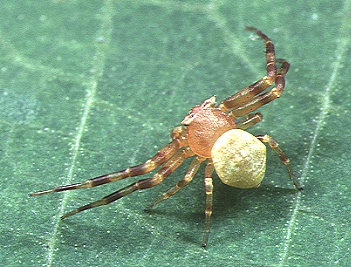
This spider is recognized by its first two pairs of legs, which are longer and sturdier, giving it a crab-like appearance. Its body is stocky, often angular, and its coloration ranges from white to yellow, green, or pink depending on the species and flowers it frequents. It does not build a web to capture prey, and its eyes, arranged in two rows, provide good vision for detecting movement.
Characteristics
Indicative values: they vary by subspecies, sex and region.
Habitat and distribution
The crab spider frequents flowering meadows, gardens, forest edges and shrubby areas where flowers grow. It typically stays on petals or leaves in ambush, in settings with good sun exposure. It is found both in natural habitats and in cultivated or urban areas with vegetation.
CURRENT RANGE
The group of crab spiders, which includes the family Thomisidae, is present on nearly all continents except Antarctica. Several species are common in Europe, North Africa, Asia and the Americas. In Tunisia, it is frequently observed in gardens and flowering natural habitats.
Behaviour
The crab spider hunts by ambush rather than by web, remaining motionless on a flower or foliage whose color it often mimics. It waits for a pollinating insect to land nearby before seizing it suddenly with its front legs. Some species can gradually change their hue to blend in with their chosen surface. It readily moves sideways or backward, in the manner of a crab, hence its name.
Reproduction
After mating, which is often risky for the smaller male who may be eaten by the female, she lays her eggs in a silk cocoon that she hides beneath a leaf or in a plant fold. She actively protects the cocoon until the young hatch. The juveniles then disperse rapidly to avoid cannibalism and begin a solitary life.
Peculiarities
Its ability to gradually change colour to camouflage itself on flowers is one of its most studied features. Its sideways manner of moving, like a crab, gives it its common name. Unlike most spiders, it does not build a web to hunt.
Threats and conservation
The species is not considered threatened globally, as its wide distribution and good adaptability limit risks. The loss of flowering habitats due to urbanisation and pesticide use can locally reduce its populations. It is not subject to any specific protection measures.
Numbers and trends vary across sources and regions. See the IUCN assessment for the latest reference data.
Gallery
1 documented photographs.
References
Profile updated 28 August 2026 · Reviewed by the TunisieVet editorial team.
Comments (0)
No comments yet.
CONSERVATION STATUS
Least concern (LC)
IUCN source, latest published assessment.
Similar animals
Other species documented in Animalpedia.

📱 عندك صفحة على فايسبوك؟ باهي… أما وين موقعك؟ الصفحة وحدها ما تكفيش. موقعك يخلي الناس تلقاك، يعرفوك أكثر ويثقو في خدمتك. 🌐 موقع باسم مشروعك 📲 يخدم أربعة وعشرين ساعة 🤝 يعطي ثقة واحترافية .📈 يعاونك تكبّر خدمتك خلّيه موجود وين الناس تلوّج عليه 🚀نعملولك موقع يشرّف مشروعك
WhatsApp