
Presentation
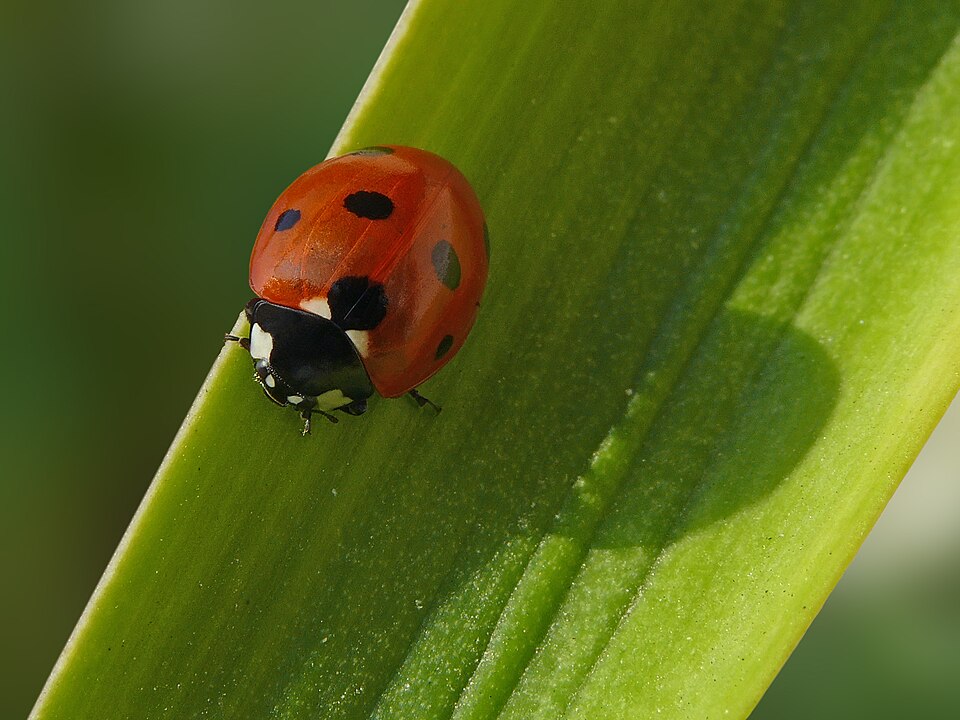
The Seven-spot ladybird is a small, very recognizable beetle, characterized by its bright red carapace decorated with seven distinct black dots. It is one of the most common and popular ladybugs in Europe, symbolizing good luck in many cultures.
Its body is oval and rounded. The red carapace has seven symmetrically arranged black dots: three on each side and one in the center. The head and pronotum are usually black with white spots. The antennae are short and the legs are black.
Did you know?
Why is the ladybug red with black spots?
Characteristics
Indicative values: they vary by subspecies, sex and region.
Habitat and distribution
Seven-spot ladybird frequents forests, orchards, agricultural crops, meadows and urban environments. It prefers areas where there are abundant colonies of aphids, its main prey. It is found from sea level to moderate altitudes.
CURRENT RANGE
The species is widely distributed in Europe, from north to south, and extends to Southwest Asia and North Africa. It has also been introduced to many other parts of the world for the biological control of aphids.
Behaviour
It is a diurnal and active species, particularly on sunny and warm days. She is an excellent thief and moves quickly to hunt her prey. During cold periods, it enters diapause and gathers with other individuals in protected places to overwinter.
Reproduction
The female lays her eggs in small groups on plants infested with aphids. The very voracious larvae emerge after a few days and feed intensely for four to five weeks before transforming into a chrysalis. There can be two to three generations per year depending on climatic conditions.
Peculiarities
Seven-spot ladybird has a remarkable chemical defense: when threatened, it secretes a toxic yellow-orange substance that repels predators. Its Latin name, Coccinella septempunctata, literally means “small seven-spotted cochineal”. It is a very useful species in organic agriculture.
Threats and conservation
The species benefits from great population stability on a global scale. No major threats are currently documented, although intensive agricultural practices and excessive pesticide use may indirectly affect food availability.
Numbers and trends vary across sources and regions. See the IUCN assessment for the latest reference data.
Gallery
1 documented photographs.
References
UICN — Liste rouge des espèces menacées
Profile updated 28 August 2026 · Reviewed by the TunisieVet editorial team.
Comments (0)
No comments yet.
CONSERVATION STATUS
Least concern (LC)
IUCN source, latest published assessment.
To discover around: Seven-spot ladybird
Videos, facts, stories and records linked to this species.
Similar animals
Other species documented in Animalpedia.

TunisieVet in your pocket 📱🐾 Access your veterinary services wherever you are. [ Download the app ]
Learn more