Presentation
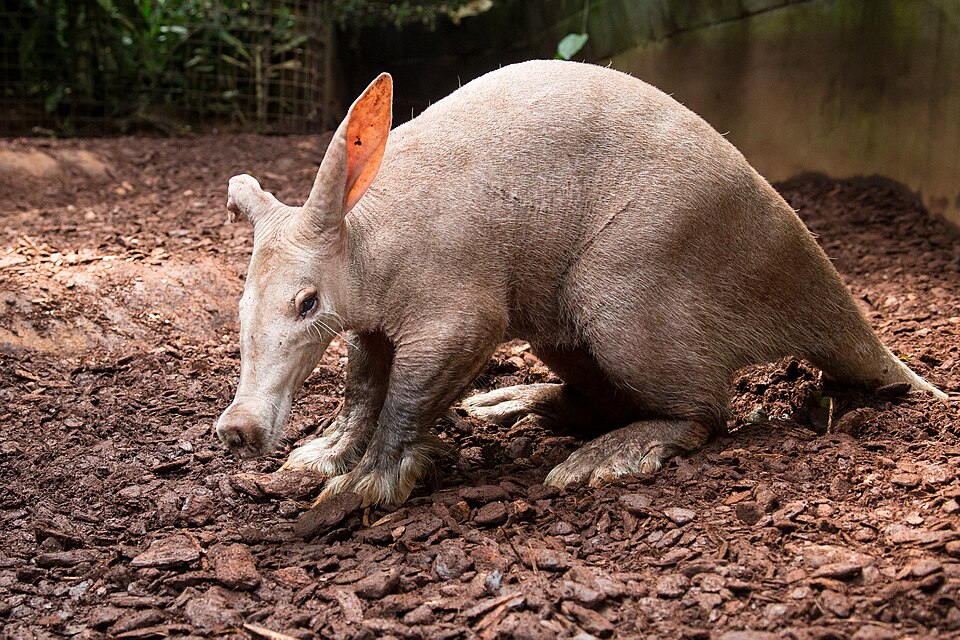
The aardvark is a nocturnal, burrowing mammal found in sub-Saharan Africa and is the only living member of the order Tubulidentata. Its robust body, large upright ears, and elongated pig-like snout give it a unique silhouette among mammals. It specializes in eating ants and termites, which it captures with a long, sticky tongue. Secretive and solitary, it spends the day hidden in underground tunnels that it digs itself. Though widely distributed across the continent, it remains rarely seen because of its nocturnal habits and reclusive nature.
The aardvark has a stocky body covered in thick skin with sparse hair, colored grayish-brown to yellowish. Its front legs are equipped with strong claws adapted for rapid tunnel digging. Its long, mobile ears provide keen hearing, while its highly developed sense of smell compensates for its weak eyesight.
Characteristics
Indicative values: they vary by subspecies, sex and region.
Habitat and distribution
The aardvark inhabits savannas, grasslands, and wooded areas where termite mounds and ant hills are abundant. It avoids arid regions with insufficient prey and rocky areas unsuitable for digging. The presence of loose soil is essential to its burrowing lifestyle.
CURRENT RANGE
The species is widely distributed across sub-Saharan Africa, from Senegal to Ethiopia and south to South Africa. It is absent from North Africa and the most extreme desert regions. Its range essentially follows the presence of savannas and soil suitable for burrowing.
Behaviour
A solitary and primarily nocturnal animal, the aardvark spends most of the night traveling long distances in search of insect nests. It possesses an excellent sense of smell that allows it to detect underground colonies before rapidly digging to access them. During the day, it takes shelter in a deep burrow, which it can dig in just a few minutes if threatened. Its abandoned burrows are subsequently used by many other animal species.
Reproduction
The female gives birth to a single offspring after a gestation period of approximately seven months. The young stays with its mother for several months, feeding on termites from a few weeks of age while continuing to nurse. It becomes independent around six months of age but may remain near the maternal burrow for longer.
Peculiarities
The aardvark is the only surviving member of the order Tubulidentata, a very ancient group of mammals. Its teeth lack enamel and roots, a unique characteristic in the animal kingdom. Its burrows, sometimes very extensive, play an important ecological role by providing shelter for many other species.
Threats and conservation
The species is not globally threatened but suffers locally from hunting pressure for its meat and habitat destruction. Climate change, particularly prolonged droughts that reduce insect populations, represents an emerging threat. Conversion of savannas to agricultural land also limits its feeding areas.
Numbers and trends vary across sources and regions. See the IUCN assessment for the latest reference data.
Gallery
1 documented photographs.
References
Profile updated 01 September 2026 · Reviewed by the TunisieVet editorial team.
Comments (0)
No comments yet.
CONSERVATION STATUS
Least concern (LC)
IUCN source, latest published assessment.
Species health
Documented diseases for this species.
This information is provided for educational purposes only and is not a substitute for a veterinary consultation. If you have any concerns about your animal's health, consult a veterinarian.
Related species
To discover around: Aardvark
Videos, facts, stories and records linked to this species.
Similar animals
Other species documented in Animalpedia.

Be among the first to use our app. Sign up and get early Google Play access.
Discover