
Presentation
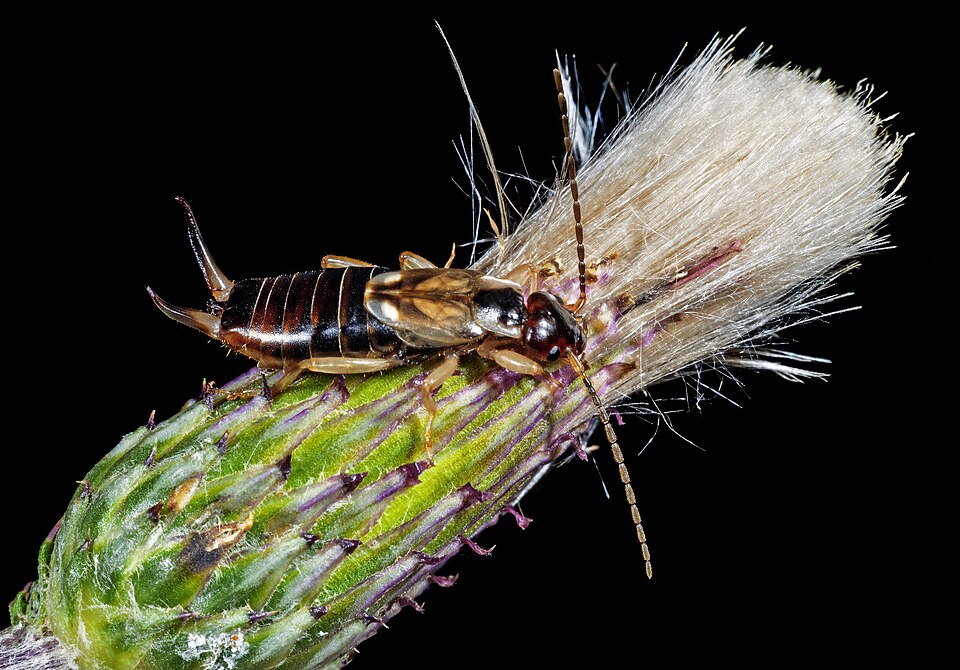
The earwig is a small insect recognizable by its pincerlike cerci located at the tip of the abdomen. It belongs to the order Dermaptera and is commonly found in gardens, under stones, and in woodpiles. Its elongated, flattened body allows it to squeeze into very tight spaces. Despite its reputation, it is harmless to humans and plays a useful role in regulating certain pests. It is active mainly at night and hides during the day in damp, dark places.
The earwig has a reddish-brown, elongated, flexible body, generally measuring between 10 and 15 mm. It has two pairs of wings, the first short and leathery, the second membranous and folded, although it rarely flies. Its cerci, shaped like pincers, are more curved in males than in females and serve for defense and capturing prey.
Characteristics
Indicative values: they vary by subspecies, sex and region.
Habitat and distribution
The earwig inhabits gardens, meadows, cultivated areas, and urban environments where it finds shelter under stones, bark, or within plant debris. It prefers damp, dark places, which explains its frequent presence in compost piles and leaf litter. It is found both in natural habitats and in the immediate vicinity of human dwellings.
CURRENT RANGE
The species is widely distributed across Europe, North Africa, Asia, and has been introduced to North America. It has adapted to a wide range of temperate and Mediterranean climates. Its presence is particularly common in regions with mild, humid climates.
Behaviour
This insect is nocturnal and gregarious, often clustering in small groups in damp shelters during the day. It displays notable maternal behavior for an insect, with the female protecting and cleaning her eggs and remaining near the young after they hatch. When threatened, it may raise its abdominal pincers in warning, but their use against humans is negligible and poses no danger.
Reproduction
Reproduction typically occurs in autumn, after which the female lays between 20 and 80 eggs in an underground nest that she digs herself. She actively guards the eggs throughout winter, protecting them from mold and predators. The larvae, called nymphs, resemble miniature adults and undergo several molts before reaching their adult form.
Peculiarities
The most distinctive feature of the earwig is the maternal care it provides to its eggs and young, a rare behavior among insects. Contrary to a widespread popular belief, it does not pierce human ears, and its name likely derives instead from the shape of its folded wings, which resemble an ear. Its pincers, though intimidating, are not venomous and cause at worst a slight pinch.
Threats and conservation
The earwig is not threatened and is not subject to any particular conservation measures. It may be considered a minor pest in some gardens due to occasional damage to flowers and tender fruits. Pesticides used in agriculture and domestic horticulture constitute the main pressure on local populations.
Numbers and trends vary across sources and regions. See the IUCN assessment for the latest reference data.
Gallery
1 documented photographs.
References
Profile updated 27 August 2026 · Reviewed by the TunisieVet editorial team.
Comments (0)
No comments yet.
CONSERVATION STATUS
Least concern (LC)
IUCN source, latest published assessment.
Similar animals
Other species documented in Animalpedia.

📱 عندك صفحة على فايسبوك؟ باهي… أما وين موقعك؟ الصفحة وحدها ما تكفيش. موقعك يخلي الناس تلقاك، يعرفوك أكثر ويثقو في خدمتك. 🌐 موقع باسم مشروعك 📲 يخدم أربعة وعشرين ساعة 🤝 يعطي ثقة واحترافية .📈 يعاونك تكبّر خدمتك خلّيه موجود وين الناس تلوّج عليه 🚀نعملولك موقع يشرّف مشروعك
WhatsApp