
Presentation
The Giant anteater (Myrmecophaga tridactyla) is a myrmecophagous mammal from South and Central America, recognizable by its long, tapered snout and bushy tail. It is the largest of the current anteater species, entirely toothless and specialized in capturing ants and termites using an extendable tongue covered in mucus. It evolves alone in varied habitats ranging from open savannahs to tropical forests, generally avoiding areas that are too densely wooded. Despite its imposing size, it remains discreet and not very aggressive, only defending itself when threatened. The species is now threatened by deforestation, road collisions and fires, which has led to its classification as vulnerable by the IUCN. It is not present in Tunisia, neither in the wild nor in common captivity.
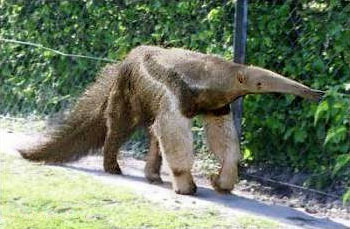
The species is distinguished by its long tubular snout, its extendable tongue which can extend over 60 cm, and the total absence of teeth. Its coat is gray-brown with a broad black band bordered in white crossing the shoulder and flank. Its bushy tail, as long as the body, serves as a cover and a balance. The front legs bear four powerful, curved claws, one of which is particularly developed, adapted to burrowing into insect nests.
Characteristics
Indicative values: they vary by subspecies, sex and region.
Habitat and distribution
The Giant anteater occupies a wide range of habitats, from grassy savannahs, to wet and dry tropical forests, to swampy areas. It favors environments offering good access to ant and termite nests while avoiding intensive agricultural areas. Its ability to adapt to varied habitats explains its wide geographical distribution in Latin America.
CURRENT RANGE
The species occurs from Honduras, Central America, to northern Argentina, covering much of tropical South America. It is particularly widespread in the Amazon basin, the Brazilian Cerrado and the Pantanal. However, its populations are fragmented and declining in several regions due to the conversion of natural habitats into agricultural land.
Behaviour
The Giant anteater is a solitary and mainly diurnal animal, although in areas frequented by humans it becomes more active at dusk and night. It moves on the ground with a characteristic plantigrade gait, claws folded inwards, and can stand on its hind legs to defend itself. Its eyesight and hearing are poor, but its highly developed sense of smell allows it to locate ant and termite nests. When faced with a predator, it rears up and uses its powerful front claws as a defensive weapon.
Reproduction
The female gives birth to a single young after a gestation of about 190 days, generally in the rainy season. The young cling to its mother's back for several months, during which time it learns foraging techniques. Complete weaning occurs around the age of two, and sexual maturity is reached between three and four years.
Peculiarities
The Giant anteater has one of the longest tongues in the animal kingdom relative to its body size, capable of extending over 60 cm outside the mouth. It has no teeth and its body temperature, around 33°C, is among the lowest known among mammals. Its claws are so powerful that it must walk on the outer side of its front legs to avoid self-injury.
Threats and conservation
Deforestation and the conversion of natural habitats to agricultural land constitute the main threats to the species. Collisions with vehicles on roads crossing its habitat also cause significant mortality. Savanna and forest fires, as well as illegal hunting in some regions, are further worsening population declines.
Numbers and trends vary across sources and regions. See the IUCN assessment for the latest reference data.
Gallery
1 documented photographs.
References
Profile updated 24 August 2026 · Reviewed by the TunisieVet editorial team.
Comments (0)
No comments yet.
CONSERVATION STATUS
Vulnerable (VU)
IUCN source, latest published assessment.
Species health
Documented diseases for this species.
See the 7 diseases of this species Find a veterinarianThis information is provided for educational purposes only and is not a substitute for a veterinary consultation. If you have any concerns about your animal's health, consult a veterinarian.
To discover around: Giant anteater
Videos, facts, stories and records linked to this species.
RECORD
up to 60 cm in length
Longest tongue relative to body size
Measured in adults, the extendable, mucus-covered tongue can capture thousands of insects...
Similar animals
Other species documented in Animalpedia.

TunisieVet in your pocket 📱🐾 Access your veterinary services wherever you are. [ Download the app ]
Learn more