
Presentation
The wolf spider is the common name for members of the Lycosidae family, active hunting spiders rather than web builders. It gets its name from its hunting technique, which involves stalking and pursuing prey on the ground much as a wolf would. Its squat, hairy body, often brown or gray, allows it to blend into leaf litter and dry soil. It is also recognized by its eight eyes arranged in three rows, including two very large rear median eyes that provide excellent night vision. In Tunisia as throughout the Mediterranean basin, it is frequently observed in fields, gardens, and rocky areas.
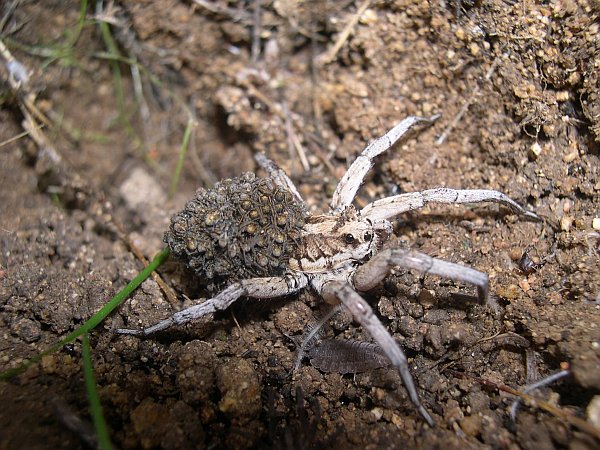
The body typically measures between 1 and 3 cm depending on the species, with robust, hairy legs enabling rapid movement. Color ranges from light brown to dark gray with patterns that provide effective camouflage against the soil. Females are often larger than males and are distinguished by the egg sac they carry attached to their spinnerets.
Characteristics
Indicative values: they vary by subspecies, sex and region.
Habitat and distribution
Wolf spiders inhabit open, dry environments such as fields, grasslands, scrub, and rocky areas. They sometimes dig a burrow in the soil that serves as a daytime shelter. They are found in both rural areas and urban fringes, in gardens and green spaces.
CURRENT RANGE
The family Lycosidae is found on all continents except Antarctica, with great diversity of species adapted to various climates. In North Africa and Tunisia, several species of the genus Lycosa are common in agricultural and semi-arid zones. Their wide distribution makes them one of the most cosmopolitan families of spiders.
Behaviour
Solitary and primarily nocturnal, it spends the day hidden in a burrow or under stones. The female displays remarkable maternal behavior: she carries her egg cocoon attached to her abdomen, then transports her young on her back after they hatch. She moves quickly and typically flees rather than attacks when threatened.
Reproduction
Reproduction occurs through mating preceded by a courtship display in which the male waves his pedipalps to signal his intentions to the female. After fertilization, the female spins a silk cocoon containing several dozen eggs that she carries attached to her abdomen. Once the eggs hatch, the young climb onto their mother's back and remain there for a few days before dispersing.
Peculiarities
Unlike the majority of spiders, the female carries her young on her back after hatching, a parental behaviour uncommon among arthropods. Her large posterior median eyes, which reflect light at night, make her easy to spot with a torchlight.
Threats and conservation
The species is not threatened and receives no particular protection. Agricultural pesticide use can locally reduce populations by diminishing available prey. It is sometimes killed through misunderstanding because of its formidable appearance.
Numbers and trends vary across sources and regions. See the IUCN assessment for the latest reference data.
Gallery
1 documented photographs.
References
Profile updated 12 September 2026 · Reviewed by the TunisieVet editorial team.
Comments (0)
No comments yet.
CONSERVATION STATUS
Least concern (LC)
IUCN source, latest published assessment.
Species health
Documented diseases for this species.
Find a veterinarianThis information is provided for educational purposes only and is not a substitute for a veterinary consultation. If you have any concerns about your animal's health, consult a veterinarian.
To discover around: Wolf Spider
Videos, facts, stories and records linked to this species.
Similar animals
Other species documented in Animalpedia.
