Presentation
A mite is a tiny arthropod belonging to the subclass Acari, which includes tens of thousands of species found worldwide. Most mites measure less than one millimeter and go unnoticed, though some species like ticks can reach several millimeters. They are found in nearly every environment: soil, fresh water, household dust, bird feathers, and mammal skin. Some species are free-living and harmless, while others are parasites of plants, animals, or humans, and can transmit diseases or trigger allergies. Their ecological diversity makes them an essential group in decomposition cycles and in certain parasitic balances.
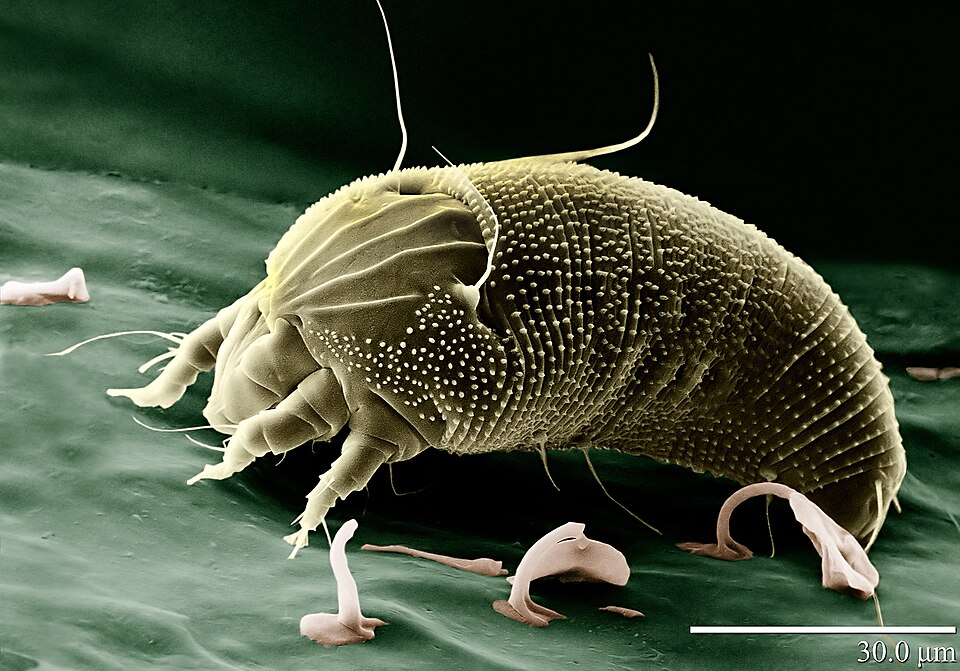
The mite body is broadly oval-shaped, without visible segmentation, and bears four pairs of legs in the adult stage. It has no antennae and shows no clear separation between the head, thorax, and abdomen, unlike insects. Body size ranges from a few tenths of a millimeter to about one centimeter for engorged ticks.
Characteristics
Indicative values: they vary by subspecies, sex and region.
Habitat and distribution
Mites colonise an extremely wide range of habitats, from forest soil to aquatic environments, as well as human dwellings and animal bodies. Some species are restricted to very specific microhabitats such as hair follicles or the respiratory passages of birds. Their ability to adapt allows them to survive in environments as varied as deserts or wetlands.
CURRENT RANGE
Mites are present on all continents, including Antarctica where certain soil-dwelling species survive extreme cold. Their distribution follows that of their hosts or favoured habitats, making them one of the most widely distributed groups of arthropods on Earth.
Behaviour
Most mites lead a discreet life hidden in soil, plant litter, dust, or animal fur. Parasitic species actively search for a host using chemical or thermal stimuli. Many species can survive extreme conditions of dryness or temperature by entering dormancy.
Reproduction
Mite reproduction is generally sexual, though some species reproduce by parthenogenesis. The life cycle passes through several stages: egg, larva, one or more nymphs, then adult. This cycle can be very fast, sometimes completed in just one to a few weeks depending on environmental conditions.
Peculiarities
The mite group is one of the most diverse among arachnids, with tens of thousands of described species and probably many more unrecorded. Some species are invisible to the naked eye and are detected only by their effects, such as respiratory allergies. Others, like ticks, are major vectors of infectious diseases in humans and animals.
Threats and conservation
As a group that is globally very abundant and diverse, mites are not threatened overall. Some specialised species may however be sensitive to destruction of their specific habitat or loss of their hosts. Pesticides and acaricides used in agriculture and veterinary medicine locally regulate certain populations.
Numbers and trends vary across sources and regions. See the IUCN assessment for the latest reference data.
Gallery
1 documented photographs.
References
Profile updated 12 September 2026 · Reviewed by the TunisieVet editorial team.
Comments (0)
No comments yet.
CONSERVATION STATUS
Least concern (LC)
IUCN source, latest published assessment.
Species health
Documented diseases for this species.
Find a veterinarianThis information is provided for educational purposes only and is not a substitute for a veterinary consultation. If you have any concerns about your animal's health, consult a veterinarian.
Similar animals
Other species documented in Animalpedia.