
Presentation
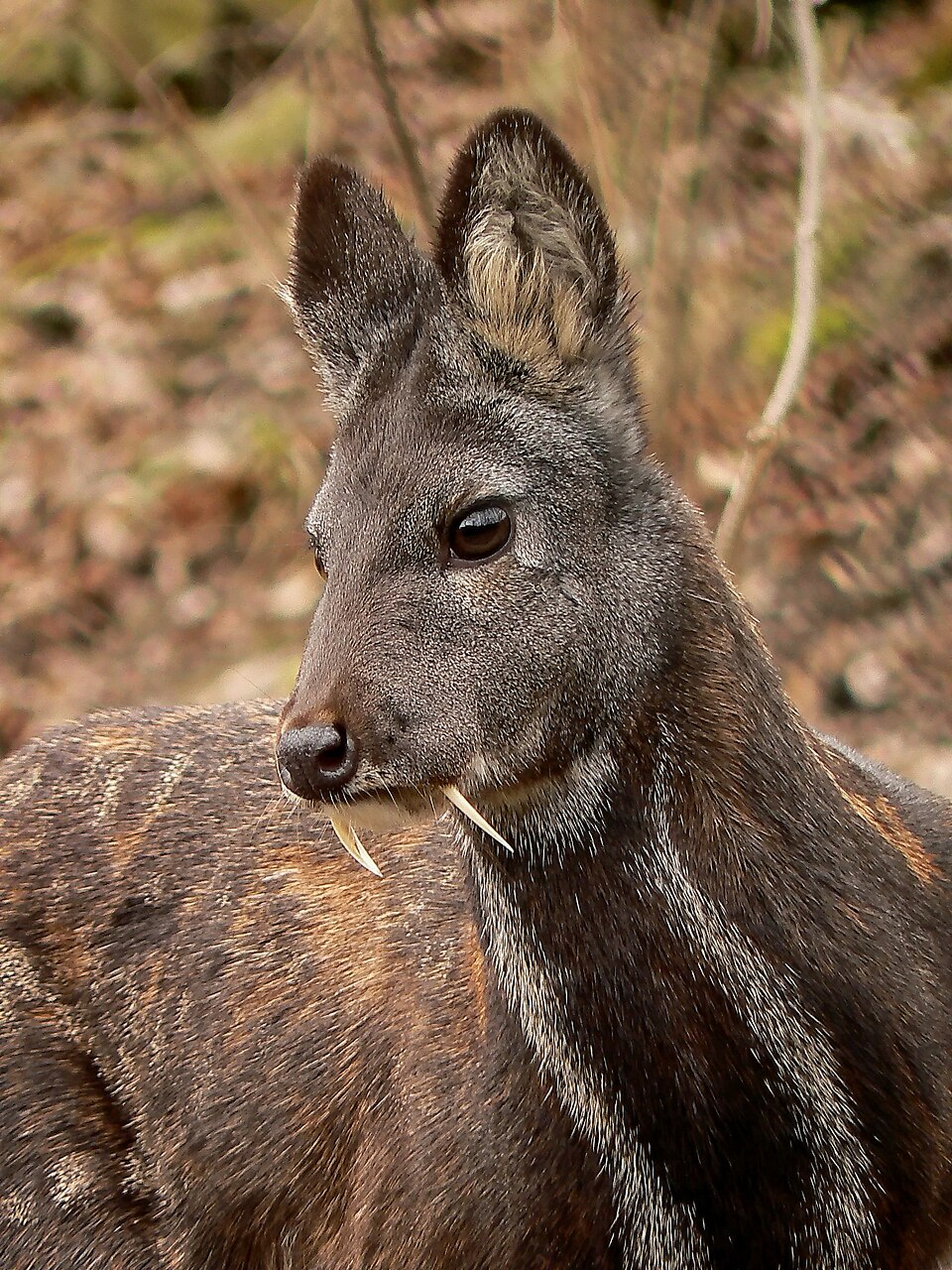
The musk deer is a small hoofed mammal native to Asia, lacking antlers but equipped with long protruding canine teeth in males. It belongs to a distinct family separate from true deer, the Moschidae, due to unique anatomical and physiological characteristics. Its name derives from the male's abdominal musk gland, whose secretion is highly prized in perfumery and traditional medicine. Discreet and solitary, it lives hidden in dense mountainous forests. Its stocky build, hind legs longer than front legs, and bounding gait resemble those of a giant hare. Today it faces serious threats from intensive poaching targeting its musk gland.
Stocky body measuring 80 to 100 cm in length with a shoulder height of approximately 50 cm. Males possess long curved upper canine teeth that protrude visibly from the mouth, serving as weapons during fights. The coat is brownish-grey, thick and coarse, suited to cold climates. Unlike true deer, it never grows antlers.
Characteristics
Indicative values: they vary by subspecies, sex and region.
Habitat and distribution
It inhabits coniferous forests and mountain taiga, often on steep and rocky slopes. It favors dense areas with substantial vegetation cover and good availability of lichens. Its habitat ranges from low altitudes to fairly high mountain zones depending on the region.
CURRENT RANGE
The species is found across much of Asia, particularly in Siberia, Mongolia, northeastern China, and Korea. It occupies extensive forest massifs but often in a fragmented manner due to human pressure. Its range generally follows the temperate and cold mountain forest zones of the Asian continent.
Behaviour
A solitary and territorial animal, most active at dusk and night. It communicates through scent marking using its musk gland and caudal glands. Extremely wary, it flees with rapid, silent bounds at the first sign of danger. Adult males show little tolerance for other males on their territory, particularly during the breeding season.
Reproduction
The rut occurs in late autumn and winter, a period when males compete for females using their tusks. Gestation lasts approximately 185 to 195 days and usually results in the birth of a single fawn, occasionally two. The young remains hidden in dense vegetation during its first weeks of life, a common anti-predator strategy among small forest ungulates.
Peculiarities
The male's musk gland, located under the abdomen, produces a scented substance that has been used for centuries in luxury perfumery and traditional Asian medicine. Its prominent long tusks give it an atypical appearance among ungulates. The complete absence of antlers clearly sets it apart from true deer.
Threats and conservation
Poaching for musk, which commands very high market value, is the primary threat facing the species. Deforestation and fragmentation of its forest habitat are worsening its decline. Captive-breeding operations exist to produce musk without killing the animals, but illegal poaching persists.
Numbers and trends vary across sources and regions. See the IUCN assessment for the latest reference data.
Gallery
1 documented photographs.
References
Profile updated 19 September 2026 · Reviewed by the TunisieVet editorial team.
Comments (0)
No comments yet.
CONSERVATION STATUS
Vulnerable (VU)
IUCN source, latest published assessment.
Species health
Documented diseases for this species.
See the 4 diseases of this species Find a veterinarianThis information is provided for educational purposes only and is not a substitute for a veterinary consultation. If you have any concerns about your animal's health, consult a veterinarian.
To discover around: Musk Deer
Videos, facts, stories and records linked to this species.
Similar animals
Other species documented in Animalpedia.

TunisieVet in your pocket 📱🐾 Access your veterinary services wherever you are. [ Download the app ]
Learn more