Presentation
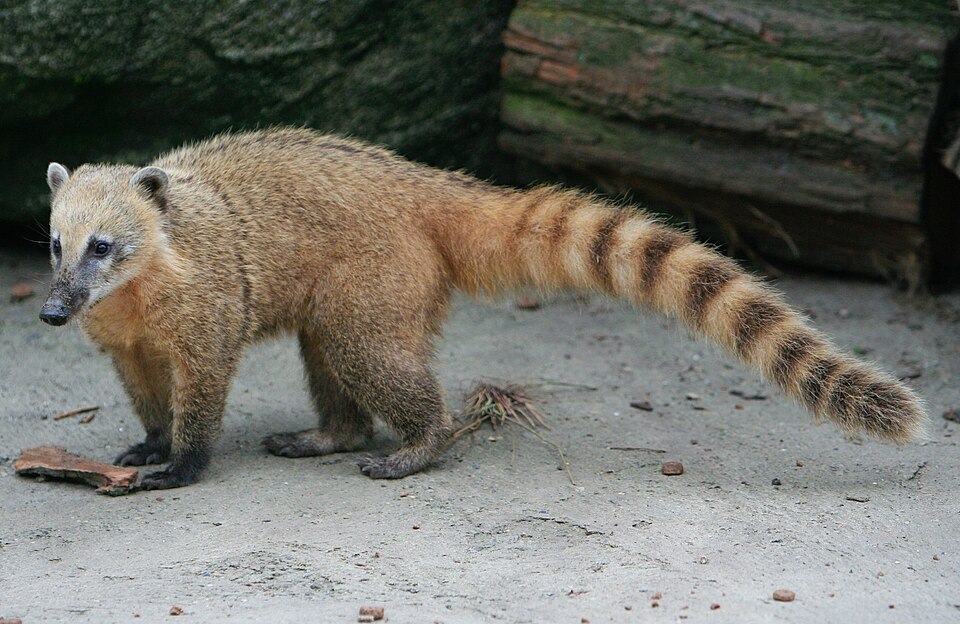
The red coati (Nasua nasua) is a carnivorous mammal from South America, identified by its long flexible snout and ringed tail often held upright. It lives in matriarchal bands that may include several dozen individuals, except for adult males which tend to be solitary. Active during the day, it forages on the ground and in tree trunks using its highly developed sense of smell. Related to the raccoon, it has adapted well to tropical forests and also to more open habitats. The species is increasingly kept as an exotic pet, raising questions about welfare and legality depending on the country.
The body measures approximately 16 to 28 inches, plus a tail nearly as long, ringed with brown and black. The coat colour ranges from reddish to dark brown depending on the individual and region. The elongated and flexible snout, ending in a prominent nose, serves to probe the ground and crevices. Robust non-retractile claws facilitate both digging and climbing trees.
Characteristics
Indicative values: they vary by subspecies, sex and region.
Habitat and distribution
The red coati inhabits mainly humid tropical forests and gallery forests of South America. It also adapts to wooded savannas and transitional zones between forest and open habitat. Its ability to exploit both the canopy and the ground allows it to colonize varied habitats.
CURRENT RANGE
The species is widely distributed across South America, from northern Argentina and Uruguay to Colombia and Venezuela. It occupies notably the Amazon basin and adjacent forested regions. Its distribution generally follows the tropical and subtropical forest cover of the continent.
Behaviour
Females and young live in structured social groups called bands, while adult males become solitary outside the breeding season. The species is diurnal and spends the night sheltered in trees. Highly communicative, it uses vocalisations, tail postures and scent marking to interact within the group. It is as skilled a climber as it is a ground forager.
Reproduction
Breeding occurs once a year, typically during the dry season. After a gestation period of approximately 70 to 77 days, the female gives birth away from the group, in a tree nest, to a litter of 2 to 7 young. The youngsters rejoin the band a few weeks after birth and are raised collectively by the females.
Peculiarities
The red coati often holds its long tail upright and vertical when moving in a group, which facilitates visual recognition among individuals in dense vegetation. Its highly mobile snout can pivot in almost every direction to forage efficiently on the ground and in crevices. Unlike many carnivores, it is almost exclusively diurnal.
Threats and conservation
Deforestation and fragmentation of forest habitats constitute the main threat to local populations. Hunting and capture for the exotic pet trade also affect certain regional populations. The species remains, however, widely distributed and is not globally threatened.
Numbers and trends vary across sources and regions. See the IUCN assessment for the latest reference data.
Gallery
1 documented photographs.
References
Profile updated 02 September 2026 · Reviewed by the TunisieVet editorial team.
Comments (0)
No comments yet.
CONSERVATION STATUS
Least concern (LC)
IUCN source, latest published assessment.
Species health
Documented diseases for this species.
This information is provided for educational purposes only and is not a substitute for a veterinary consultation. If you have any concerns about your animal's health, consult a veterinarian.
Similar animals
Other species documented in Animalpedia.

Be among the first to use our app. Sign up and get early Google Play access.
Discover