
Presentation
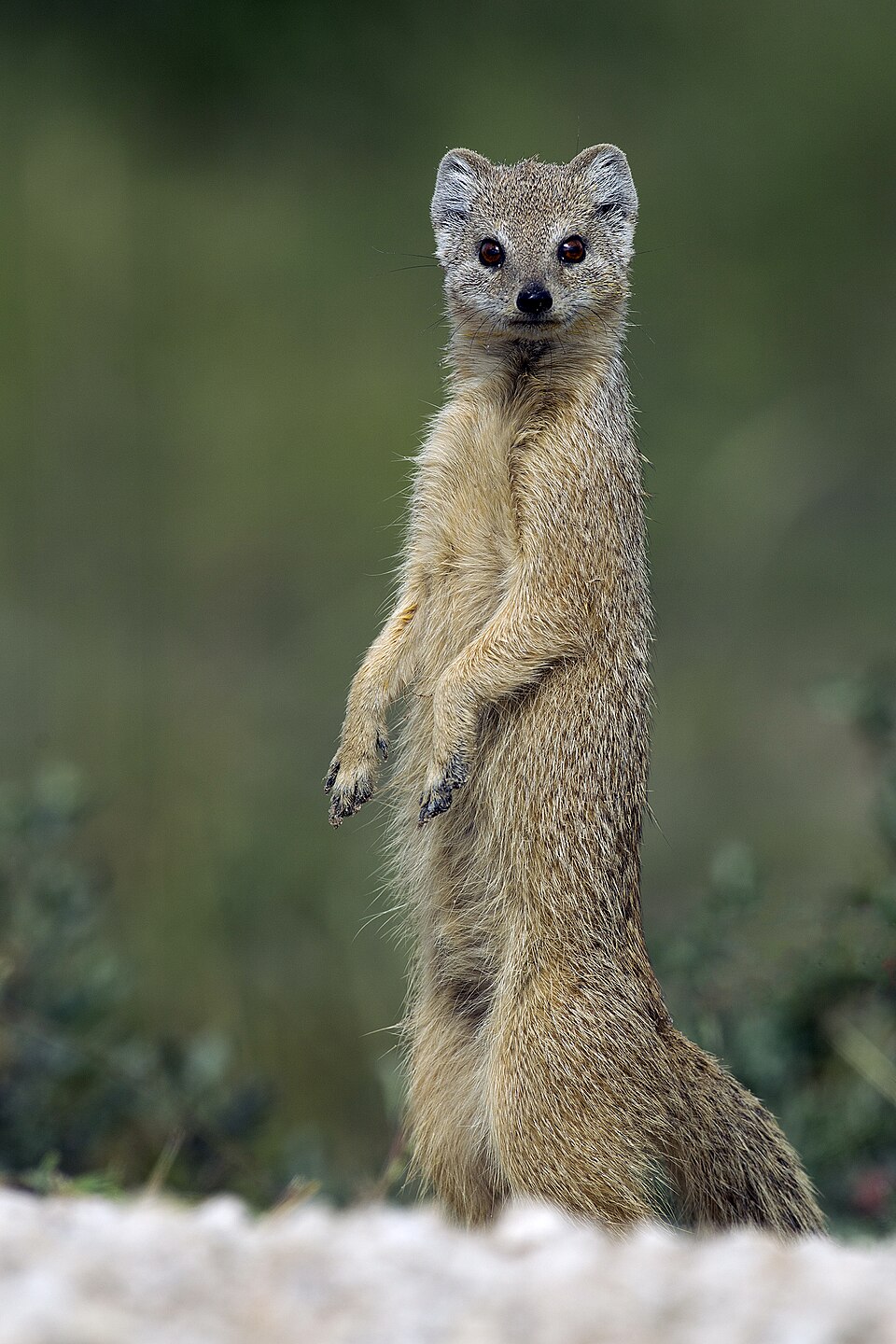
The Yellow mongoose is a small African carnivore recognizable by its reddish-yellowish coat and its bushy tail ending in a white tip. It lives in social colonies in burrows dug in arid and semi-arid areas of southern Africa. Active mainly during the day, it mainly hunts insects and small invertebrates on the ground. It often shares its burrow with other species such as meerkats or ground squirrels. Its small size and gregarious behavior make it a species well studied by ethologists.
It measures approximately 50 cm long, including the tail, and weighs approximately 600 to 800 grams. Its coat varies from pale yellow to orange-red depending on the region, with a lighter throat and belly. The bushy tail ends in a characteristic touch of white hair. The legs are short and have non-retractable claws adapted to burrowing.
Characteristics
Indicative values: they vary by subspecies, sex and region.
Habitat and distribution
The species frequents open shrub savannahs, steppes and semi-desert areas of southern Africa. It favors loose soils favorable for digging burrows. It is also found on the outskirts of agricultural areas and pastures.
CURRENT RANGE
Yellow mongoose is present in southern Africa, notably in Namibia, Botswana, South Africa, Lesotho and Zimbabwe. Its distribution area corresponds to the arid and semi-arid regions of the south of the continent. It is not present outside this geographical area.
Behaviour
The Yellow mongoose is diurnal and lives in colonies that can number several dozen individuals sharing the same network of burrows. The social structure is based on a dominant breeding pair, with the other members participating in collective surveillance against predators. Sentries are stationed regularly to scan the surroundings and emit alarm cries. It frequently cohabits with meerkats and Cape ground squirrels in common burrows.
Reproduction
The dominant female gives birth once a year, generally in southern spring, after a gestation of about two months. The litter has an average of two to four young, born in the family burrow. The young are weaned around two months and gradually become independent, some remaining in the natal group. Sexual maturity is reached around one year of age.
Peculiarities
She happily shares her burrow with meerkats and Cape ground squirrels, an unusual interspecific association among carnivores. Its bushy, white-tipped tail facilitates visual identification between conspecifics when moving in groups. It can stand on its hind legs to observe its surroundings, like other social mongooses.
Threats and conservation
The species is not globally threatened and benefits from a wide distribution in its natural area. It can nevertheless be considered harmful by certain farmers and be subject to local destruction. Predation by domestic dogs and habitat loss due to agricultural expansion are localized pressures.
Numbers and trends vary across sources and regions. See the IUCN assessment for the latest reference data.
Gallery
1 documented photographs.
References
Profile updated 19 August 2026 · Reviewed by the TunisieVet editorial team.
Comments (0)
No comments yet.
CONSERVATION STATUS
Least concern (LC)
IUCN source, latest published assessment.
Species health
Documented diseases for this species.
See the 8 diseases of this species Find a veterinarianThis information is provided for educational purposes only and is not a substitute for a veterinary consultation. If you have any concerns about your animal's health, consult a veterinarian.
To discover around: Yellow mongoose
Videos, facts, stories and records linked to this species.
Similar animals
Other species documented in Animalpedia.

TunisieVet in your pocket 📱🐾 Access your veterinary services wherever you are. [ Download the app ]
Learn more