Presentation
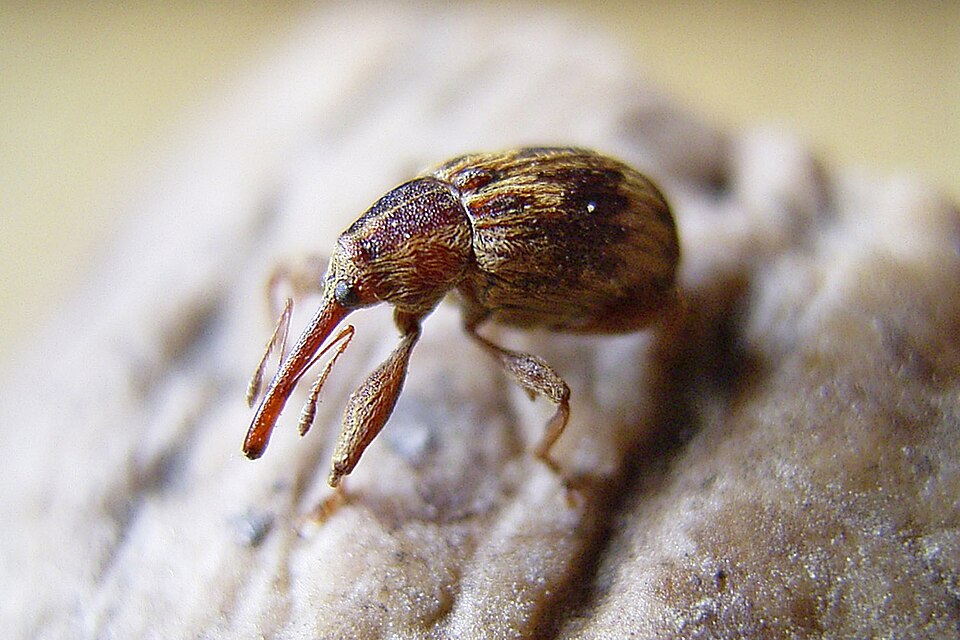
The weevil is a beetle belonging to the family Curculionidae, one of the largest families in the animal kingdom with tens of thousands of species. It is characterized by an elongated snout shaped like a proboscis, equipped with mouthparts at its tip, which it uses to pierce plants. Found on almost every continent, it inhabits varied environments ranging from cultivated fields to grain storage facilities. Many species are considered major agricultural pests, attacking cereals, fruits, roots, or palm trees. Others, more inconspicuous, live in forests without causing significant economic damage. The red palm weevil, present in Tunisia, illustrates the impact these insects can have on certain crops.
The weevil is recognized by its elongated snout shaped like a proboscis, bearing small chewing mouthparts at its tip. Its body is covered in a hard cuticle, often dark brown to black, sometimes adorned with colored scales. The elbowed antennae, inserted on the snout, are a distinctive feature of the Curculionidae family. Size varies greatly among species, ranging from a few millimeters to over one centimeter.
Characteristics
Indicative values: they vary by subspecies, sex and region.
Habitat and distribution
Weevils occupy a wide variety of habitats, from cultivated fields to grain storage facilities, forests, and gardens. Some species are restricted to specific crops such as cereals, cotton, or palms. Others are found in urban environments, particularly in domestic food stores. Their presence is closely linked to the availability of their host plant.
CURRENT RANGE
The Curculionidae family is present on all continents except Antarctica, with very high species diversity in the tropics. Some species, such as the rice weevil or grain weevil, have been widely distributed through agricultural trade and are now cosmopolitan. Other species have a more restricted range, linked to that of their host plant. They are found in temperate zones as well as in arid or tropical regions.
Behaviour
The adult weevil moves slowly and flies little depending on the species, preferring to walk or drop to the ground when threatened. It is active mainly during warm conditions and feeds quietly within crops or stored food. The larvae remain immobile and develop within their food source itself. Some species display marked nocturnal activity to avoid predators.
Reproduction
The female lays her eggs directly into seeds, fruit, or plant tissue after piercing them with her snout. Each larva then develops inside this food source, protected from the external environment. Metamorphosis passes through several larval stages before pupation and the emergence of the adult. The complete cycle can last from a few weeks to several months depending on temperature and the species involved.
Peculiarities
Weevils constitute one of the most diverse families in the animal kingdom, with several tens of thousands of described species. Their snout, a true drilling tool, allows them to reach food resources inaccessible to other insects. The red palm weevil, in particular, is feared for the damage it causes to ornamental and fruit palms, including in Tunisia. Some species play a role in biological control of invasive plants.
Threats and conservation
Weevils are not threatened species; on the contrary, several are considered pests to be controlled. They are subject to agricultural control measures and plant health quarantine in many countries. No conservation threat concerns this group as a whole.
Numbers and trends vary across sources and regions. See the IUCN assessment for the latest reference data.
Gallery
1 documented photographs.
References
Profile updated 11 September 2026 · Reviewed by the TunisieVet editorial team.
Comments (0)
No comments yet.
CONSERVATION STATUS
Least concern (LC)
IUCN source, latest published assessment.
Species health
Documented diseases for this species.
Find a veterinarianThis information is provided for educational purposes only and is not a substitute for a veterinary consultation. If you have any concerns about your animal's health, consult a veterinarian.
Similar animals
Other species documented in Animalpedia.