Presentation
The takin (Budorcas taxicolor) is a large hoofed mammal living in the eastern Himalayan highlands and southwestern China. It belongs to the Bovidae family and has a stocky build, part cattle and part goat, with dense fur and a broad head. The national emblem of Bhutan, it inhabits dense forests and alpine meadows at varying elevations depending on the season. Its robust appearance and gregarious behavior make it an emblematic species of Asian mountains.
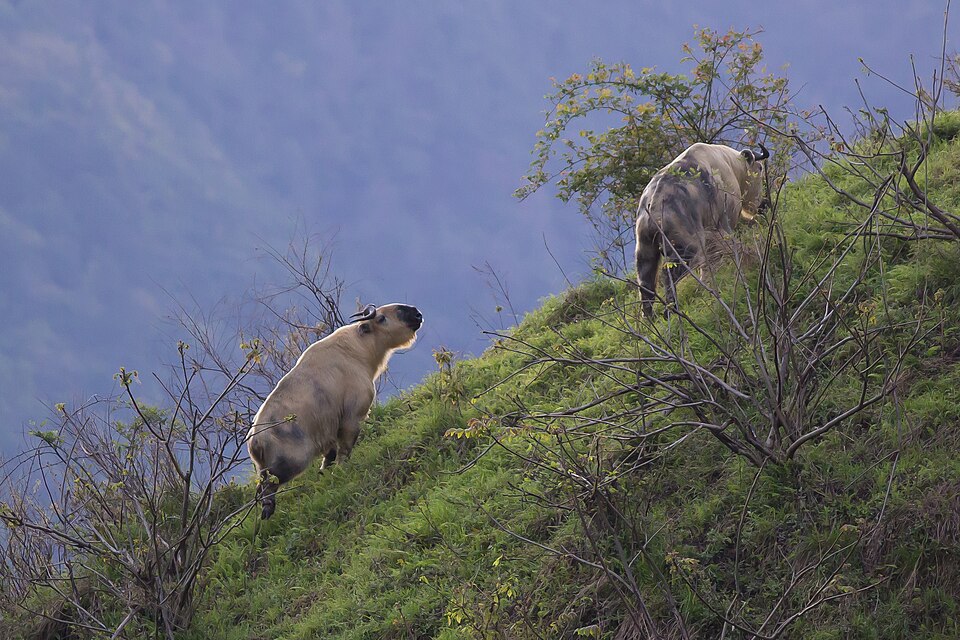
The takin has a compact body, short muscular legs, and a prominent head resembling that of a wildebeest or buffalo. Both males and females carry short horns that curve backward. Its coat ranges from golden to dark brown depending on the subspecies and season, providing effective camouflage in mountainous terrain.
Characteristics
Indicative values: they vary by subspecies, sex and region.
Habitat and distribution
The takin inhabits dense forests of bamboo and conifers as well as alpine meadows in mountainous regions. It is found at altitudes ranging from 1,000 to over 4,500 metres depending on the season. This type of habitat provides both abundant food and cover from predators.
CURRENT RANGE
The species is found in the eastern Himalaya, notably in Bhutan, north-east India, Myanmar and the Chinese provinces of Sichuan, Shaanxi and Tibet. Its range is fragmented due to rugged terrain and habitat loss. Bhutan has designated it as its national animal.
Behaviour
The takin lives in herds ranging from a few individuals to several dozen, especially in summer. It undertakes seasonal vertical migrations, descending to forests in winter and climbing to alpine meadows in summer. It is a generally calm animal but will charge if threatened, particularly solitary males.
Reproduction
The breeding season typically occurs between July and August. After a gestation period of around eight months, the female gives birth to a single calf, rarely two. The young takin is able to follow the herd shortly after birth and reaches sexual maturity around two or three years of age.
Peculiarities
The takin emits a strong musky odour that likely serves territorial communication. Its hybrid appearance, between a musk ox and an antelope, has long intrigued naturalists. It is sometimes called a "goat-ox" because of its composite appearance.
Threats and conservation
The takin is threatened by hunting, deforestation and fragmentation of its mountain habitat. Increasing human pressure in border areas reduces its natural migration spaces. Protection programmes exist notably in Bhutan and China.
Numbers and trends vary across sources and regions. See the IUCN assessment for the latest reference data.
Gallery
1 documented photographs.
References
Profile updated 03 September 2026 · Reviewed by the TunisieVet editorial team.
Comments (0)
No comments yet.
CONSERVATION STATUS
Vulnerable (VU)
IUCN source, latest published assessment.
Species health
Documented diseases for this species.
Find a veterinarianThis information is provided for educational purposes only and is not a substitute for a veterinary consultation. If you have any concerns about your animal's health, consult a veterinarian.
Similar animals
Other species documented in Animalpedia.

Be among the first to use our app. Sign up and get early Google Play access.
Discover