
Presentation
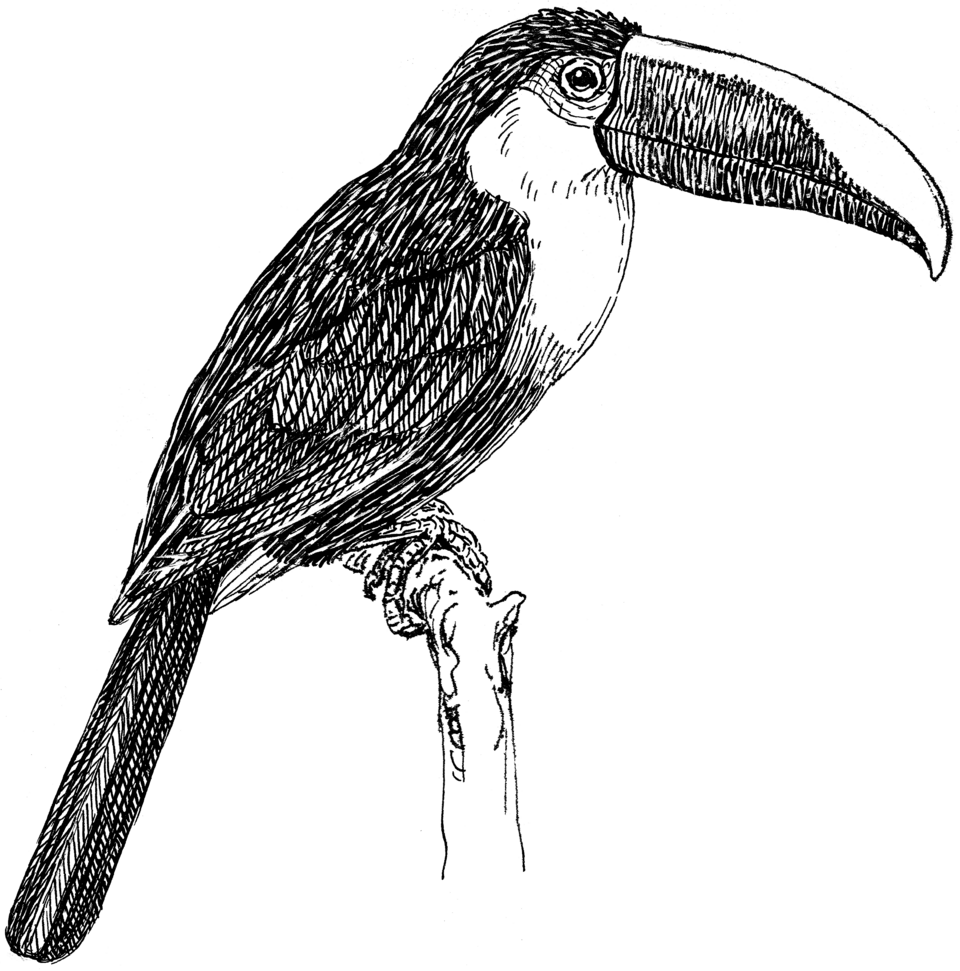
The toucan is an iconic bird of tropical forests in the Americas, recognized by its oversized, colorful bill. It comprises several genera within the family Ramphastidae, including the toco toucan, the most familiar to the general public. Its striking plumage, often black and white highlighted with vibrant colors, makes it a symbol of South American biodiversity. Toucans live in small groups in the canopy and feed mainly on fruit. Their distinctive appearance has greatly helped popularize the image of tropical rainforests in Western culture.
The toucan's most striking feature is its bill, which can make up nearly one-third of its total body length while remaining remarkably light thanks to its hollow honeycomb-like internal structure. The body is compact, with short, rounded wings poorly suited for extended flight. Plumage varies by species but often displays bright colors around the throat and eyes. Short, sturdy legs with zygodactyl toes allow the bird to move easily among branches.
Characteristics
Indicative values: they vary by subspecies, sex and region.
Habitat and distribution
The toucan inhabits tropical rainforests, where it occupies the canopy and upper vegetation layers. Some species also frequent forest edges and more open woodland areas. It depends on the presence of large trees that provide both food and nesting cavities.
CURRENT RANGE
The toucan is found in Central America and South America, from Mexico to northern Argentina. Its range follows that of the tropical and subtropical forests across the American continent. Some species occupy more restricted ranges, associated with specific forest massifs.
Behaviour
The toucan is a social bird that typically lives in small family groups of a few individuals. It communicates through loud, repetitive calls, particularly to establish and maintain territory. Reluctant to travel long distances, it moves from branch to branch by hopping rather than sustained flight. The bill also plays a role in social interactions and thermoregulation.
Reproduction
Toucans nest in natural tree cavities, sometimes enlarged old woodpecker nests. The female typically lays two to four eggs, incubated in turns by both parents for around two to three weeks. The young hatch blind and featherless, remaining dependent on adults for several weeks before fledging. Both parents actively participate in feeding the chicks.
Peculiarities
Although large, the toucan's bill weighs only a fraction of the bird's total body weight thanks to its honeycomb-like internal structure. It is thought to play a role in thermoregulation, allowing the bird to dissipate body heat. The diversity of bill colours among species also facilitates identification by ornithologists.
Threats and conservation
Deforestation is the main threat to toucans, reducing their natural habitat and fragmenting populations. The illegal wildlife trade for exotic pets also impacts certain species prized for their spectacular plumage and bills. Local hunting, though marginal, can affect some restricted populations.
Numbers and trends vary across sources and regions. See the IUCN assessment for the latest reference data.
Gallery
1 documented photographs.
References
Profile updated 06 September 2026 · Reviewed by the TunisieVet editorial team.
Comments (0)
No comments yet.
CONSERVATION STATUS
Least concern (LC)
IUCN source, latest published assessment.
Species health
Documented diseases for this species.
This information is provided for educational purposes only and is not a substitute for a veterinary consultation. If you have any concerns about your animal's health, consult a veterinarian.
To discover around: Toucan
Videos, facts, stories and records linked to this species.
RECORD
up to 19 cm in the toco toucan
The longest relative beak in birds
The beak can measure nearly one-third of the total body length in an adult toco toucan.
Similar animals
Other species documented in Animalpedia.

TunisieVet in your pocket 📱🐾 Access your veterinary services wherever you are. [ Download the app ]
Learn more