
Presentation
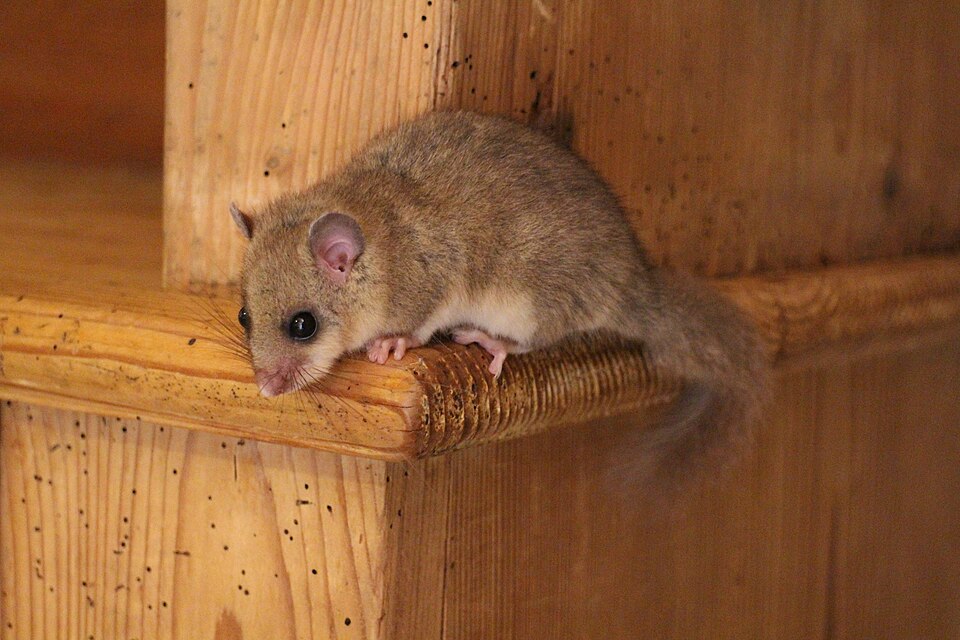
The gray dormouse (Glis glis) is a small arboreal rodent of the Gliridae family, recognizable by its gray fur and its long bushy tail reminiscent of that of a squirrel. It is famous for its long hibernation, which can last up to seven months a year. Present mainly in Europe, it frequents deciduous forests, orchards and sometimes the attics of rural homes. Its nocturnal and discreet lifestyle makes it rarely observed despite a sometimes significant local presence.
The dormouse measures between 13 and 19 cm long, to which is added a bushy tail almost equal to the body length. Its fur is ash gray above and whitish underneath, with large black eyes adapted to night life. Its legs have short but effective claws for climbing trees.
Characteristics
Indicative values: they vary by subspecies, sex and region.
Habitat and distribution
The dormouse lives mainly in deciduous forests, orchards and hedgerows where it finds hollow trees and fruits in abundance. It readily settles in attics, barns and attics of rural homes, especially when seeking winter shelter. It avoids areas that are too open, preferring environments offering dense plant cover.
CURRENT RANGE
The gray dormouse occurs across much of central and southern Europe, as well as parts of the Near East. In North Africa, its presence is limited and localized to a few mountainous areas. It has also been introduced to some British Isles where it has acclimatized well.
Behaviour
The dormouse is a solitary and strictly nocturnal animal, active especially at nightfall. It spends a large part of the year in deep hibernation, generally from October to April, taking refuge in a burrow, a hollow trunk or an attic. An excellent climber, it moves easily through branches in search of food. It can emit high-pitched cries when disturbed or during the breeding season.
Reproduction
Reproduction of dormouse takes place in spring, shortly after awakening from hibernation. The female gives birth to a single litter of 2 to 9 young after a gestation of approximately one month. The young are weaned after four to six weeks and reach sexual maturity the following year.
Peculiarities
The dormouse is named for its exceptionally long hibernation behavior among mammals, which gave rise to the popular expression "sleeping like an dormouse." Its relative longevity for a small rodent, which can reach several years, is partly explained by this seasonal metabolic slowdown.
Threats and conservation
dormouse is not globally threatened and remains widespread throughout its range. Locally, the disappearance of old cavity trees and forest fragmentation can reduce its refuge sites. It is sometimes considered harmful when it establishes itself in homes, which can lead to targeted destruction measures.
Numbers and trends vary across sources and regions. See the IUCN assessment for the latest reference data.
Gallery
1 documented photographs.
References
Profile updated 22 August 2026 · Reviewed by the TunisieVet editorial team.
Comments (0)
No comments yet.
CONSERVATION STATUS
Least concern (LC)
IUCN source, latest published assessment.
Species health
Documented diseases for this species.
See the 7 diseases of this species Find a veterinarianThis information is provided for educational purposes only and is not a substitute for a veterinary consultation. If you have any concerns about your animal's health, consult a veterinarian.
Similar animals
Other species documented in Animalpedia.

TunisieVet in your pocket 📱🐾 Access your veterinary services wherever you are. [ Download the app ]
Learn more