
Presentation
The goldcrest is a tiny songbird belonging to the family Regulidae, often cited among Europe's smallest birds. Its olive-green plumage and colorful crown—yellow or orange depending on the species—make it inconspicuous in conifer foliage. Highly active, it moves constantly in search of insects and shows little fear of humans. In North Africa, it favors mountain forests where it nests in conifers. Its high, thin call often betrays its presence before it can be spotted. Despite its diminutive size, it survives harsh winters thanks to distinctive behavioral and physiological strategies.
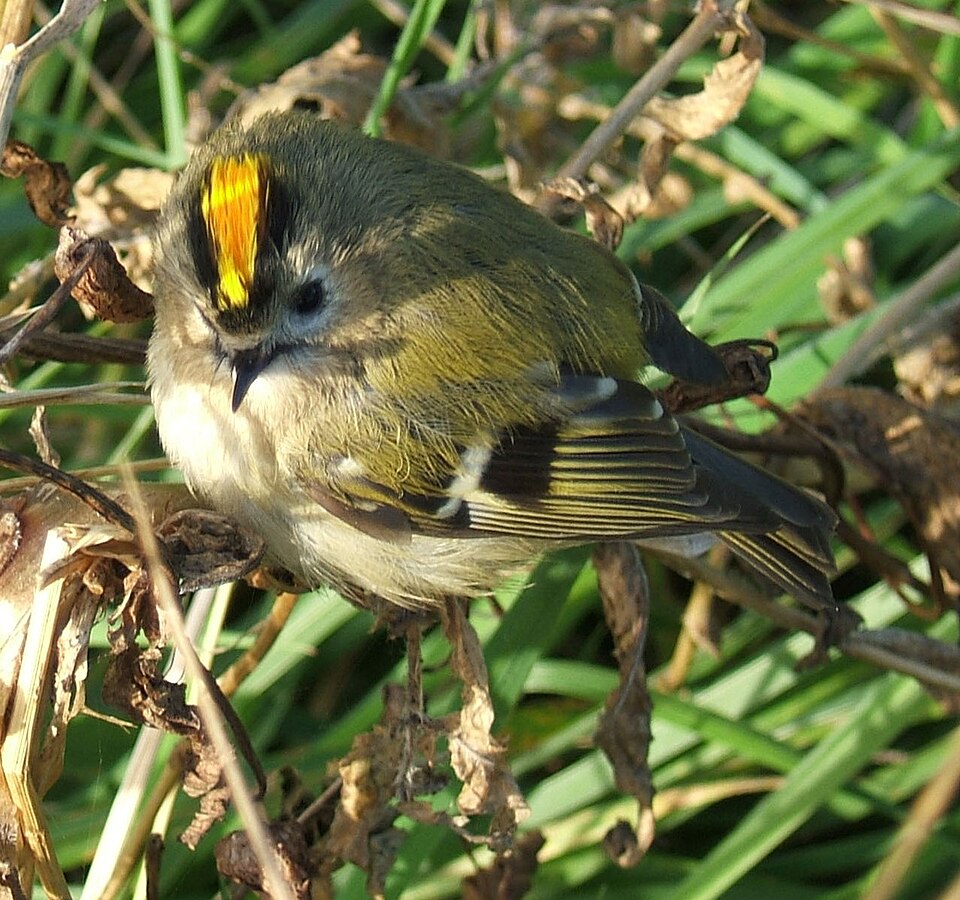
The goldcrest measures about 9 cm and weighs barely 5 to 7 grams, making it one of the continent's smallest birds. It bears a fine colored band on the crown of its head—bright yellow in the crested goldcrest, yellow edged with orange and black in the firecrest. Its stocky body, short wings, and fine pointed bill are suited to capturing tiny insects in foliage. Its short tail and quick flight complete a compact silhouette typical of the Regulidae family.
Characteristics
Indicative values: they vary by subspecies, sex and region.
Habitat and distribution
The wren favours coniferous forests but also inhabits mixed woodlands and certain montane forests. In North Africa, it is mainly found in fir and cedar stands at altitude. It generally avoids open habitats lacking dense tree cover. Its habitat must provide both shelter from cold and an abundance of insects.
CURRENT RANGE
The genus Regulus is widely distributed across Europe, Asia, and North America. In Africa, isolated populations occur in the mountainous massifs of Algeria and Tunisia, notably in the cedar forests of Kroumirie and the Tellian Atlas. These North African populations represent relics of a formerly more continuous range extending into Europe. They remain localised and scarce.
Behaviour
It is a very lively and restless bird, constantly flitting from branch to branch in search of food. It typically lives alone or in pairs during breeding season, but sometimes forms small mixed flocks with tits in winter. Little wary, it can approach humans without great hesitation. On cold nights, several individuals may huddle together to conserve body heat.
Reproduction
The wren builds an elaborate spherical nest suspended beneath a conifer branch, woven from moss, lichens, and spider silk. The female lays 7 to 11 small eggs, a remarkable number for her body size. Incubation takes approximately two to three weeks, and both parents feed the chicks. Two broods per season are possible in the most favourable regions.
Peculiarities
The wren is often cited as Europe's smallest bird, tied in size with the firecrest. Its ability to survive very low temperatures despite its tiny body mass fascinates ornithologists. Its suspended nest, a true architectural feat, ranks among the most complex in the avian world. The coloured stripe on its head serves as a visual signal during displays and territorial conflicts.
Threats and conservation
Degradation and fragmentation of coniferous forests, particularly North African cedar stands, threaten its breeding habitats. Severe winters naturally cause high mortality, with populations fluctuating markedly year to year. Climate change and drought affect insect availability and the health of the forest stands upon which it depends. Locally, Tunisian and Algerian populations are considered vulnerable due to their isolation.
Numbers and trends vary across sources and regions. See the IUCN assessment for the latest reference data.
Gallery
1 documented photographs.
References
Profile updated 05 September 2026 · Reviewed by the TunisieVet editorial team.
Comments (0)
No comments yet.
CONSERVATION STATUS
Least concern (LC)
IUCN source, latest published assessment.
Species health
Documented diseases for this species.
See the 4 diseases of this species Find a veterinarianThis information is provided for educational purposes only and is not a substitute for a veterinary consultation. If you have any concerns about your animal's health, consult a veterinarian.
Similar animals
Other species documented in Animalpedia.

TunisieVet in your pocket 📱🐾 Access your veterinary services wherever you are. [ Download the app ]
Learn more