
Presentation
The Asp, or Asp viper, is a venomous snake belonging to the Viperidae family, widely distributed in western and southern Europe. It is distinguished by a stocky body, a triangular head clearly separated from the neck and a muzzle that is often slightly upturned. Its coloring varies from gray to reddish brown, with banded or zigzag patterns that ensure effective mimicry in its environment. This reptile is active mainly on the ground, in sunny and rocky environments, where it hunts in hiding. Although venomous, it is not aggressive towards humans and only bites if they feel threatened or surprised. It plays an important role in regulating populations of small rodents and other prey.
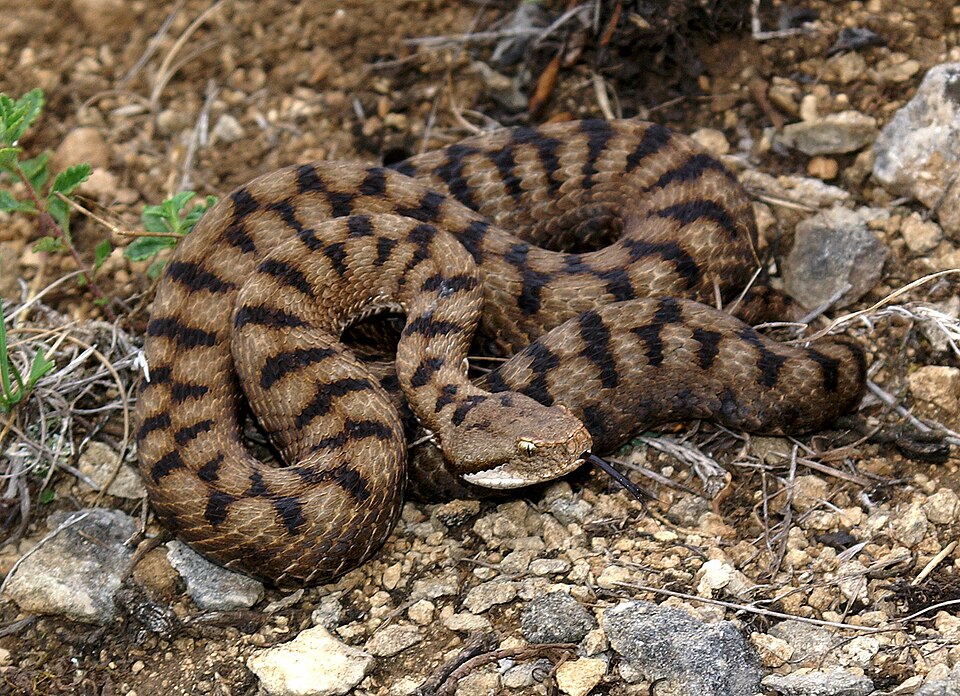
The Asp has a massive body compared to other European vipers, with a broad, triangular head covered in small scales. Its eyes, with vertical pupils, are topped with prominent supraocular scales which give it a characteristic appearance. The dorsal coloration, ranging from light gray to dark brown, often shows a pattern of dark transverse spots or bands. The belly is generally lighter, sometimes grayish or yellowish, dotted with small dark markings.
Characteristics
Indicative values: they vary by subspecies, sex and region.
Habitat and distribution
Asp prefers dry, sunny environments such as rocky hillsides, scrubland, forest edges and well-exposed meadows. It is also found in the mountains, up to relatively high altitudes, where it takes advantage of the rocks to thermoregulate. On the other hand, it avoids areas that are too humid or densely wooded, preferring habitats offering plenty of shelter and good sunlight.
CURRENT RANGE
The species is present mainly in France, Italy, northeastern Spain and Switzerland. It also occupies certain regions of Germany and the Western Balkans. Its distribution is essentially linked to the mid-mountain and hilly areas of southern Europe.
Behaviour
This snake is rather discreet and diurnal, although it can become crepuscular during the high summer heat. It spends a large part of its time hidden under stones, brush or in rocky crevices. In case of danger, it prefers to flee rather than attack, but can adopt a defensive posture by hissing and forming an "S" with its body before biting if necessary. The species overwinters during the cold months, taking refuge in burrows or crevices sheltered from frost.
Reproduction
Mating takes place in spring, after emerging from hibernation, and can give rise to ritual fights between rival males. The Asp is ovoviviparous: the eggs develop inside the body of the female, who gives birth to already formed young in late summer or autumn. A litter generally has between 5 and 15 young, independent from birth and capable of hunting alone.
Peculiarities
The name "Asp" historically evokes many legends, notably its erroneous association with the snake which is said to have killed Cleopatra, although the latter was probably bitten by an Egyptian cobra. Its bite, although rarely fatal in healthy adults with prompt treatment, can cause significant pain and local edema. It is one of the two most common species of vipers in mainland France.
Threats and conservation
The species suffers from the destruction of its natural habitat, particularly through urbanization and agricultural intensification. It is also the victim of significant road mortality and direct persecution by humans, due to the fear inspired by venomous snakes. In some regions, declining prey populations are also contributing to the decline of the species.
Numbers and trends vary across sources and regions. See the IUCN assessment for the latest reference data.
Gallery
1 documented photographs.
References
Profile updated 02 September 2026 · Reviewed by the TunisieVet editorial team.
Comments (0)
No comments yet.
CONSERVATION STATUS
Least concern (LC)
IUCN source, latest published assessment.
Species health
Documented diseases for this species.
See the 7 diseases of this species Find a veterinarianThis information is provided for educational purposes only and is not a substitute for a veterinary consultation. If you have any concerns about your animal's health, consult a veterinarian.
Similar animals
Other species documented in Animalpedia.

TunisieVet in your pocket 📱🐾 Access your veterinary services wherever you are. [ Download the app ]
Learn more