
Presentation
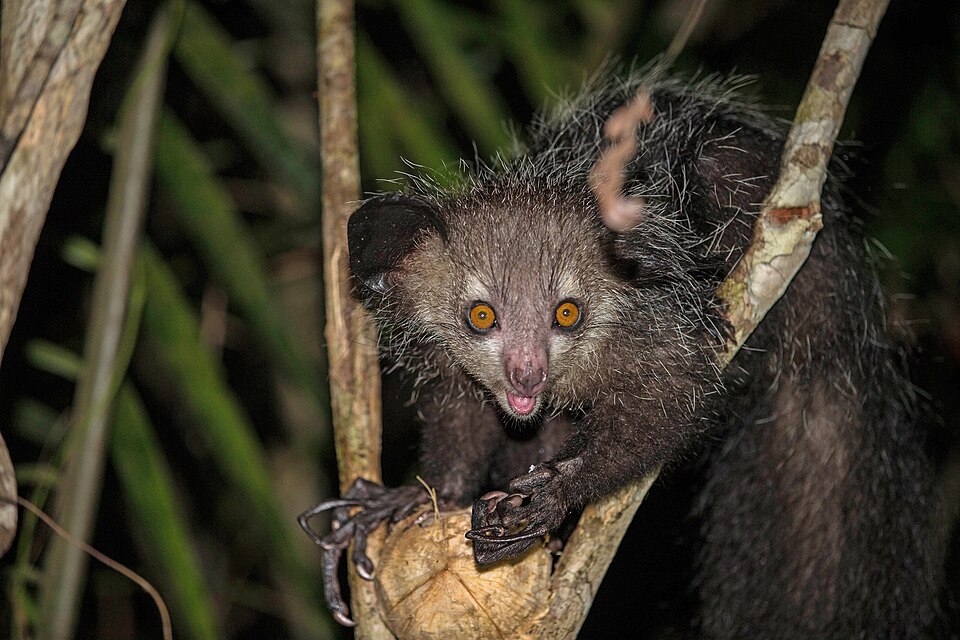
The Aye-aye (Daubentonia madagascariensis) is a nocturnal primate endemic to Madagascar, the only current representative of the Daubentoniidae family. It is distinguished by its very thin and elongated middle finger, used to extract insect larvae from wood. Its shaggy brown-black coat, large ears and bulging eyes give it a singular appearance, long a source of local superstitions. This discreet, arboreal animal remains poorly known due to its nocturnal habits and its rarity. It is today threatened by deforestation and beliefs that sometimes push for its destruction.
The Aye-aye has a dark brown to black coat, a bushy tail longer than the body, and large movable membranous ears. Its most distinctive feature is its third finger, very thin and elongated, with a particular articulation allowing it to probe wood. Its incisors, continuously growing like those of rodents, are a unique adaptation among primates.
Characteristics
Indicative values: they vary by subspecies, sex and region.
Habitat and distribution
The Aye-aye lives in lowland tropical rainforests as well as some dry forests and mangrove areas of Madagascar. It frequents the primary canopy as well as secondary habitats and plantations at the edge of the forest. Its ability to adapt to degraded environments allows it to survive locally despite deforestation.
CURRENT RANGE
The species is endemic to Madagascar, where it occurs scatteredly along the east, north and west coasts of the island. Its distribution is fragmented due to loss of forest habitat. It is absent from the rest of the African continent and the world.
Behaviour
Strictly nocturnal and solitary, the Aye-aye spends the day sleeping in a spherical nest built in the high branches. It moves cautiously through the canopy and defends a home range that may overlap with that of other individuals. Its secretive behavior and stealthy habits make it rarely observed, even in its natural habitat.
Reproduction
The female generally gives birth to a single young after a gestation of about five months. The young remain dependent on their mother for several months, or even more than a year, to learn foraging techniques. Sexual maturity is reached around the age of two to three years, and births are infrequent.
Peculiarities
Aye-aye is the only known primate to use a form of tactile echolocation to locate prey beneath the bark. Its continuously growing incisors and filiform middle finger make it a unique anatomical curiosity among primates. In some regions of Madagascar, it is seen as an omen of death, which has long led to its persecution.
Threats and conservation
Deforestation linked to slash-and-burn agriculture and logging considerably reduces its habitat. Traditional beliefs associating Aye-aye with bad luck still lead to its killing in some communities. Occasional poaching and forest fragmentation increase the vulnerability of the species.
Numbers and trends vary across sources and regions. See the IUCN assessment for the latest reference data.
Gallery
1 documented photographs.
References
Profile updated 26 August 2026 · Reviewed by the TunisieVet editorial team.
Comments (0)
No comments yet.
CONSERVATION STATUS
Endangered (EN)
IUCN source, latest published assessment.
Species health
Documented diseases for this species.
This information is provided for educational purposes only and is not a substitute for a veterinary consultation. If you have any concerns about your animal's health, consult a veterinarian.
To discover around: Aye-aye
Videos, facts, stories and records linked to this species.
Similar animals
Other species documented in Animalpedia.

TunisieVet in your pocket 📱🐾 Access your veterinary services wherever you are. [ Download the app ]
Learn more