
Presentation
The Bonobo (Pan paniscus) is a great ape endemic to the Democratic Republic of Congo, where it lives exclusively in tropical forests south of the Congo River. A close cousin of the chimpanzee, it shares more than 98% of its genetic heritage with humans. It is distinguished by a more slender morphology, a black face from birth and a matriarchal social organization based on cooperative bonds rather than aggressiveness. A discreet and long unknown species, it was only formally described scientifically in 1929. The Bonobo is today threatened by deforestation, poaching and political instability in its range.
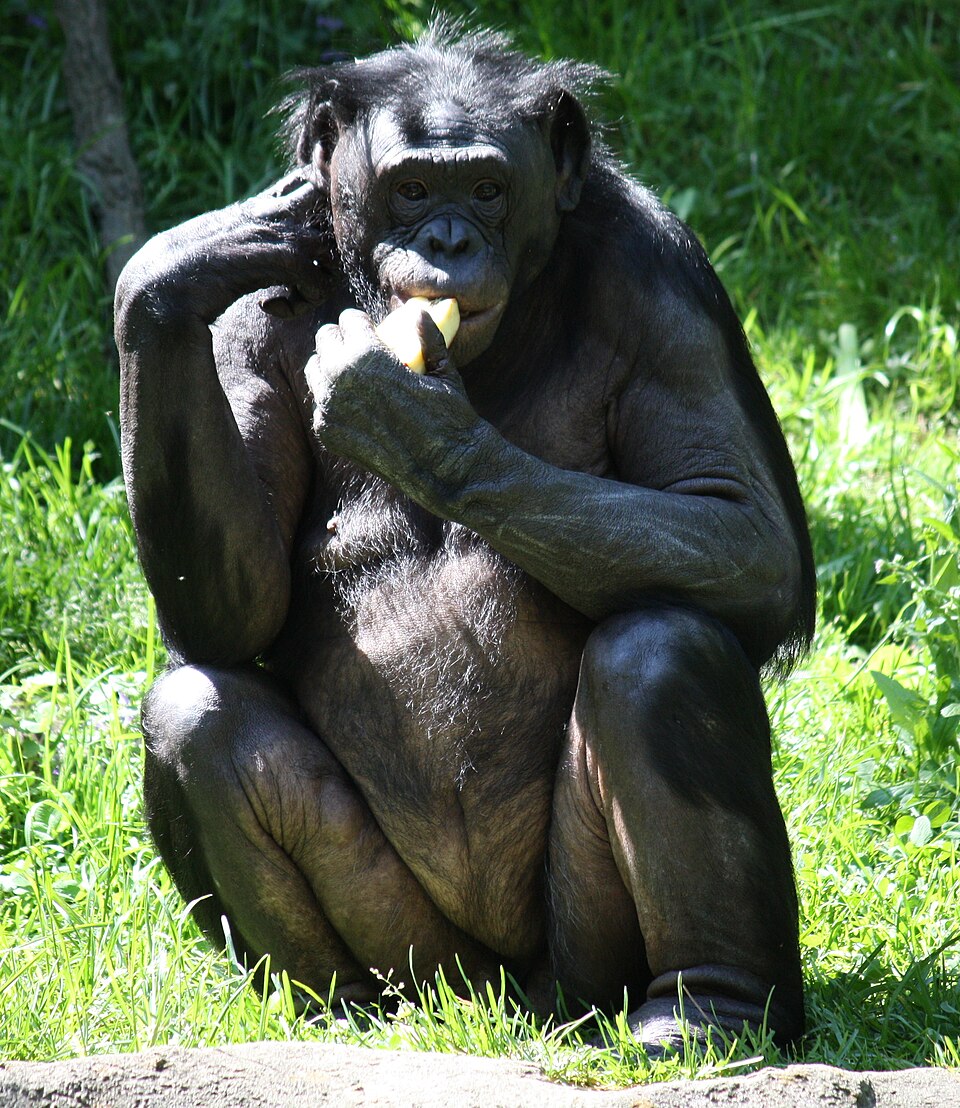
The Bonobo features a slender body, long limbs, and an often bipedal stance when moving on the ground. Its coat is black, its dark face and its pink lips distinguish it from the common chimpanzee. He has a developed social intelligence, with complex vocal and gesture communication skills.
Characteristics
Indicative values: they vary by subspecies, sex and region.
Habitat and distribution
Bonobo occupies dense tropical rainforests, including swamp forests and primary forests of the Congo Basin. It evolves both in the canopy and on the forest floor to move and feed.
CURRENT RANGE
The species is endemic to the Democratic Republic of Congo, where it lives only in a limited area south of the Congo River. This restricted distribution makes it one of the most geographically localized great apes.
Behaviour
Bonobo live in mixed social groups dominated by females, where tensions are often resolved through affiliative behavior rather than violence. Social interactions, including sexual, play an important role in easing conflicts and strengthening group bonds. The species is known for its generally less aggressive behavior than that of the chimpanzee.
Reproduction
The Bonobo female generally gives birth to a single calf after a gestation of approximately eight months. The young person remains dependent on his mother for several years, during which he learns the social codes of the group. Sexual maturity is reached around the age of seven to ten years.
Peculiarities
The Bonobo is often referred to as the most peaceful great ape due to its matriarchal society and conflict resolution mechanisms through social contact. It is one of the rare animal species besides humans to use sexuality for social and not just reproductive purposes.
Threats and conservation
Deforestation linked to agriculture and logging is reducing its natural habitat. Poaching for bushmeat and regional political instability are exacerbating its decline. The small distribution area makes the species particularly vulnerable to these pressures.
Numbers and trends vary across sources and regions. See the IUCN assessment for the latest reference data.
Gallery
1 documented photographs.
References
Profile updated 25 August 2026 · Reviewed by the TunisieVet editorial team.
Comments (0)
No comments yet.
CONSERVATION STATUS
Endangered (EN)
IUCN source, latest published assessment.
Species health
Documented diseases for this species.
See the 4 diseases of this species Find a veterinarianThis information is provided for educational purposes only and is not a substitute for a veterinary consultation. If you have any concerns about your animal's health, consult a veterinarian.
To discover around: Bonobo
Videos, facts, stories and records linked to this species.
Similar animals
Other species documented in Animalpedia.

TunisieVet in your pocket 📱🐾 Access your veterinary services wherever you are. [ Download the app ]
Learn more