Presentation
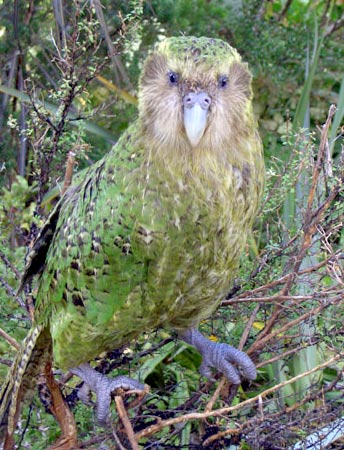
The kakapo (Strigops habroptilus) is a nocturnal, flightless parrot native to New Zealand. It is one of the rarest and most endangered bird species in the world, with its surviving population concentrated on a few protected islands. Its dull green plumage provides effective camouflage in forest vegetation. Massive and heavy for a parrot, it moves primarily on the ground and climbs trees to feed. Its distinctive breeding system, based on a display behavior called "booming," sets it apart from all other parrots.
The kakapo has mottled green plumage spotted with brown and yellow, providing optimal camouflage. Its wings are reduced and unable to support flight, but it retains strong, muscular legs for walking and climbing. Its beak is robust and adapted for crushing tough plant material. It displays a facial disc of feathers resembling that of nocturnal raptors, which earned it the name "owl parrot."
Characteristics
Indicative values: they vary by subspecies, sex and region.
Habitat and distribution
The kakapo lives in the dense, humid forests of New Zealand, rich in understory vegetation and fruit-bearing trees. Today it is found mainly on protected islands free from introduced predators, where similar forest habitats have been preserved or restored. It seeks areas offering both dense vegetation cover and abundant seasonal food.
CURRENT RANGE
The kakapo is endemic to New Zealand. Once widespread across the main islands, it has nearly vanished from its original range due to predators introduced by humans. Its current population survives only through conservation programs on a few predator-free sanctuary islands.
Behaviour
The kakapo is a solitary, nocturnal, and territorial bird outside the breeding season. It moves primarily on foot, following trails it maintains through vegetation. During the breeding season, males produce a deep, dull sound called "booming" to attract females over long distances. Its behavior is generally calm and unafraid, which made it vulnerable to introduced predators.
Reproduction
The kakapo's breeding is irregular and tied to the fruiting cycles of certain trees, notably the rimu, which produces abundant fruit only once every two to four years. Males gather on display grounds to produce their calls and attract females. The female typically lays one to four eggs on the ground in a rudimentary nest, and alone handles incubation and chick-rearing. This slow reproductive pattern contributes to the species' demographic fragility.
Peculiarities
The kakapo is the only parrot in the world entirely unable to fly. It also holds the distinction of being one of the heaviest birds among parrots. Its unique reproductive system based on 'booming'—a deep sound carrying several kilometers—is unlike anything else in the bird world.
Threats and conservation
The kakapo is primarily threatened by introduced predators in New Zealand, such as rats, cats, and stoats, against which it has no effective natural defense. Historical deforestation has further reduced its available habitat. Its slow and irregular breeding greatly limits its ability to recover quickly. Intensive conservation programs are now gradually stabilizing its population.
Numbers and trends vary across sources and regions. See the IUCN assessment for the latest reference data.
Gallery
1 documented photographs.
References
Profile updated 02 September 2026 · Reviewed by the TunisieVet editorial team.
Comments (0)
No comments yet.
CONSERVATION STATUS
Critically endangered (CR)
IUCN source, latest published assessment.
Species health
Documented diseases for this species.
Find a veterinarianThis information is provided for educational purposes only and is not a substitute for a veterinary consultation. If you have any concerns about your animal's health, consult a veterinarian.
To discover around: Kakapo
Videos, facts, stories and records linked to this species.
RECORD
1 species out of around 400
The only flightless parrot
This finding is based on all parrot species known worldwide.
Similar animals
Other species documented in Animalpedia.

Be among the first to use our app. Sign up and get early Google Play access.
Discover