
Presentation
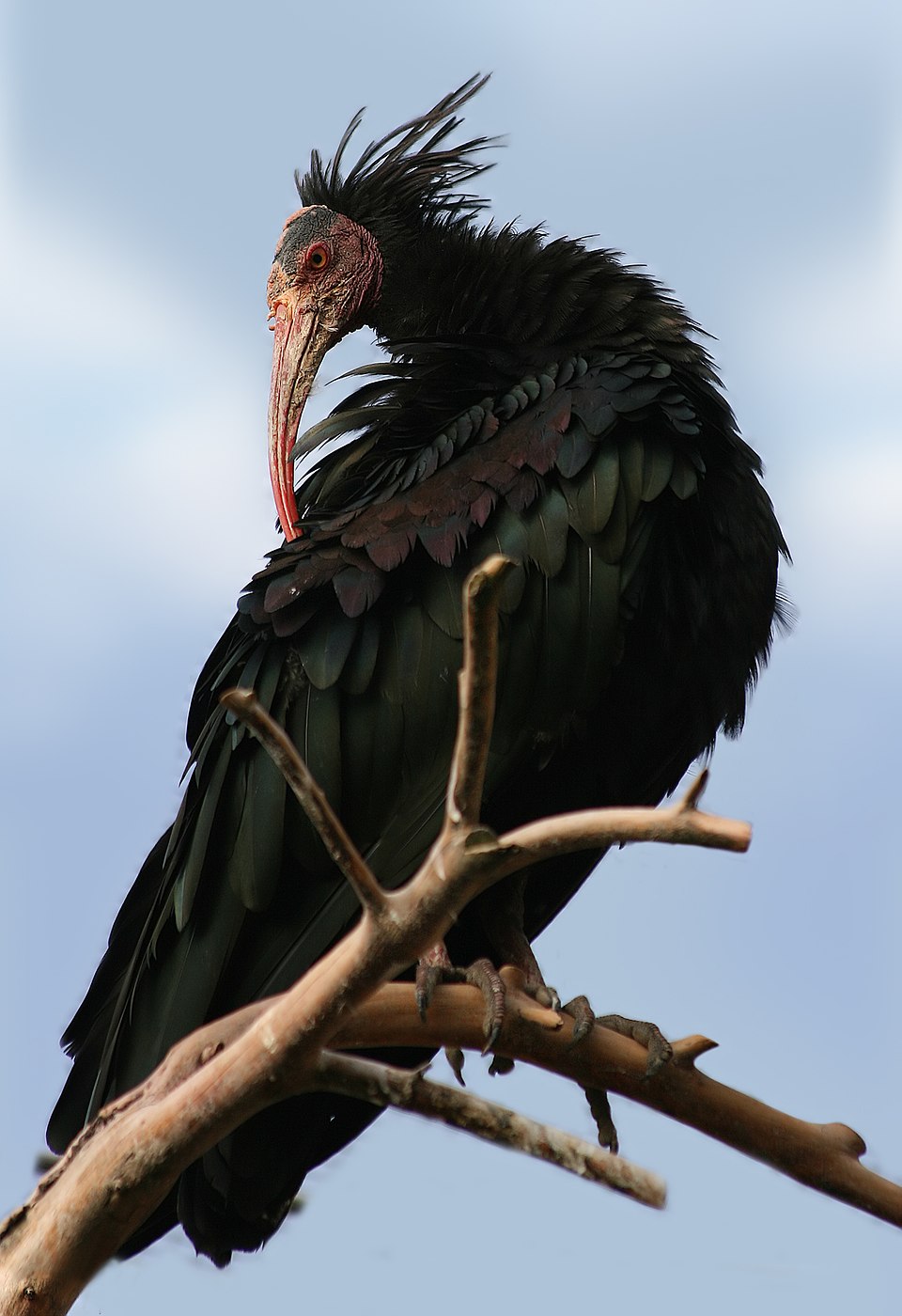
The Northern bald ibis is a large wading bird recognizable by its featherless, dark red head and throat and its long curved beak. Its plumage is black, with green and purple metallic reflections depending on the light. It forms nesting colonies on rocky cliffs, often near agricultural or steppe areas where it feeds. Once widespread around the Mediterranean and in the Middle East, it has experienced a drastic decline linked to the destruction of its habitat and hunting. Today, surviving wild populations are concentrated mainly in Morocco, with colonies reintroduced in Europe. It is one of the most endangered bird species in the world and a strong symbol of avian conservation.
The Northern bald ibis measures approximately 70 to 80 cm long with a wingspan of approximately 125 to 135 cm. Its bald red-brown head contrasts with its iridescent black plumage and long reddish legs. Its long, thin, arched bill allows it to probe the ground in search of food. It flies in formation, alternating wing beats and gliding phases.
Characteristics
Indicative values: they vary by subspecies, sex and region.
Habitat and distribution
The Northern bald ibis frequents coastal or continental cliffs to nest, near steppes, semi-deserts or agricultural lands where it feeds. It avoids areas that are too densely wooded or urbanized. Colonies are often located near waterholes or temporary wetlands.
CURRENT RANGE
Historically present throughout the Mediterranean, in North Africa, the Middle East and Central Europe, the species has declined significantly. The main wild population remains today in Morocco, in the Souss-Massa region. Reintroduction programs have established small populations in Spain and Austria/Germany.
Behaviour
It is a gregarious species that lives and nests in colonies that can number several dozen individuals. Pairs generally remain faithful over several breeding seasons. The species is partially migratory depending on the populations, some making seasonal movements towards more lenient wintering areas. Courtship displays include characteristic head movements and harsh calls.
Reproduction
The clutch generally includes 2 to 3 eggs laid in a nest built on rock ledges inaccessible to terrestrial predators. Incubation lasts approximately 24 to 25 days, carried out by both parents. The young take flight around 45 to 50 days old and remain dependent on adults for several additional weeks.
Peculiarities
The Northern bald ibis was revered in ancient Egypt, where it appears in religious iconography. Its completely bald head distinguishes it from other ibis species. It is among the rarest birds in the world, having come close to extinction in the 20th century.
Threats and conservation
The main threats are habitat loss linked to intensive agriculture, the use of pesticides reducing food resources, as well as historical poaching. Human disturbance near nesting sites and introduced predators also weaken remaining colonies. International conservation programs attempt to stabilize populations through reintroduction and site protection.
Numbers and trends vary across sources and regions. See the IUCN assessment for the latest reference data.
Gallery
1 documented photographs.
References
Profile updated 17 August 2026 · Reviewed by the TunisieVet editorial team.
Comments (0)
No comments yet.
CONSERVATION STATUS
Endangered (EN)
IUCN source, latest published assessment.
Species health
Documented diseases for this species.
See the 7 diseases of this species Find a veterinarianThis information is provided for educational purposes only and is not a substitute for a veterinary consultation. If you have any concerns about your animal's health, consult a veterinarian.
To discover around: Northern bald ibis
Videos, facts, stories and records linked to this species.
Similar animals
Other species documented in Animalpedia.

TunisieVet in your pocket 📱🐾 Access your veterinary services wherever you are. [ Download the app ]
Learn more