
Presentation
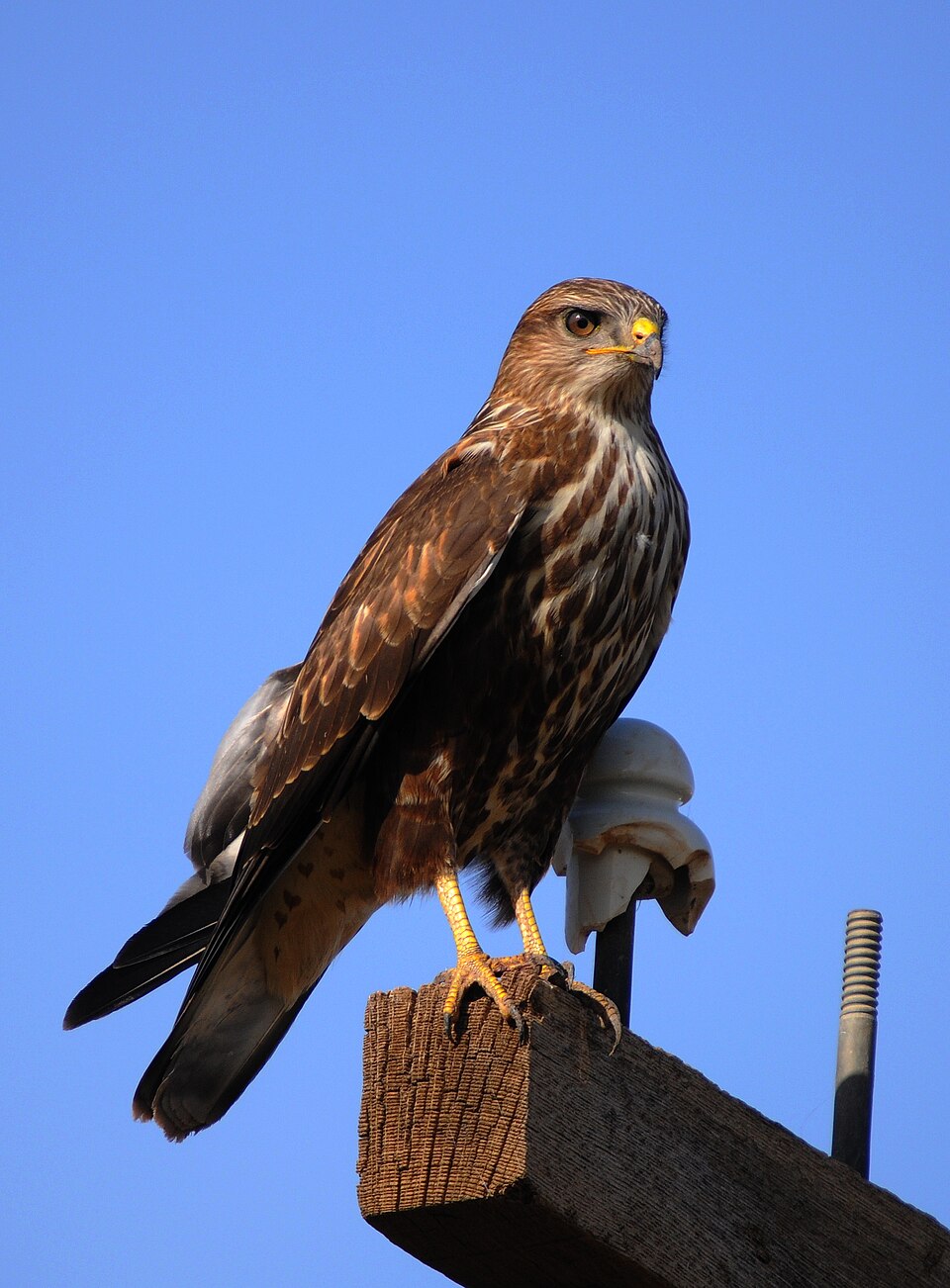
The Long-legged buzzard is a large diurnal raptor found in North Africa, the Middle East and Central Asia. It is distinguished from the common buzzard by its more imposing size, its often unbarred red tail and its long and broad wings. It frequents open, steppe and desert environments where it hunts in hiding or in gliding flight. In Tunisia, it is a regular bird of prey in the arid zones and steppes of the center and south. Its diet is dominated by small mammals, especially rodents. It is a protected species in several countries due to human pressure on its habitats.
The Long-legged buzzard measures between 50 and 65 cm in length with a wingspan of up to 1.60 m. Its plumage is very variable, ranging from light to almost uniform dark shapes. It has feathered tarsi up to mid-height, which gave it its English name "Long-legged buzzard". Its flight is broad, often carried out in circles at high altitude to locate its prey.
Characteristics
Indicative values: they vary by subspecies, sex and region.
Habitat and distribution
This buzzard favors open and arid environments such as steppes, semi-deserts and rocky areas. It avoids dense forests and very humid areas, preferring open landscapes conducive to sight hunting. In Tunisia, it frequents the high steppe plains and the edges of the desert. It may nest on cliffs or isolated rock outcrops.
CURRENT RANGE
The range of Long-legged buzzard covers North Africa, the Middle East, Central Asia and parts of southeastern Europe. European and North African populations are partially sedentary while Asian populations may migrate south in winter. In North Africa, it is present from Morocco to Egypt via Tunisia and Algeria. It mainly occupies the steppe and desert areas of these regions.
Behaviour
The Long-legged buzzard is a rather solitary species or living in pairs, especially during the breeding season. It defends a hunting territory which it regularly patrols in circular flight. It is diurnal and particularly active during the hottest hours of the day in arid areas. Its behavior is discreet outside of courtship periods, when acrobatic flights are more visible.
Reproduction
The breeding season is generally between March and June depending on the region. The nest, built on a cliff, an isolated tree or sometimes on the ground, generally accommodates 2 to 4 eggs. Incubation lasts about a month and is mainly carried out by the female. The young take flight after six to seven weeks but remain dependent on the parents for a few more weeks.
Peculiarities
Its very polymorphic plumage makes its identification sometimes difficult, particularly with regard to the common buzzard. Its partially feathered tarsi constitute a useful distinctive feature in the field. It often uses the same nesting sites from one year to the next.
Threats and conservation
The main threats to this species are the degradation of its steppe habitat, electrocution on power lines and indirect poisoning by bait intended for other predators. The scarcity of its main prey in certain intensified agricultural areas also constitutes notable pressure. Human disturbance near nesting sites can also affect reproductive success.
Numbers and trends vary across sources and regions. See the IUCN assessment for the latest reference data.
Gallery
1 documented photographs.
References
Profile updated 17 August 2026 · Reviewed by the TunisieVet editorial team.
Comments (0)
No comments yet.
CONSERVATION STATUS
Least concern (LC)
IUCN source, latest published assessment.
Species health
Documented diseases for this species.
See the 7 diseases of this species Find a veterinarianThis information is provided for educational purposes only and is not a substitute for a veterinary consultation. If you have any concerns about your animal's health, consult a veterinarian.
To discover around: Long-legged buzzard
Videos, facts, stories and records linked to this species.
Similar animals
Other species documented in Animalpedia.

TunisieVet in your pocket 📱🐾 Access your veterinary services wherever you are. [ Download the app ]
Learn more