
Presentation
The bearded bearded vulture (Gypaetus barbatus) is a large scavenging raptor belonging to the family Accipitridae, famous for its almost exclusively bony diet. It inhabits steep mountainous regions of Europe, Africa and Asia, where it exploits the carcasses of wild or domestic ungulates. Its impressive wingspan and diamond-shaped silhouette make it easily identifiable in flight. A long-lived species with a low reproduction rate, it is particularly vulnerable to human threats. Its populations, formerly persecuted, are today the subject of conservation programs in several countries. In North Africa, its presence remains residual and threatened.
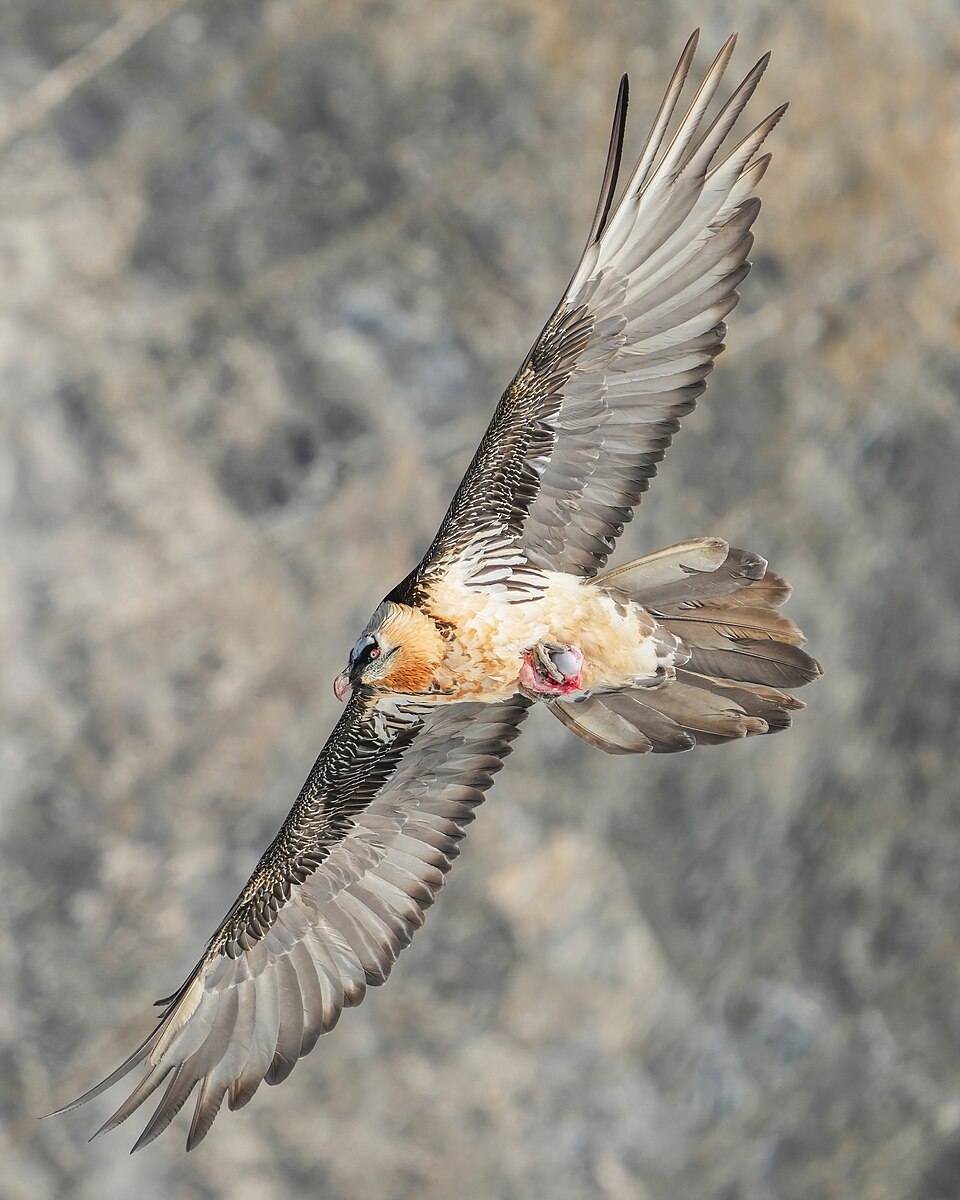
The bearded bearded vulture can be recognized by its orange to whitish plumage on the head and belly, contrasting with dark, elongated diamond-shaped wings and tail. A black “beard” plumage under the bill gives it its name. His eyes are ringed in red, a sign of his state of excitement or stress. The orange coloring comes from regular bathing in ferruginous sludge.
Characteristics
Indicative values: they vary by subspecies, sex and region.
Habitat and distribution
The bearded bearded vulture favors steep mountain ranges, rocky cliffs and deep gorges, often at high altitude. It nests on inaccessible ledges, sheltered from terrestrial predators. The surrounding steppe and high-altitude pasture areas provide it with a hunting territory to spot carcasses. It generally avoids highly urbanized or densely forested areas.
CURRENT RANGE
The species is present in a fragmented manner in Europe (Pyrenees, Alps, Corsica, Balkans), in North and East Africa, as well as in central and southern Asia up to the Himalayas and Tibet. Populations are generally isolated from each other due to the degradation and fragmentation of mountain habitats. Reintroduction programs have helped stabilize certain European populations. In North Africa, the species persists in certain Atlas mountains.
Behaviour
The bearded bearded vulture is a solitary or pair-living bird, active during the day, which roams vast mountainous territories in search of carcasses. It is distinguished from other vultures by its habit of breaking bones by dropping them from a great height onto rocky areas, called “bone breakers”, to extract the marrow. It adopts a powerful gliding flight, exploiting the ascending currents of steep terrain. The couple generally remains faithful and defends a stable territory for several years.
Reproduction
The female generally lays one to two eggs in winter, a period when food remains available despite the mountain cold. Incubation lasts approximately 55 days and is carried out by both parents. Only one chick usually survives, the younger one often being eliminated by competition with its older one. The young take flight at around 100 to 130 days old but remain dependent on adults for several additional months.
Peculiarities
The bearded bearded vulture is the only known vertebrate whose diet consists of more than 70% bone. It voluntarily dyes its plumage orange by rubbing itself in baths of ferruginous mud, a behavior that is still poorly explained in birds. His nickname "bone breaker" comes from his unique technique of fragmenting bones by controlled falling.
Threats and conservation
The species is threatened by poisoning, whether intentional or accidental, particularly via poisoned bait intended for other predators. Collisions with power lines and cables, as well as human disturbance near nesting sites, also reduce its reproductive success. The reduction in extensive pastoralism reduces the availability of carcasses, its main food resource. The low population density and slow reproduction rate make recovery particularly slow.
Numbers and trends vary across sources and regions. See the IUCN assessment for the latest reference data.
Gallery
1 documented photographs.
References
Profile updated 03 September 2026 · Reviewed by the TunisieVet editorial team.
Comments (0)
No comments yet.
CONSERVATION STATUS
Near threatened (NT)
IUCN source, latest published assessment.
Species health
Documented diseases for this species.
This information is provided for educational purposes only and is not a substitute for a veterinary consultation. If you have any concerns about your animal's health, consult a veterinarian.
To discover around: bearded vulture
Videos, facts, stories and records linked to this species.
Similar animals
Other species documented in Animalpedia.

TunisieVet in your pocket 📱🐾 Access your veterinary services wherever you are. [ Download the app ]
Learn more