Presentation
The binturong is an arboreal mammal native to the tropical forests of Southeast Asia. Often nicknamed the «bearcat» due to its appearance combining feline and ursine features, it actually belongs to the family Viverridae, closely related to civets. It is distinguished by a long prehensile tail that serves as a fifth limb for moving through the canopy. Its coarse black fur and its distinctive popcorn-like smell, produced by glandular secretions, make it a singular species. Discreet and primarily nocturnal, it remains poorly known to the general public despite its wide range. Its populations are now in decline due to deforestation and poaching.
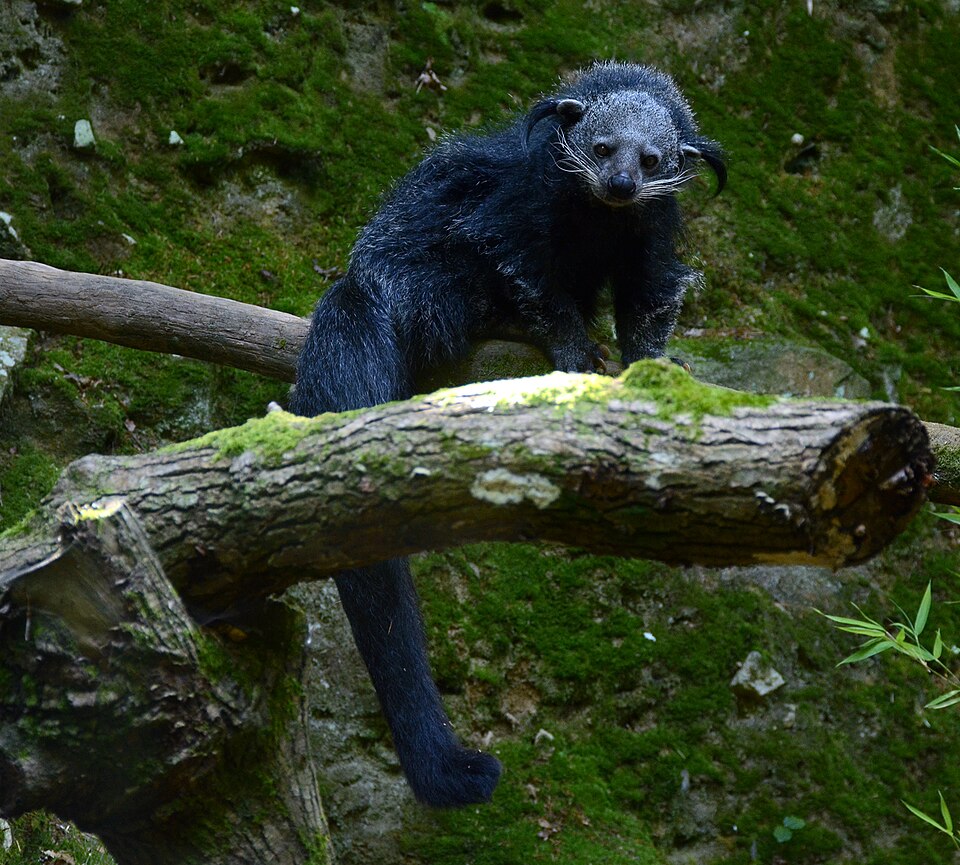
The binturong has a robust body covered in thick, coarse fur, typically black with grayish highlights. Its head is round, its ears are rounded and edged with white fur, and its dark eyes give it a distinctive expression. Its tail, as long as its body, is prehensile and unique among Asian carnivores. It has semi-retractile claws adapted for arboreal life.
Characteristics
Indicative values: they vary by subspecies, sex and region.
Habitat and distribution
The binturong inhabits primarily the wet tropical forests and dense secondary forests of Southeast Asia. It also occasionally frequents forest edges near cultivated areas. Its dependence on continuous forest cover makes it highly vulnerable to habitat fragmentation.
CURRENT RANGE
The species is found in Southeast Asia, from northeastern India and Bangladesh to southern China, across the Indochinese peninsula, Malaysia, Sumatra, Borneo, and the Philippines. Its range is increasingly fragmented due to deforestation.
Behaviour
Primarily solitary and nocturnal to crepuscular, the binturong moves slowly but deliberately through the trees using its prehensile tail. It communicates through varied vocalizations including grunts, whistles, and chuckles, as well as through scent marking with its characteristic fur odor. It spends most of its life in the canopy and rarely descends to the ground.
Reproduction
The female may give birth at any time of year, following a gestation period of approximately 90 days. She typically produces a litter of 1 to 3 young, which are blind at birth. The young are weaned around 3 months of age and reach sexual maturity at around 2 years.
Peculiarities
The binturong produces an odor resembling hot popcorn, released from perianalal glands, which it uses to mark its territory. Its prehensile tail makes it the only Asian carnivore with this adaptation, shared only with the kinkajou in the Americas.
Threats and conservation
Deforestation and conversion of forests to plantations, particularly palm oil plantations, significantly reduce its habitat. It is also hunted for its meat, its organs used in traditional medicine, and sometimes captured for the exotic pet trade. These combined pressures drive a continuous decline in wild populations.
Numbers and trends vary across sources and regions. See the IUCN assessment for the latest reference data.
Gallery
1 documented photographs.
References
Profile updated 01 September 2026 · Reviewed by the TunisieVet editorial team.
Comments (0)
No comments yet.
CONSERVATION STATUS
Vulnerable (VU)
IUCN source, latest published assessment.
Species health
Documented diseases for this species.
Find a veterinarianThis information is provided for educational purposes only and is not a substitute for a veterinary consultation. If you have any concerns about your animal's health, consult a veterinarian.
Similar animals
Other species documented in Animalpedia.

Be among the first to use our app. Sign up and get early Google Play access.
Discover