
Presentation
The blackbird is a medium-sized songbird widely found across Europe, North Africa, and Western Asia. The adult male stands out with entirely black plumage and a yellow-orange bill, while the female displays a dusky brown plumage. Very common in gardens, parks, and forests, it has adapted well to human presence. Its melodious, flutelike song, often heard at dawn or dusk, makes it one of the most cherished songbirds. In Tunisia, it is present in many regions, particularly in wooded areas and urban gardens. It is a resident species throughout much of its range.
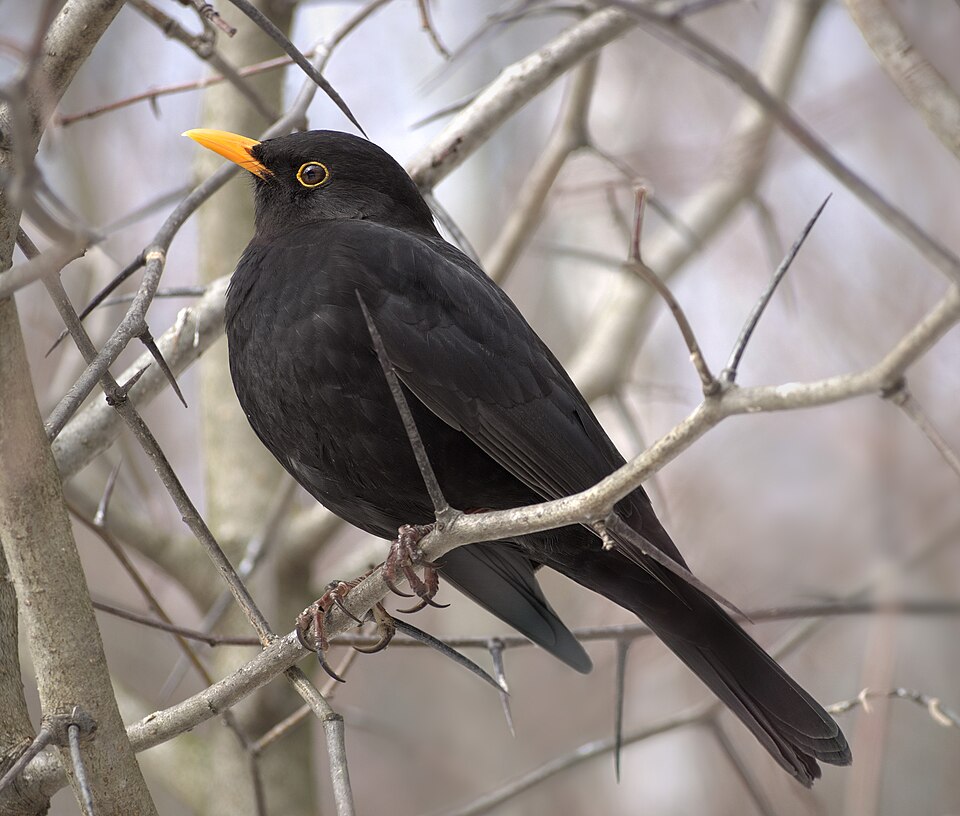
The blackbird measures roughly 24 to 25 cm in length with a wingspan of 34 to 38 cm. Sexual dimorphism is marked: the male is black with a yellow-orange bill and a yellow eye-ring, while the female is dark brown with a clearer throat streaked with markings. Young birds resemble females before moulting into adult plumage.
Characteristics
Indicative values: they vary by subspecies, sex and region.
Habitat and distribution
Blackbirds frequent a wide variety of habitats: forests, hedgerow country, gardens, urban parks, and farmland. They particularly favour environments with dense vegetation for nesting and soft soil for foraging. Their adaptability allows them to thrive in both rural areas and densely populated city centres.
CURRENT RANGE
The species is native to Europe, North Africa, and parts of western and central Asia. It has also been successfully introduced to Australia and New Zealand. In Tunisia, the blackbird is present year-round, particularly in the north and forested mountainous regions.
Behaviour
The blackbird is territorial, especially the male, who actively defends his breeding territory through song and threatening postures. It is generally solitary or pairs up, though flocking can occur in winter around food sources. Its characteristic behaviour of hopping along the ground, punctuated by pauses to scan the surroundings, aids identification. It is a diurnal species, active from first light.
Reproduction
Breeding season typically runs from March through July, with multiple clutches possible in a single year. The female builds a cup-shaped nest from twigs, grass, and mud, usually hidden in a bush or hedge. She lays 3 to 5 blue-green spotted eggs and incubates them alone for about two weeks. Young birds leave the nest approximately two weeks after hatching but remain dependent on their parents for several additional days.
Peculiarities
The blackbird's song is renowned for its melodic richness and ability to mimic certain environmental sounds. The male's bright yellow bill stands in sharp contrast to its black plumage, a distinctive feature that inspired its scientific and common names. The species shows considerable behavioural flexibility in adapting to urbanisation.
Threats and conservation
The blackbird faces no major threats and its populations are generally stable or expanding thanks to its adaptability. It may be locally affected by pesticides, predation by domestic cats, and certain viral diseases such as West Nile virus. Destruction of hedgerows and green spaces can reduce nesting sites in some areas.
Numbers and trends vary across sources and regions. See the IUCN assessment for the latest reference data.
Gallery
1 documented photographs.
References
Profile updated 04 September 2026 · Reviewed by the TunisieVet editorial team.
Comments (0)
No comments yet.
CONSERVATION STATUS
Least concern (LC)
IUCN source, latest published assessment.
Species health
Documented diseases for this species.
Find a veterinarianThis information is provided for educational purposes only and is not a substitute for a veterinary consultation. If you have any concerns about your animal's health, consult a veterinarian.
Similar animals
Other species documented in Animalpedia.

TunisieVet in your pocket 📱🐾 Access your veterinary services wherever you are. [ Download the app ]
Learn more