
Presentation
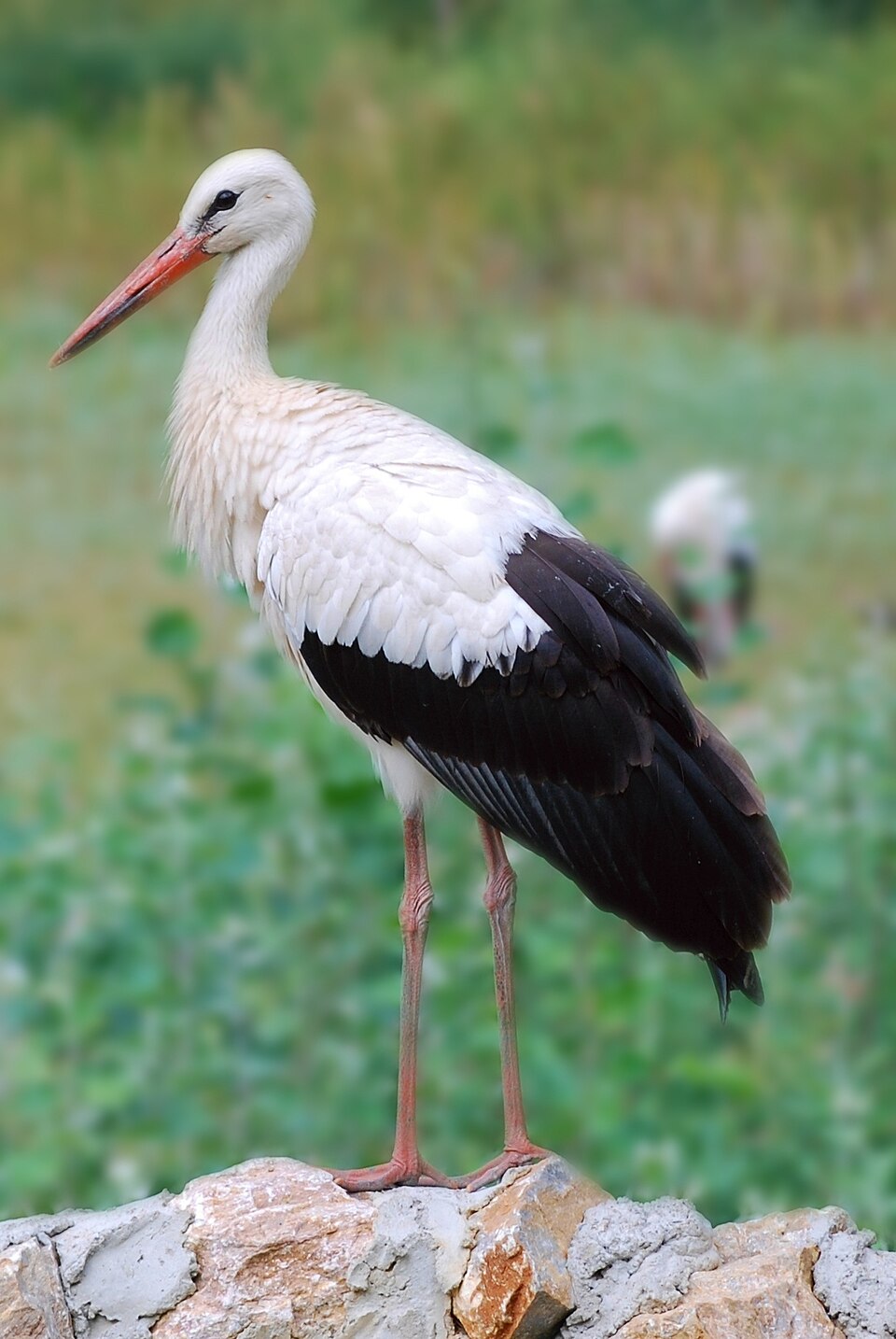
The White stork is a large wader with characteristic white and black plumage, a long red bill and red legs. It is one of the largest storks in the world, instantly recognizable by its slender silhouette and impressive wingspan. This migratory bird is historically associated with European rooftops, where it has nested for millennia.
The plumage is pure white over the majority of the body, with glossy black primary and secondary flight feathers visible in flight. The long, pointed beak is vermilion red in color, as are the bird's legs. The eyes are dark, surrounded by an area of bare yellowish skin. This slender morphology allows it to be very effective during aquatic hunts.
Did you know?
Do birds see the Earth's magnetic field?
Characteristics
Indicative values: they vary by subspecies, sex and region.
Habitat and distribution
White stork frequents open wetlands such as marshes, floodplain meadows and shallow lakes. It adapts well to anthropized environments, notably farms and agricultural meadows. It also appreciates urban and peri-urban environments where it nests on buildings and anthropogenic structures.
CURRENT RANGE
White stork is widely distributed in Europe, North Africa and Western Asia. European and West Asian populations are migratory, wintering in sub-Saharan Africa. It is regularly present in the Mediterranean basin, particularly in Tunisia where it is observed during migratory passages.
Behaviour
White stork is a highly gregarious species, congregating in large groups during migration and at rest. It is renowned for its spectacular courtship displays involving distinctive bill clicking. In flight, it uses thermal currents to glide long distances with minimal effort.
Reproduction
White stork is monogamous and nests in colonies, often faithful to the same site for several years. She builds bulky nests made of branches that the pair reuse and enlarge each year, sometimes forming impressive structures. The female usually lays 3 to 5 eggs, incubated for approximately 33 days.
Peculiarities
The White stork is famous for its spectacular migration covering more than 10,000 km between Europe and Africa. She is able to hover for hours using thermal currents, saving considerable energy. Its bill-clicking displays, called “rattles”, constitute a particular mode of communication between individuals.
Threats and conservation
Although the species is largely stable, it faces threats from wetland habitat loss, pollution, and electrocution on power lines. The degradation of breeding and wintering areas impacts migratory populations.
Numbers and trends vary across sources and regions. See the IUCN assessment for the latest reference data.
Gallery
1 documented photographs.
References
UICN — Liste rouge des espèces menacées
Profile updated 01 September 2026 · Reviewed by the TunisieVet editorial team.
Comments (0)
No comments yet.
CONSERVATION STATUS
Least concern (LC)
IUCN source, latest published assessment.
Species health
Documented diseases for this species.
Find a veterinarianThis information is provided for educational purposes only and is not a substitute for a veterinary consultation. If you have any concerns about your animal's health, consult a veterinarian.
To discover around: White stork
Videos, facts, stories and records linked to this species.
Similar animals
Other species documented in Animalpedia.

TunisieVet in your pocket 📱🐾 Access your veterinary services wherever you are. [ Download the app ]
Learn more