
Presentation
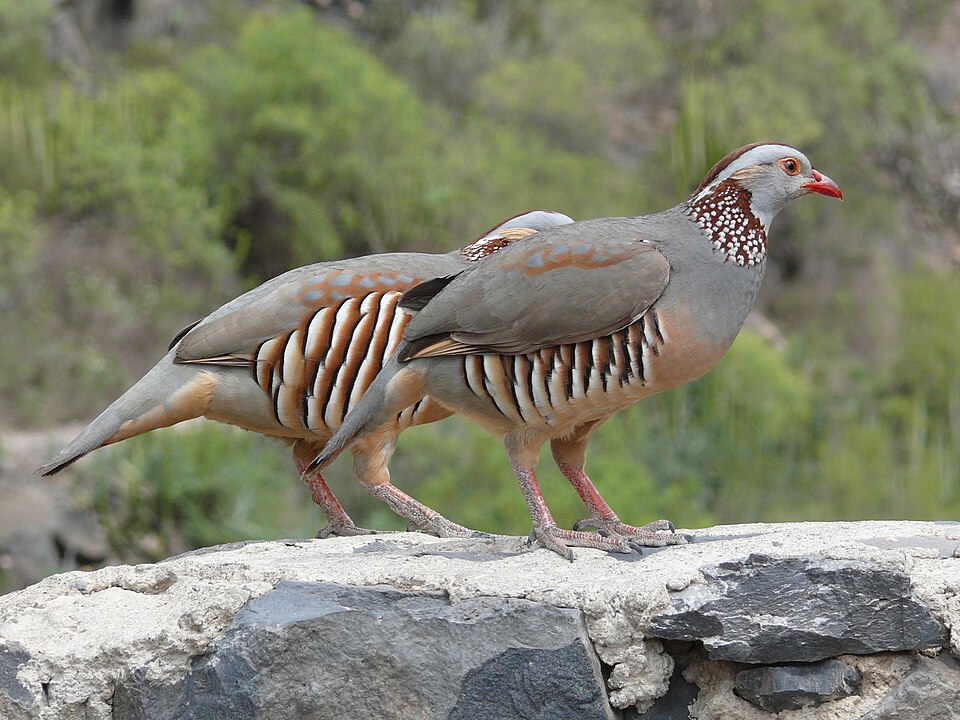
Barbary partridge is a medium-sized galliform, endemic to North Africa. It is distinguished by its gray-brown plumage and its variegated characteristics, with a chest tinged with red and white cheeks framed in black. It is a terrestrial species that prefers to walk or run rather than fly, except in cases of immediate danger.
This bird displays subtle sexual dimorphism: the male has a slightly more colorful head than the female. Its light gray-brown plumage is dotted with black crossbars, and its sides have distinctive rufous stripes. The legs are sturdy and reddish, adapted for walking over rough terrain.
Characteristics
Indicative values: they vary by subspecies, sex and region.
Habitat and distribution
Barbary partridge inhabits the mountainous areas and forested slopes of North Africa, including oak forests and Mediterranean scrub. It also frequents scrubby steppes and semi-arid areas with adequate vegetation cover. It prefers moderate to high altitudes, but adapts to various biotopes where it finds food and sufficient cover.
CURRENT RANGE
An endemic species from the Maghreb, Barbary partridge is found mainly in Algeria and Morocco, with a notable presence in Tunisia. It occupies the North African mountain ranges, notably the heights of the Atlas and mid-mountain regions. Its distribution area remains restricted and fragmented depending on available habitats.
Behaviour
A gregarious and crepuscular bird, the Barbary partridge lives in small groups or pairs during the nesting season. It is known to be difficult to observe due to its discreet behavior and its tendency to camouflage itself in vegetation. In case of danger, it prefers to flee on foot rather than take flight, and emits characteristic calls to communicate with its group.
Reproduction
The Barbary partridge nests on the ground, nesting in a shallow depression lined with feathers and grasses. The female generally lays 8 to 14 eggs between April and May. Incubation lasts about 23 to 24 days, and chicks are altricial, leaving the nest shortly after hatching to follow the parents in foraging.
Peculiarities
Unlike other partridges, the Barbary partridge is monogamous and the male actively contributes to guarding the young. Its characteristic call sounds like a distinctive “terr-terr-terr” which makes its sound identification easier. It is one of the rare North African partridges to have adapted to life in the mountains, thanks to its robust legs and its ability to move easily in uneven terrain.
Threats and conservation
Although classified as Least Concern, Barbary partridge faces moderate threats related to habitat loss and fragmentation due to overgrazing, agricultural and urban development. Unregulated hunting and poaching in some areas also pose pressures. Its restricted range makes it potentially vulnerable in the long term.
Numbers and trends vary across sources and regions. See the IUCN assessment for the latest reference data.
Gallery
1 documented photographs.
References
UICN — Liste rouge des espèces menacées
Profile updated 01 September 2026 · Reviewed by the TunisieVet editorial team.
Comments (0)
No comments yet.
CONSERVATION STATUS
Least concern (LC)
IUCN source, latest published assessment.
Species health
Documented diseases for this species.
Find a veterinarianThis information is provided for educational purposes only and is not a substitute for a veterinary consultation. If you have any concerns about your animal's health, consult a veterinarian.
Similar animals
Other species documented in Animalpedia.

TunisieVet in your pocket 📱🐾 Access your veterinary services wherever you are. [ Download the app ]
Learn more