
Presentation
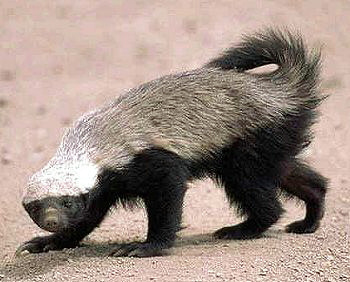
The honey badger, also called a ratel, is a small carnivorous mammal renowned for its toughness and combative temperament. It has thick, loose skin that protects it effectively from stings, bites and scratches. Its two-tone coat—grey and white on the back and black on the belly—makes it easy to recognize. Despite its modest size, it is capable of standing up to predators far larger than itself. It inhabits a wide variety of environments across Africa and Asia, from deserts to wooded areas.
The honey badger has a stocky body, short powerful legs equipped with long claws suited for digging. Its very thick skin, which is loose from the body, allows it to turn around and bite an attacker that has grabbed it. It also has anal glands capable of releasing a foul-smelling secretion used for defense.
Characteristics
Indicative values: they vary by subspecies, sex and region.
Habitat and distribution
The honey badger frequents highly varied habitats, from arid savannas and steppes to forests and desert zones. It adapts equally well to mountainous regions and plains, provided prey and cavities for shelter are available. It generally avoids very humid areas.
CURRENT RANGE
It is found across much of sub-Saharan Africa as well as the Near East and South Asia, extending into India. Its range encompasses highly contrasting environments, from the Sahara Desert to the more humid regions of East Africa. It is not present in North Africa.
Behaviour
A primarily solitary and nocturnal animal, it has an aggressive and reckless temperament known for taking on animals much larger than itself. It digs burrows or occupies those of other animals to rest during the day. It communicates with grunts and hisses when it feels threatened.
Reproduction
The female gives birth to one or two young after a gestation period of approximately six months. Young remain with their mother for several months to learn hunting and self-defense skills. Sexual maturity is reached at around two years of age.
Peculiarities
The honey badger is renowned for its exceptional resistance to snake venom, particularly when hunting cobras. Its thick skin makes it virtually invulnerable to bites from medium-sized animals. It is sometimes cited as one of the most fearless mammals in the animal kingdom.
Threats and conservation
It is threatened by conflicts with livestock farmers, who view it as a pest for attacking cattle and beehives. Poaching and habitat destruction also contribute to pressure on certain local populations. Overall, the species remains widespread and its conservation status is stable.
Numbers and trends vary across sources and regions. See the IUCN assessment for the latest reference data.
Gallery
1 documented photographs.
References
Profile updated 04 September 2026 · Reviewed by the TunisieVet editorial team.
Comments (0)
No comments yet.
CONSERVATION STATUS
Least concern (LC)
IUCN source, latest published assessment.
Species health
Documented diseases for this species.
Find a veterinarianThis information is provided for educational purposes only and is not a substitute for a veterinary consultation. If you have any concerns about your animal's health, consult a veterinarian.
To discover around: Honey badger
Videos, facts, stories and records linked to this species.
RECORD
Title awarded by Guinness World Records in 2002
The Most Fearless Animal
Recognition based on its fearlessness in the face of predators much larger than itself.
Similar animals
Other species documented in Animalpedia.

TunisieVet in your pocket 📱🐾 Access your veterinary services wherever you are. [ Download the app ]
Learn more