
Presentation
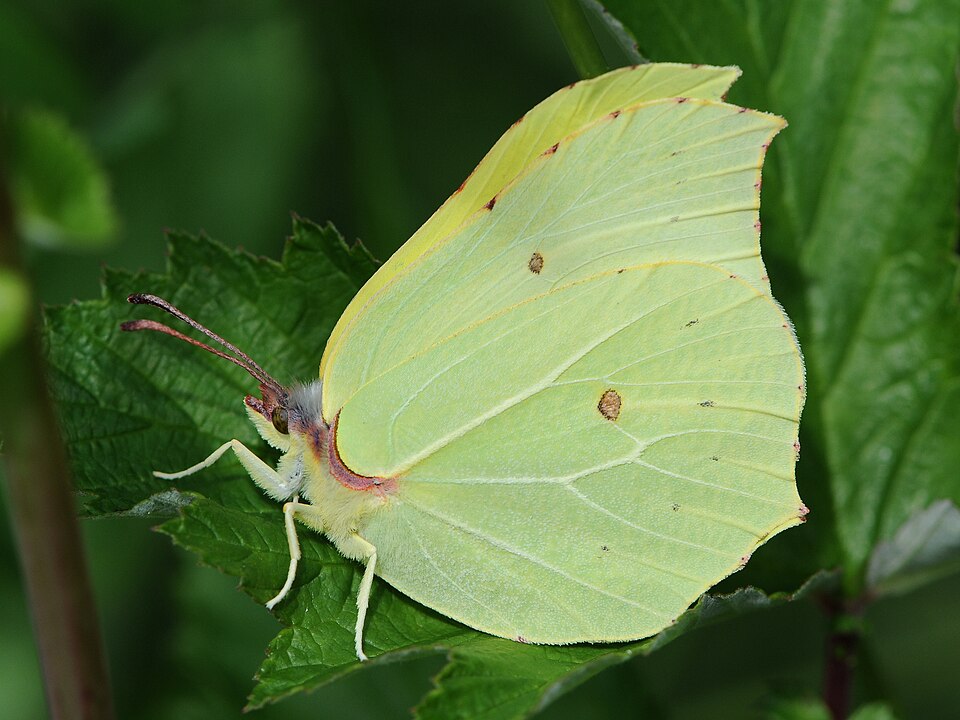
The Brimstone is a medium-sized butterfly belonging to the Pieridae family, recognized by its leaf-shaped wings. Males display a bright sulphur yellow color, while females show a paler tone, almost whitish-green. Its pointed wing shape and vein pattern mimicking leaf veins provide effective camouflage at rest. This species is among Europe's longest-lived adult butterflies, with some individuals surviving over a year by overwintering. Widespread, it frequents a wide variety of open and wooded habitats. It is often one of the first butterflies spotted in spring.
The wings have an angular shape resembling a leaf, with a small central point on each forewing and hindwing. Sexual dimorphism is marked: bright yellow in males, whitish-yellow in females. The body is slender and covered in fine scales, typical of butterflies. Wingspan generally ranges between 5 and 6 cm.
Characteristics
Indicative values: they vary by subspecies, sex and region.
Habitat and distribution
The species frequents woodland edges, hedgerows, flower-rich meadows, and gardens, wherever its host plants grow. It favors semi-open habitats offering both nectar sources and sheltered overwintering sites. It is found equally in lowland and middle mountain regions.
CURRENT RANGE
The Brimstone butterfly is widely distributed across Europe, North Africa, and temperate Asia. It is common throughout much of the European continent, from sea level to moderate mountain altitudes. In North Africa, it is present notably in the Maghreb.
Behaviour
The Brimstone is a diurnal butterfly active from the first warm days, often visible in flight from late winter onward. It overwinters as an adult, hidden in dense vegetation such as ivy or evergreen shrubs, where its shape and color render it nearly invisible. Males actively patrol in spring searching for females. It displays fairly rapid and erratic flight.
Reproduction
Mating occurs in spring after adults emerge from winter dormancy. The female lays her eggs singly on young buckthorn shoots. The green caterpillar develops through several instars before forming a suspended chrysalis. Typically one generation occurs annually, with adults emerging in summer and then overwintering until the following spring.
Peculiarities
Its leaf mimicry at rest, with wings closed, is particularly effective at deceiving predators. It is among the few European butterflies capable of surviving winter in the adult stage thanks to a form of cold resistance. Its species name would date from an old English word for yellow, which originated the term "butterfly."
Threats and conservation
The species is not globally threatened and remains common across its range. Local decline of hedgerows and wild buckthorn, linked to agricultural intensification, can reduce its populations in certain regions. Pesticide use also poses a threat to its larval stages.
Numbers and trends vary across sources and regions. See the IUCN assessment for the latest reference data.
Gallery
1 documented photographs.
References
Profile updated 09 September 2026 · Reviewed by the TunisieVet editorial team.
Comments (0)
No comments yet.
CONSERVATION STATUS
Least concern (LC)
IUCN source, latest published assessment.
Similar animals
Other species documented in Animalpedia.

TunisieVet in your pocket 📱🐾 Access your veterinary services wherever you are. [ Download the app ]
Learn more