
Presentation
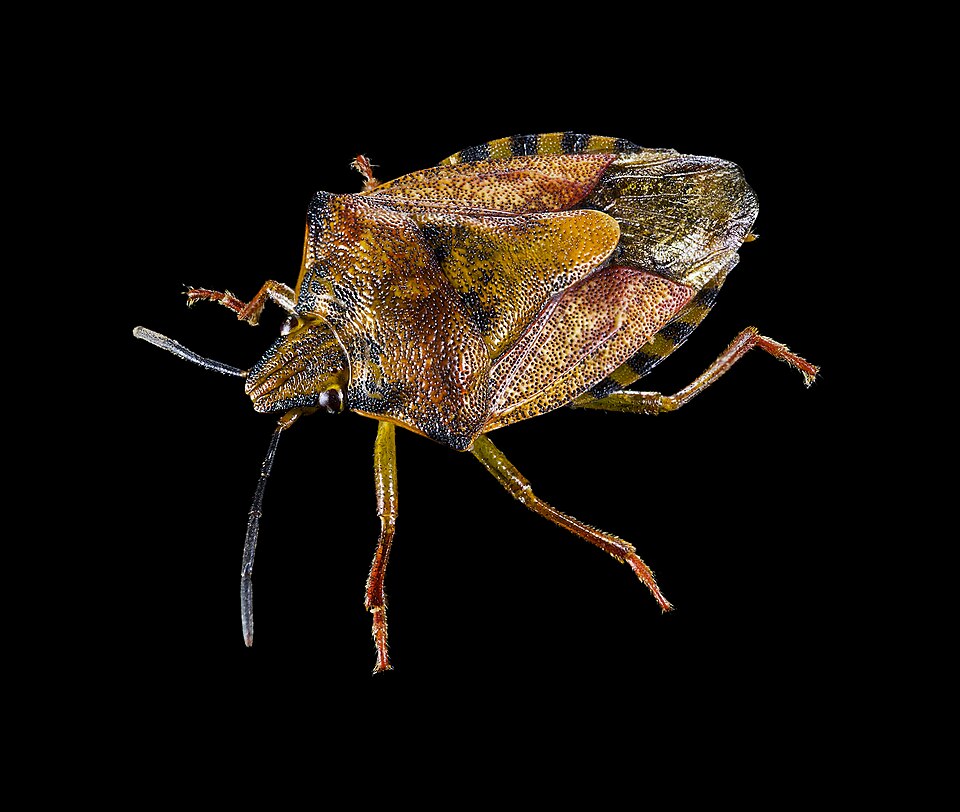
Bugs are insects in the order Hemiptera, characterized by piercing-sucking mouthparts that form a proboscis. The term refers to a highly diverse group that includes plant-feeding species, predatory species, and blood-feeding species such as the bed bug. The body is usually flattened and oval-shaped, and many species have defensive scent glands that release an unpleasant odor when threatened. Bugs are found in nearly all terrestrial environments, from gardens to homes. Some species are considered pests to crops or nuisances in buildings, while others play a useful role in controlling populations of other insects.
The body is often flat and oval or elongated in shape, protected by hemelytrons that partially cover the membranous wings. The head carries an articulated proboscis used to pierce plant or animal tissues and draw out their fluids. Size ranges from a few millimeters to more than two centimeters depending on the species. Many bugs have scent glands located on the thorax, which are responsible for their characteristic odor.
Characteristics
Indicative values: they vary by subspecies, sex and region.
Habitat and distribution
Bugs occupy a wide variety of environments: gardens, cultivated fields, forests, wetlands, and urban dwellings. Some species are strictly associated with host plants on which they feed, while others, such as the bed bug, live exclusively in contact with humans.
CURRENT RANGE
The group of bugs is present on all continents, with thousands of species described throughout the world. Some species have a very broad distribution thanks to their association with human activities and international trade.
Behaviour
Most bugs are active on the ground, on plants, or in the case of some domestic species, in human dwellings. Many are diurnal, but blood-feeding species such as bed bugs are nocturnal. When threatened, several species release a defensive odorous secretion. Some species live in groups while others are solitary.
Reproduction
Reproduction occurs through mating followed by egg-laying, typically on plants, in the soil, or in crevices depending on the species. Development passes through several larval stages (nymphs) that resemble adults but are smaller and lack functional wings. Maturity is reached after several successive molts, over a period ranging from a few weeks to several months.
Peculiarities
The term "bug" actually groups together thousands of different species belonging to several families within the hemiptera. The defensive scent gland, present in many species, is the origin of the familiar name "stink bug". The bed bug, though unwelcome, does not transmit known diseases to humans despite its irritating bites.
Threats and conservation
Phytophagous bugs are often controlled as agricultural pests through insecticide treatments, which can reduce their populations locally. The bed bug, however, has developed resistance to common insecticides, making its management more difficult. Overall, the group is not threatened at the global level due to its great diversity and abundance.
Numbers and trends vary across sources and regions. See the IUCN assessment for the latest reference data.
Gallery
1 documented photographs.
References
Profile updated 26 August 2026 · Reviewed by the TunisieVet editorial team.
Comments (0)
No comments yet.
CONSERVATION STATUS
Least concern (LC)
IUCN source, latest published assessment.
Species health
Documented diseases for this species.
Find a veterinarianThis information is provided for educational purposes only and is not a substitute for a veterinary consultation. If you have any concerns about your animal's health, consult a veterinarian.
Similar animals
Other species documented in Animalpedia.
