
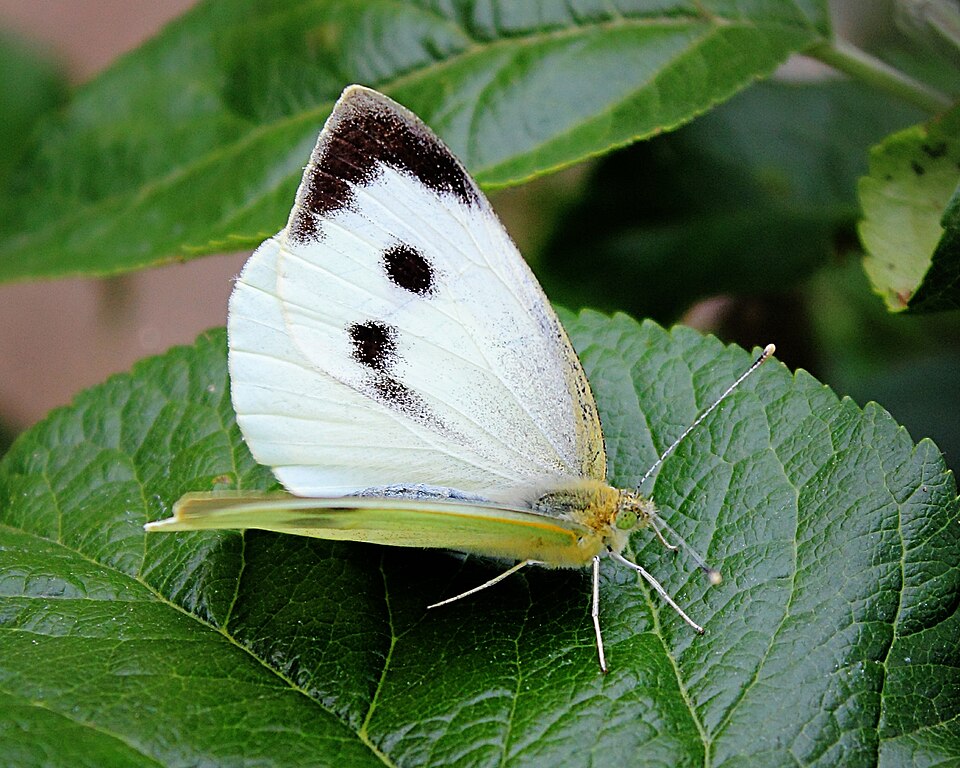
Presentation
The cabbage white is a medium-sized butterfly belonging to the Pieridae family, widely distributed across Europe, North Africa, and Asia. Its name refers to the white or pale yellow colour of its wings, often adorned with black spots. This daytime butterfly is frequently observed in gardens, cultivated fields, and meadows, where it feeds on nectar from numerous flowers. The cabbage white caterpillar feeds primarily on plants of the Brassicaceae family, which sometimes makes it a pest of cabbage crops. The species is common and subject to no particular protection measures.
Cabbage whites typically have a wingspan of 4 to 6 cm, with white or yellowish wings marked with variable black patterns depending on the species and sex. Their body is slender and covered with fine scales, typical of lepidopterans. Sexual dimorphism is often visible through the number and arrangement of dark spots on the forewings.
Characteristics
Indicative values: they vary by subspecies, sex and region.
Habitat and distribution
The cabbage white frequents a wide variety of open, sunny habitats, such as meadows, gardens, cultivated fields, and fallow areas. It adapts easily to environments modified by humans, including urban vegetable gardens and parks. Its presence is closely linked to the availability of host plants and nectar sources.
CURRENT RANGE
This butterfly is widely distributed throughout Europe, North Africa including Tunisia, and much of temperate Asia. It has also been accidentally introduced to other regions of the world where it has sometimes become permanently established. Its broad geographic range reflects its great capacity to adapt to different climates and habitats.
Behaviour
The cabbage white is a daytime butterfly active mainly during sunny days from spring to autumn. It often undertakes migratory flights over short to medium distances depending on populations and seasons. Males actively patrol flowering areas in search of mates, while females seek host plants for egg-laying.
Reproduction
The female lays her eggs singly or in small clusters on the underside of leaves of host plants. After hatching, the caterpillar passes through several larval stages before forming a chrysalis attached to a plant support. Depending on the region and climate, the species may produce several generations per year, with a winter dormancy in chrysalis form in temperate zones.
Peculiarities
The wings of the cabbage white contain pigments that strongly reflect ultraviolet light, a signal visible to other butterflies but invisible to the human eye. This characteristic is thought to play an important role in recognition between potential mates during reproduction.
Threats and conservation
The species is not globally threatened, and its populations remain stable or even abundant throughout most of its range. However, the intensive use of pesticides in agricultural areas can locally reduce its numbers. The loss of natural habitats due to urbanization presents an additional pressure in certain regions.
Numbers and trends vary across sources and regions. See the IUCN assessment for the latest reference data.
Gallery
1 documented photographs.
References
Profile updated 09 September 2026 · Reviewed by the TunisieVet editorial team.
Comments (0)
No comments yet.
CONSERVATION STATUS
Least concern (LC)
IUCN source, latest published assessment.
Similar animals
Other species documented in Animalpedia.

TunisieVet in your pocket 📱🐾 Access your veterinary services wherever you are. [ Download the app ]
Learn more