
Presentation
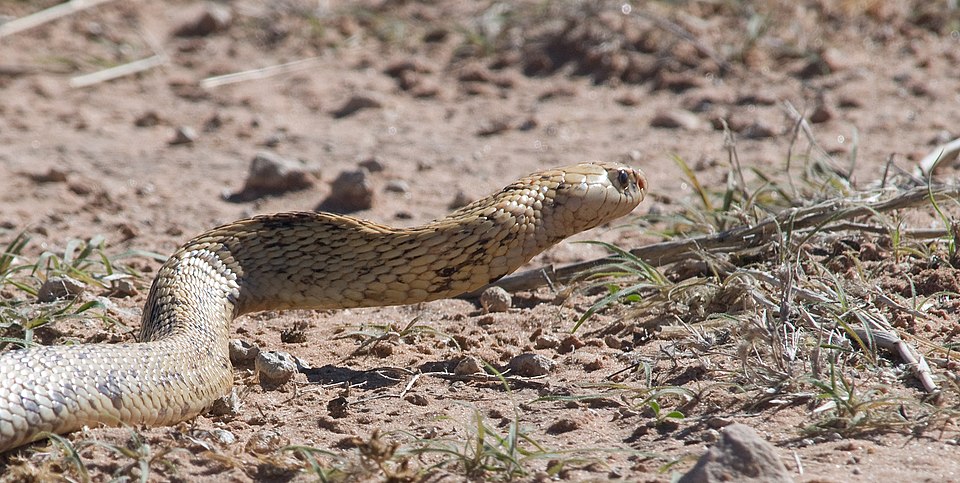
The Cape cobra is a medium-sized venomous snake endemic to southern Africa. Its coloring is very variable, ranging from golden yellow to dark brown, sometimes spotted, which has long complicated its identification. It is considered one of the most dangerous snakes in southern Africa due to the potency of its neurotoxic venom. Active mainly during the day, it frequents dry and open environments where it hunts rodents, birds and other reptiles. Its name comes from the Cape region of South Africa, where it is particularly common.
The body is robust and covered in smooth scales, with a rounded head indistinguishable from the neck. Like other cobras, it can straighten the front of its body and deploy a narrow hood when it feels threatened. Coloration varies greatly between individuals and regions, with no characteristic fixed pattern.
Characteristics
Indicative values: they vary by subspecies, sex and region.
Habitat and distribution
The species frequents dry and semi-arid environments, including rocky areas, open savannah and steppe plains. It also likes the surroundings of farms and cultivated areas where prey is abundant. It readily uses rodent burrows or rock crevices as shelter.
CURRENT RANGE
Cape cobra is endemic to southern Africa, mainly occurring in South Africa, Namibia, Botswana and Lesotho. It is particularly abundant in the Western Cape region, from which it takes its name. Its distribution does not extend beyond this southern zone of the continent.
Behaviour
The Cape cobra is diurnal and can be very defensive when startled, raising its body and hissing. It is capable of biting repeatedly and injects a significant amount of venom during defensive bites. Outside of confrontations, he remains discreet and generally avoids humans if he has the opportunity.
Reproduction
Breeding takes place in the austral spring, after a mating period which may involve fighting between males. The female lays between 8 and 20 eggs in a sheltered and humid place, such as an abandoned burrow. Incubation lasts approximately two to three months before the emergence of the young, already venomous and autonomous.
Peculiarities
This cobra exhibits exceptional color variability within the same population, a rare phenomenon among snakes. Its venom, essentially neurotoxic, acts quickly by blocking nerve transmission, which can cause respiratory paralysis in the absence of treatment.
Threats and conservation
The species is not globally threatened, but it is sometimes killed due to human fear or during conflicts with agricultural activities. The destruction of its natural habitat in certain areas can locally reduce its populations. However, it remains widespread in its distribution area.
Numbers and trends vary across sources and regions. See the IUCN assessment for the latest reference data.
Gallery
1 documented photographs.
References
Profile updated 19 August 2026 · Reviewed by the TunisieVet editorial team.
Comments (0)
No comments yet.
CONSERVATION STATUS
Least concern (LC)
IUCN source, latest published assessment.
Species health
Documented diseases for this species.
See the 8 diseases of this species Find a veterinarianThis information is provided for educational purposes only and is not a substitute for a veterinary consultation. If you have any concerns about your animal's health, consult a veterinarian.
To discover around: Cape cobra
Videos, facts, stories and records linked to this species.
Similar animals
Other species documented in Animalpedia.

TunisieVet in your pocket 📱🐾 Access your veterinary services wherever you are. [ Download the app ]
Learn more