
Presentation
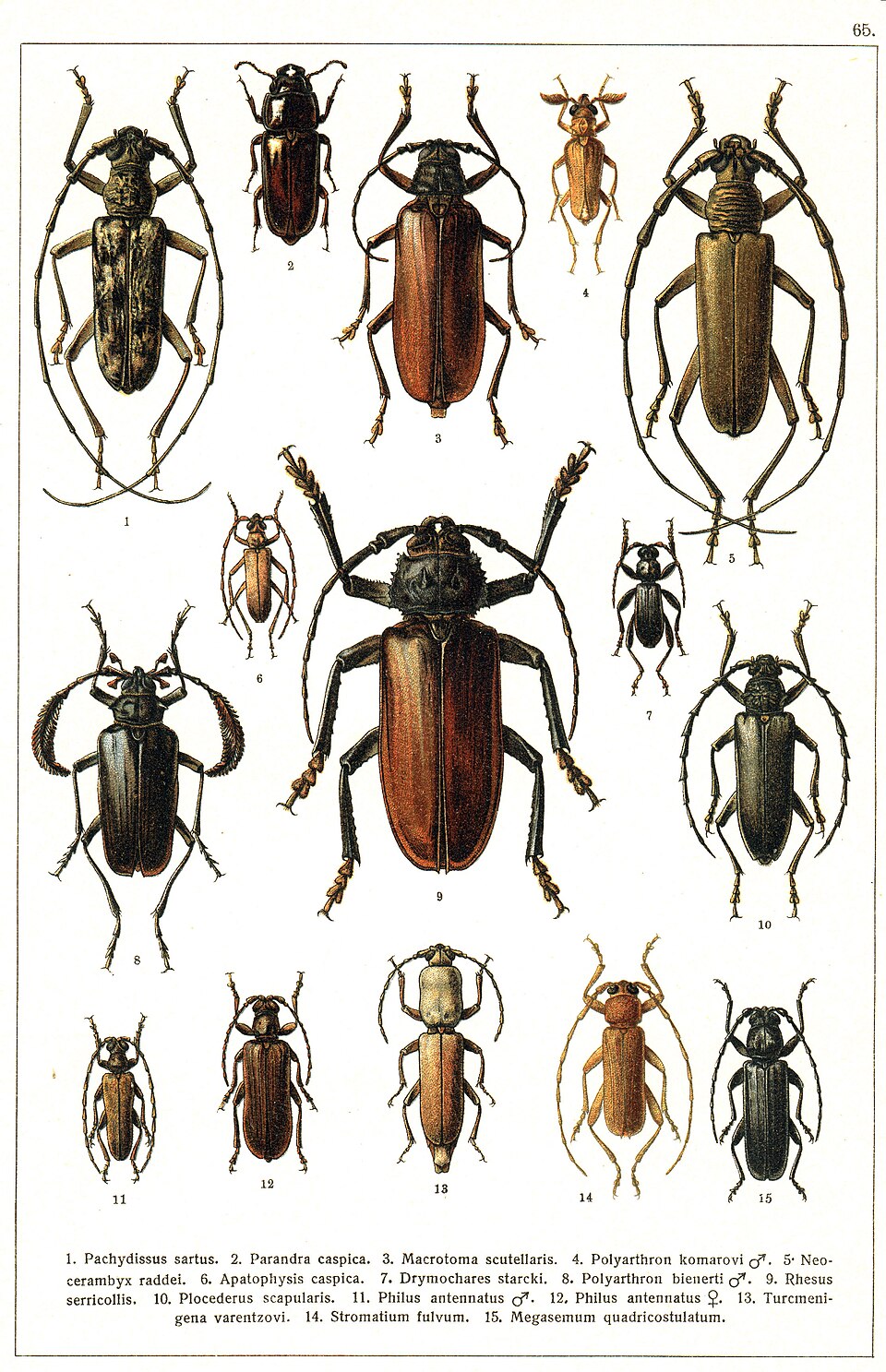
The longhorn beetle is a beetle belonging to the family Cerambycidae, characterized by long antennae that are often as large as the body itself. Several thousand species of longhorn beetles exist worldwide, with some living in North Africa and Tunisia. The body is elongated and sturdy, with colors ranging from dark brown to black depending on the species. The larvae develop in wood, sometimes for several years, before transforming into adults. This insect plays an important ecological role in the decomposition of dead wood. Some species are considered harmful to fruit and ornamental trees.
The longhorn beetle is distinguished by its very long filiform antennae, often curved backward. Its body is hard, chitinous, elongated and cylindrical in shape. Size varies greatly depending on the species, from a few millimeters to over 5 cm in the largest forms.
Characteristics
Indicative values: they vary by subspecies, sex and region.
Habitat and distribution
Longhorn beetles inhabit forests, orchards and wooded areas where they find the wood necessary for their larval development. Some species adapt to isolated trees in urban or agricultural settings. The presence of dead or aging wood favors their establishment.
CURRENT RANGE
The Cerambycidae family is distributed across all continents except Antarctica. In North Africa, several species are present, particularly in Tunisia in wooded areas and orchards. Species diversity is especially high in temperate and tropical regions.
Behaviour
The longhorn beetle is an insect that is primarily nocturnal or crepuscular, although some species are active during the day. It is generally solitary and not aggressive, though it may produce a stridulation sound when handled. Flight is possible but often remains limited to short distances.
Reproduction
The female lays her eggs in the cracks of bark or in weakened wood. The larval development, which takes place entirely within the wood, can last from one to several years depending on the species and climatic conditions. Metamorphosis into an adult occurs within a pupal chamber excavated by the larva before it emerges.
Peculiarities
The disproportionately long antennae, which give the insect its name, serve mainly for tactile and olfactory detection of the environment. Some species can produce an audible creaking sound by rubbing certain parts of their thorax, a defense mechanism against predators.
Threats and conservation
Some longhorn beetle species are threatened by the disappearance of old trees and dead wood, which is essential to their life cycle, due to intensive forest management. Other species, considered pests of crops or timber, are subject to control measures that reduce their local populations. Fragmentation of forest habitats poses an additional threat to the most specialized species.
Numbers and trends vary across sources and regions. See the IUCN assessment for the latest reference data.
Gallery
1 documented photographs.
References
Profile updated 27 August 2026 · Reviewed by the TunisieVet editorial team.
Comments (0)
No comments yet.
CONSERVATION STATUS
Least concern (LC)
IUCN source, latest published assessment.
Similar animals
Other species documented in Animalpedia.

🚀 SWConsulting — Turning Your Ideas into Digital Solutions Do you have an idea, a project, or a business process that needs to be digitalized? SWConsulting supports businesses from concept to deployment, delivering custom, reliable, and scalable digital solutions tailored to their real needs. 💻 Web & Mobile Development ⚙️ Business Applications & SaaS 🤖 Artificial Intelligence & Automation 📊 Custom CRM & Management Tools 🛒 E-commerce & Marketplaces 🔗 APIs & System Integrations Our goal is simple: turn your business needs into practical digital solutions that help you improve efficiency, automate processes, and grow your business. Have a project in mind? Let’s talk. 🚀 SWConsulting — Digital Solutions, Real Impact.
WhatsApp