
Presentation
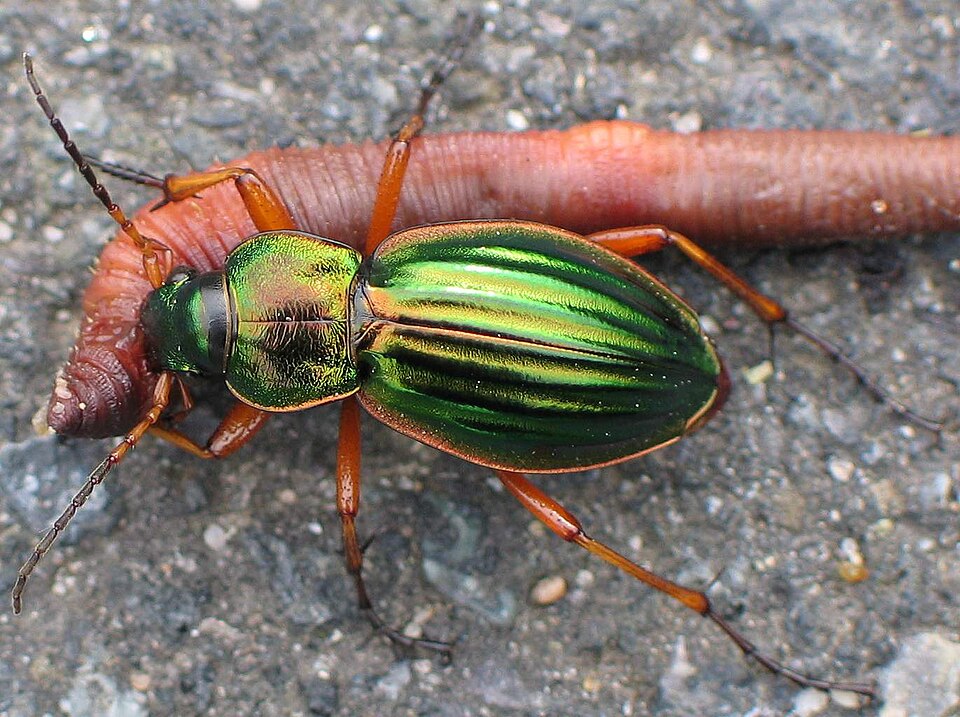
The ground beetle is a terrestrial beetle belonging to the Carabidae family, widely distributed in temperate and Mediterranean regions. Its elongated body, often black or with iridescent green, bronze, or golden reflections, measures one to four centimeters depending on the species. Primarily active at night, it moves quickly across the ground thanks to fine and powerful legs. A voracious predator, it plays an important role in controlling populations of insects and mollusks that are harmful to crops. It is frequently found in gardens, fields, and woodlands, hidden under stones or leaf litter during the day. In Tunisia, several ground beetle species are present in the agricultural and forest areas of the northern part of the country.
The ground beetle's body is divided into three distinct parts: head, thorax, and abdomen covered with rigid, striated elytra. The elytra, often fused, prevent flight in many species, making these insects strictly terrestrial. Its powerful mandibles and long legs adapted for rapid running make it an efficient hunter.
Characteristics
Indicative values: they vary by subspecies, sex and region.
Habitat and distribution
Ground beetles inhabit a wide variety of terrestrial environments, from forests and woodlands to gardens and cultivated areas. They favour damp soils rich in organic matter, which support the presence of their prey. Some species also adapt to urban settings, particularly parks and gardens.
CURRENT RANGE
The genus Carabus comprises several hundred species found mainly in Europe, Asia, and North Africa. In Tunisia, various ground beetle species are encountered in the agricultural and forested regions of the north and centre of the country. Their precise distribution varies considerably depending on the species in question.
Behaviour
The ground beetle is a nocturnal and solitary insect, active mainly at dusk and during the night. When threatened, it can spray a foul-smelling and irritating secretion from its abdomen to deter predators. During the day, it shelters under stones, bark, or in soil litter to protect itself from heat and predators.
Reproduction
Reproduction takes place in spring or summer depending on the species and region. The female lays her eggs in damp soil, and the larvae that emerge are themselves predatory and highly mobile. Larval development involves several moults before pupation, followed by the emergence of the adult.
Peculiarities
Ground beetles possess defensive glands capable of secreting chemical repellent substances when under attack. Some species display particularly striking iridescent metallic colours in light. Their capacity to consume large numbers of slugs and snails each night makes them a natural ally against garden pests.
Threats and conservation
Intensive use of agricultural pesticides is the main threat to ground beetle populations, reducing both their prey and their own survival. The destruction of hedgerows, woodlands, and areas of natural leaf litter also limits their refuge habitats. Certain localised species are vulnerable to habitat fragmentation.
Numbers and trends vary across sources and regions. See the IUCN assessment for the latest reference data.
Gallery
1 documented photographs.
References
Profile updated 27 August 2026 · Reviewed by the TunisieVet editorial team.
Comments (0)
No comments yet.
CONSERVATION STATUS
Least concern (LC)
IUCN source, latest published assessment.
Similar animals
Other species documented in Animalpedia.

🚀 SWConsulting — Turning Your Ideas into Digital Solutions Do you have an idea, a project, or a business process that needs to be digitalized? SWConsulting supports businesses from concept to deployment, delivering custom, reliable, and scalable digital solutions tailored to their real needs. 💻 Web & Mobile Development ⚙️ Business Applications & SaaS 🤖 Artificial Intelligence & Automation 📊 Custom CRM & Management Tools 🛒 E-commerce & Marketplaces 🔗 APIs & System Integrations Our goal is simple: turn your business needs into practical digital solutions that help you improve efficiency, automate processes, and grow your business. Have a project in mind? Let’s talk. 🚀 SWConsulting — Digital Solutions, Real Impact.
WhatsApp