
Presentation
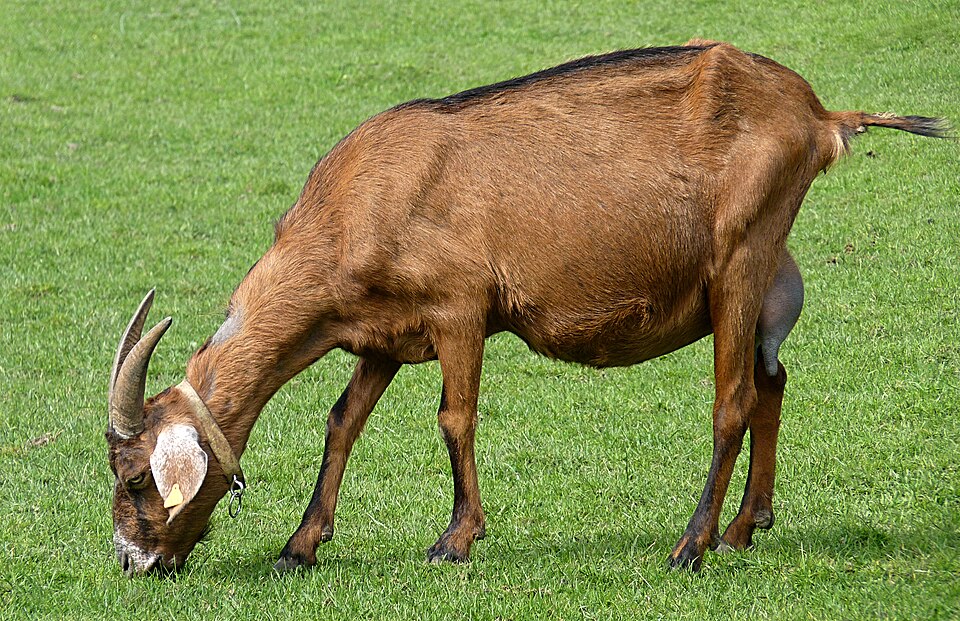
The Goat is a herbivorous mammal domesticated for more than 10,000 years, belonging to the Bovidae family. A robust and adaptive animal, it is distinguished by its intelligence, its curiosity and its great capacity to exploit varied food resources.
The Goat has a compact and muscular body, with slender but strong legs. She usually sports a distinctive beard and backward-curving horns (in most breeds). Its coat varies in color and texture depending on the breed, and its horizontal eyes provide excellent peripheral vision.
Did you know?
Why do goats climb everywhere?
Characteristics
BREEDS
Indicative values: they vary by subspecies, sex and region.
Habitat and distribution
The Goat adapts to a wide variety of habitats: rocky mountains, arid hills, meadows, rangelands and farms. It particularly thrives in mountainous areas where it easily climbs steep and rocky terrain. As a domestic animal, it is content with meadows less rich than those suitable for cattle.
CURRENT RANGE
Present on all continents in the domestic state, the Goat is one of the most widespread livestock animals in the world. It thrives in climatic zones ranging from temperate to tropical regions, and from sea level to high mountains. No distinct wild form exists in the contemporary natural state.
Behaviour
Social and hierarchical animals, Goats live in organized herds with a clear social structure. Curious and very active, they love to climb and explore their environment. They communicate with various bleats and maintain strong social bonds within the group.
Reproduction
Goats reach sexual maturity between 3 and 4 months. Gestation lasts about 150 days, and females generally give birth to one or two kids, sometimes three. Breastfeeding lasts approximately 2 to 3 months depending on breeding practices.
Peculiarities
The Goat has horizontal eyes which allow it exceptional panoramic vision, useful for detecting predators. She is remarkably agile and can jump up to 1.5 meters high. Its specialized shoes provide excellent grip on rocky surfaces. It is among the most intelligent domestic animals, with an excellent memory.
Threats and conservation
As a domestic species, Goat is not threatened with extinction. However, some traditional and local breeds face genetic erosion due to the preference given to highly productive breeds. Predation, infectious diseases and extreme weather conditions remain challenges for breeders.
Numbers and trends vary across sources and regions. See the IUCN assessment for the latest reference data.
Gallery
1 documented photographs.
References
Profile updated 11 August 2026 · Reviewed by the TunisieVet editorial team.
Comments (0)
No comments yet.
CONSERVATION STATUS
Not evaluated (NE)
IUCN source, latest published assessment.
Species health
Documented diseases for this species.
See the 109 diseases of this species Find a veterinarianThis information is provided for educational purposes only and is not a substitute for a veterinary consultation. If you have any concerns about your animal's health, consult a veterinarian.
Related species
To discover around: Goat
Videos, facts, stories and records linked to this species.
Similar animals
Other species documented in Animalpedia.

TunisieVet in your pocket 📱🐾 Access your veterinary services wherever you are. [ Download the app ]
Learn more