
Presentation
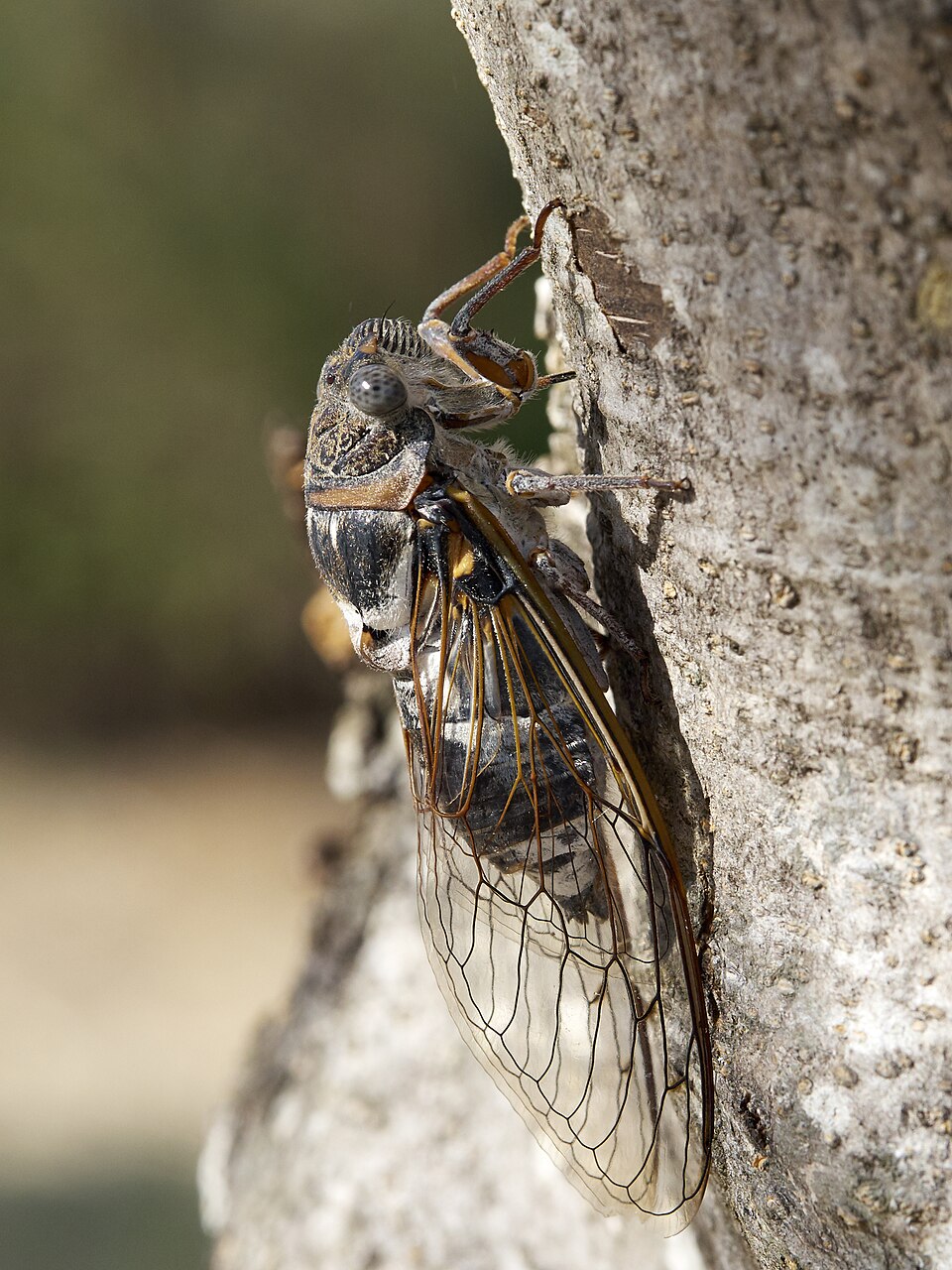
The cicada is a flying insect belonging to the order Hemiptera, renowned for the shrill song produced by males during the summer. It has a stocky body, two pairs of transparent membranous wings, and large spaced compound eyes. Found on all continents in warm zones, it spends most of its life underground in the larval stage before a brief aerial adult life. In Tunisia and throughout the Mediterranean basin, its song is closely associated with the soundscape of summer. There are several thousand cicada species worldwide, varying in size and color. Despite its acoustic fame, the cicada remains a visually discreet insect, more often heard than seen.
The cicada's body typically measures between 2 and 5 cm depending on the species, with a broad head bearing three ocelli in addition to the compound eyes. Males possess sound-producing organs called cymbals, located at the base of the abdomen, which produce the characteristic song. The front wings, often transparent and veined, are folded rooflike at rest. The front legs of larvae are adapted for digging in soil.
Characteristics
Indicative values: they vary by subspecies, sex and region.
Habitat and distribution
Cicadas inhabit warm, wooded areas, particularly Mediterranean forests, orchards, olive groves, and tree-dotted grasslands. They are especially attracted to trees with rough bark where they can camouflage themselves and lay eggs. They are found in both rural and tree-lined urban fringe areas.
CURRENT RANGE
Cicadas are present on most continents in warm temperate to tropical regions. In North Africa and Tunisia, several species are common in wooded areas and olive groves. Their worldwide distribution reflects great species diversity adapted to varied climates.
Behaviour
Only males sing, producing a powerful and repetitive sound intended to attract females, particularly active during the warmest hours of the day. The cicada spends most of its existence in larval form buried in the soil, sometimes for several years, before emerging for an aerial life of only a few weeks. It is relatively immobile and easily approached, relying mainly on its camouflage and sudden flight to escape predators.
Reproduction
After mating, the female lays her eggs in slits she cuts into the bark of branches using her ovipositor. Once hatched, the larvae fall to the ground and burrow to feed on roots for a period ranging from one to several years depending on the species. Final metamorphosis occurs above ground, with the larva climbing onto a vertical surface to molt one last time into a winged adult.
Peculiarities
The song of the male cicada ranks among the loudest sounds produced by an insect, exceeding 100 decibels in some species. The particularly long underground larval life in certain North American species contrasts sharply with the brevity of adult life.
Threats and conservation
Cicadas are not subject to any major identified threats at the global level, although loss of wooded habitats and pesticide use may locally affect certain populations. No common cicada species is currently considered threatened.
Numbers and trends vary across sources and regions. See the IUCN assessment for the latest reference data.
Gallery
1 documented photographs.
References
Profile updated 26 August 2026 · Reviewed by the TunisieVet editorial team.
Comments (0)
No comments yet.
CONSERVATION STATUS
Least concern (LC)
IUCN source, latest published assessment.
To discover around: Cicada
Videos, facts, stories and records linked to this species.
RECORD
up to about 100 dB
One of the loudest insect calls
Measurement of the call produced by males of certain cicada species at close range.
Similar animals
Other species documented in Animalpedia.

🚀 SWConsulting — Turning Your Ideas into Digital Solutions Do you have an idea, a project, or a business process that needs to be digitalized? SWConsulting supports businesses from concept to deployment, delivering custom, reliable, and scalable digital solutions tailored to their real needs. 💻 Web & Mobile Development ⚙️ Business Applications & SaaS 🤖 Artificial Intelligence & Automation 📊 Custom CRM & Management Tools 🛒 E-commerce & Marketplaces 🔗 APIs & System Integrations Our goal is simple: turn your business needs into practical digital solutions that help you improve efficiency, automate processes, and grow your business. Have a project in mind? Let’s talk. 🚀 SWConsulting — Digital Solutions, Real Impact.
WhatsApp