
Presentation
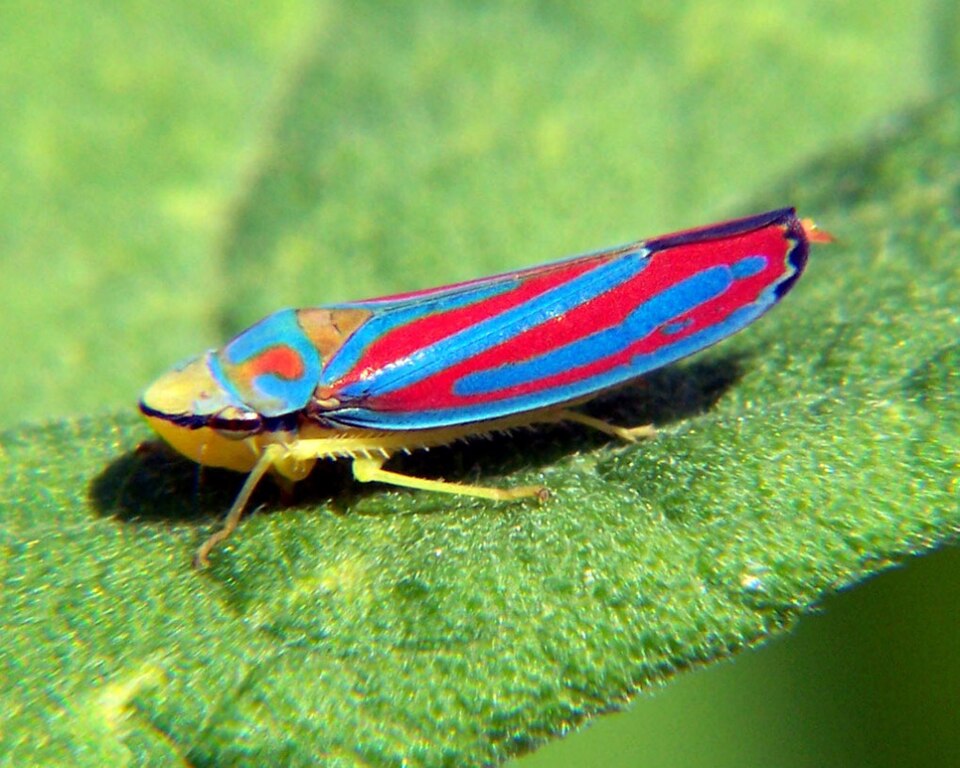
The leafhopper is a small piercing-sucking insect belonging to the family Cicadellidae, within the order Hemiptera. It typically measures between 3 and 15 mm depending on the species and is distinguished by an elongated body, often colored green, brown, or yellow. Highly mobile, it moves by rapid jumping and can also fly short distances. Leafhoppers are found in almost all terrestrial environments where herbaceous or shrubby vegetation grows. Some species are considered agricultural pests because of the damage they cause to crops and their role in transmitting plant diseases. The leafhopper also plays a role in food chains as prey for numerous invertebrate predators and insectivorous birds.
The leafhopper's body is narrow and tapering, often adorned with colorful patterns that vary depending on the species. Its hind legs, which are more developed, allow it to make powerful jumps to escape predators. It has piercing-sucking mouthparts adapted for feeding on plant sap.
Characteristics
Indicative values: they vary by subspecies, sex and region.
Habitat and distribution
Leafhoppers frequent a wide variety of vegetated habitats, from meadows to cultivated areas and forest edges. They are particularly fond of herbaceous plants and agricultural crops where sap is abundant. Their presence is closely linked to the availability of host plants suited to their feeding needs.
CURRENT RANGE
Cicadellidae form a cosmopolitan family present on all inhabited continents, with several thousand described species. Some species have a very wide distribution while others are restricted to specific regions or host plants. In North Africa, including Tunisia, several species are commonly observed in agricultural areas.
Behaviour
The leafhopper is a discreet insect, active mainly during the day. It communicates through vibrations transmitted through plants, a signaling method used especially during reproduction. When faced with danger, it reacts with sudden jumps, sometimes followed by flight.
Reproduction
The female lays her eggs in plant tissues, often inside stems or along the leaf veins. Development passes through several larval stages called nymphs, which lack functional wings, before reaching adulthood. Depending on the species and climate, several generations can occur within a single year.
Peculiarities
Some leafhoppers secrete a sweet substance called honeydew, which is appreciated by ants that may protect them in exchange. Other species transmit serious plant diseases, such as grapevine flavescence dorée. Their jumping capacity, proportional to their size, ranks among the most impressive in the insect world.
Threats and conservation
The leafhopper is not a threatened species overall; some species are even considered pests and are subject to phytosanitary treatments. Intensive pesticide use in agricultural areas can, however, reduce certain populations locally. Changes in farming practices also influence the availability of their host plants.
Numbers and trends vary across sources and regions. See the IUCN assessment for the latest reference data.
Gallery
1 documented photographs.
References
Profile updated 26 August 2026 · Reviewed by the TunisieVet editorial team.
Comments (0)
No comments yet.
CONSERVATION STATUS
Least concern (LC)
IUCN source, latest published assessment.
Species health
Documented diseases for this species.
Find a veterinarianThis information is provided for educational purposes only and is not a substitute for a veterinary consultation. If you have any concerns about your animal's health, consult a veterinarian.
Similar animals
Other species documented in Animalpedia.
