
Presentation
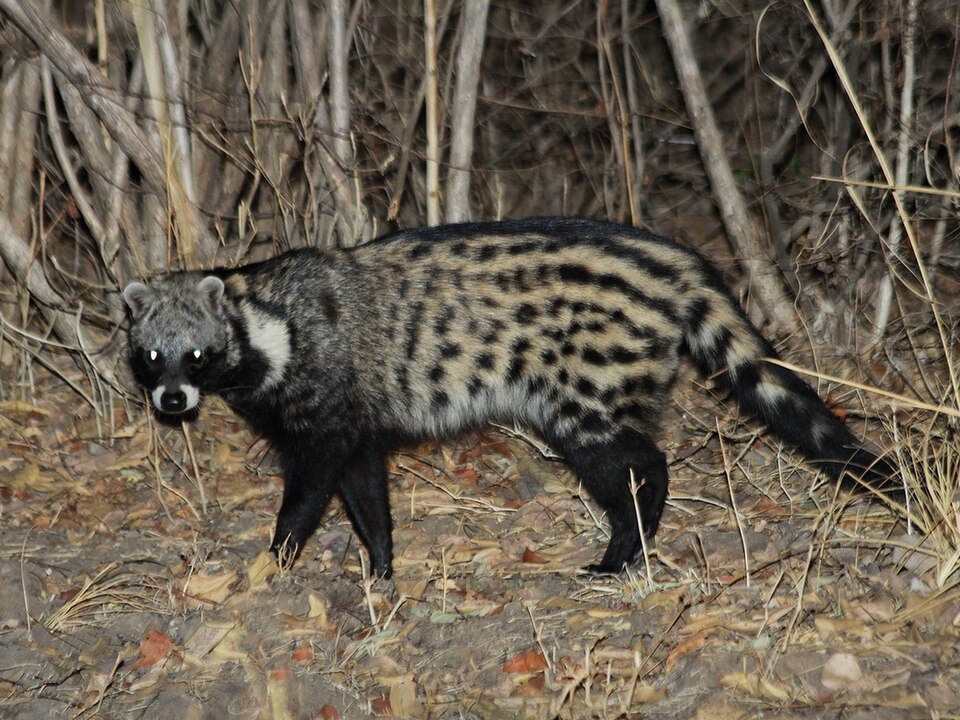
The African civet is a medium-sized carnivorous mammal, recognizable by its grey coat spotted with black and its erectile dorsal crest. It has a dark facial mask resembling that of a raccoon, as well as a long ringed tail. Discreet and mainly nocturnal, it lives on the ground in wooded regions and savannas of sub-Saharan Africa. It is best known for the scented secretion produced by its perineal glands, long exploited in the perfume industry. Despite its name, it does not belong to the cat family but to the Viverridae family.
Its stocky body measures about 60 to 90 cm in length, complemented by a bushy tail that can reach 40 cm. The yellowish-grey coat is adorned with irregular black spots and stripes, with distinct bands on the legs and tail. A line of long hairs along the spine can stand on end when the animal feels threatened, giving it a more imposing appearance.
Characteristics
Indicative values: they vary by subspecies, sex and region.
Habitat and distribution
It inhabits a wide variety of wooded habitats, from dense tropical forests to savanna woodlands, avoiding areas that are too arid. Sufficient vegetation cover to conceal itself during the day is essential to its habitat use. It also adapts to areas near human settlements when food resources are abundant.
CURRENT RANGE
The African civet is widely distributed across sub-Saharan Africa, from Senegal to East and southern Africa. It is absent from North Africa and the desert regions of the Sahara. Its range covers numerous tropical and equatorial countries across the continent.
Behaviour
Solitary and mainly nocturnal, it spends the day hidden in dense vegetation or abandoned burrows. It marks its territory using scented secretions produced by glands located near the anus. Although terrestrial, it can climb trees if needed, particularly to escape a predator.
Reproduction
The female gives birth after a gestation period of approximately 60 to 70 days, producing litters of one to four young. The offspring are born in a burrow or sheltered cavity and are weaned after several weeks. Sexual maturity is reached at around one year of age.
Peculiarities
The musky secretion from its perineal glands, called civet, was historically harvested for luxury perfumery, a practice now largely abandoned in favor of synthetic substitutes. Its facial mask and low-slung gait give it an appearance reminiscent of both the raccoon and the badger, though it is unrelated to either.
Threats and conservation
The species is locally threatened by deforestation and habitat loss linked to agricultural expansion. Hunting for its meat and, to a lesser extent, for its scent secretions, also exerts pressure on some populations. It nonetheless remains widely distributed and is not considered a major conservation concern at the global level.
Numbers and trends vary across sources and regions. See the IUCN assessment for the latest reference data.
Gallery
1 documented photographs.
References
Profile updated 16 September 2026 · Reviewed by the TunisieVet editorial team.
Comments (0)
No comments yet.
CONSERVATION STATUS
Least concern (LC)
IUCN source, latest published assessment.
Species health
Documented diseases for this species.
Find a veterinarianThis information is provided for educational purposes only and is not a substitute for a veterinary consultation. If you have any concerns about your animal's health, consult a veterinarian.
To discover around: African Civet
Videos, facts, stories and records linked to this species.
Similar animals
Other species documented in Animalpedia.
