
Presentation
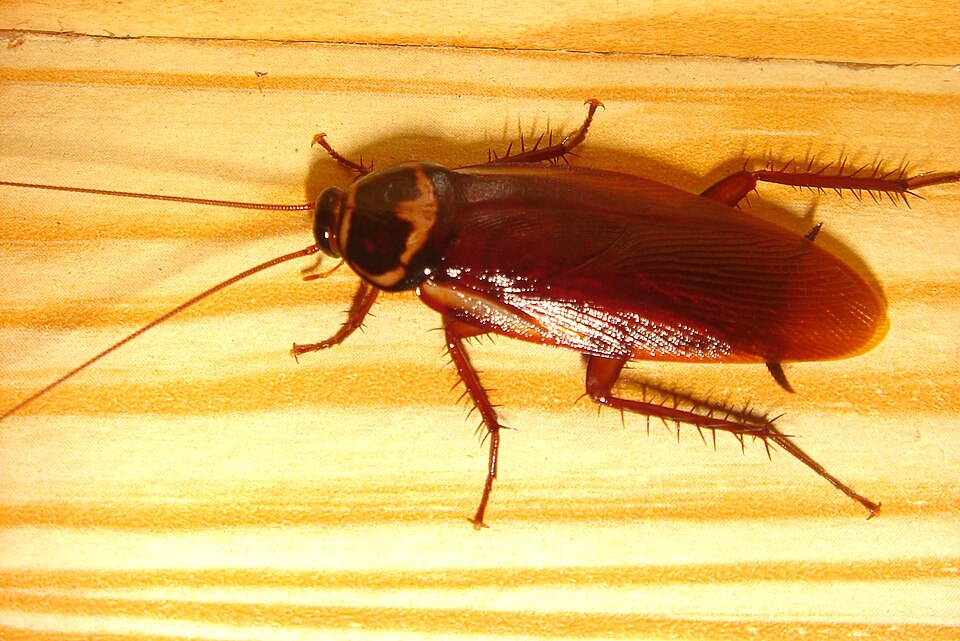
The cockroach is an insect of the order Blattodea, known for its remarkable ability to adapt to many different environments. Several species live in close association with humans, particularly in homes and sewers. Its body is flattened and oval, covered with a hard, resistant shell that allows it to squeeze through narrow cracks and crevices. It has long, sensitive antennae and is primarily nocturnal. Some species are considered pests because of their role in transmitting germs. Others, less well-known to the general public, live exclusively in natural habitats and pose no harm to humans.
Flattened and oval body, brown to blackish in colour depending on the species, ranging from a few millimetres to several centimetres in length. Six sturdy, fast-moving legs and long, thread-like antennae that are highly sensitive. Some species have functional wings, while others are wingless or fly only occasionally.
Characteristics
Indicative values: they vary by subspecies, sex and region.
Habitat and distribution
Cockroaches inhabit highly varied environments, ranging from humid tropical forests to urban dwellings, including sewers and cellars. Synanthropic species seek warmth, moisture, and proximity to food sources. Other wild species live exclusively in forest litter or under bark.
CURRENT RANGE
Cockroaches are found on all continents, with greater diversity in tropical and subtropical regions. Several cosmopolitan species have spread through the transport of goods and their association with humans. They are thus present in both urban areas and natural environments.
Behaviour
Primarily nocturnal, the cockroach avoids light and hides in dark, damp crevices during the day. It communicates through pheromones and often lives in groups within suitable habitats. Its speed and ability to squeeze into confined spaces allow it to escape predators easily.
Reproduction
The female lays her eggs clustered together in a protective capsule called an ootheca. Depending on the species, this ootheca is deposited in a shelter or carried by the female until hatching. Development passes through several larval stages before reaching the adult stage, without complete metamorphosis.
Peculiarities
The cockroach can survive several weeks without food and withstand extreme conditions thanks to its robust physiology. Some species are capable of running very quickly over short distances to escape danger. Its exoskeleton gives it great resistance to crushing.
Threats and conservation
Synanthropic species are not threatened and are instead considered pests, subject to control measures. Some rarer wild species may be affected by deforestation and loss of their natural habitat. Overall, the group is not the subject of particular conservation concerns.
Numbers and trends vary across sources and regions. See the IUCN assessment for the latest reference data.
Gallery
1 documented photographs.
References
Profile updated 25 August 2026 · Reviewed by the TunisieVet editorial team.
Comments (0)
No comments yet.
CONSERVATION STATUS
Least concern (LC)
IUCN source, latest published assessment.
To discover around: Cockroach
Videos, facts, stories and records linked to this species.
Similar animals
Other species documented in Animalpedia.
