
Presentation
Coelacanth is a deep-sea marine fish considered a “living fossil” because it belongs to a lineage that appeared more than 400 million years ago and was long believed to have been extinct since the end of the Cretaceous. Its rediscovery in 1938 off the coast of South Africa constituted one of the greatest zoological surprises of the 20th century. Two current species are recognized: the Comoros Coelacanth and the Indonesian Coelacanth. This massive fish is distinguished by its fleshy, lobed fins, reminiscent of the limbs of early land vertebrates. It lives in deep, dark waters, where it leads a slow and discreet existence. Its particular biology makes it a major subject of study for understanding the evolution of vertebrates.
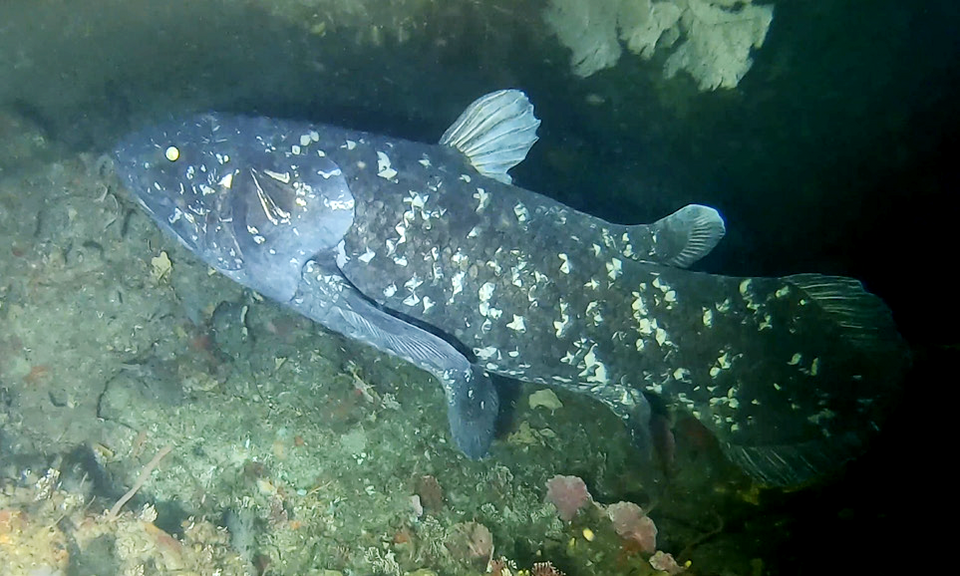
The Coelacanth has a massive body covered in thick, sturdy scales. Its paired fins are fleshy and lobed, carried by a muscular base reminiscent of limbs. It also has a small additional caudal fin, called a trilobed fin, unique among current fish. Its blue-gray to brown color, dotted with whitish spots, varies depending on the individual.
Characteristics
Indicative values: they vary by subspecies, sex and region.
Habitat and distribution
The Coelacanth lives in deep marine waters, generally between 100 and 500 meters, near volcanic rock slopes with caves. It prefers dark, cool waters, sheltered from light and surface predators. These specific habitats strongly limit its geographical distribution.
CURRENT RANGE
The best-known species lives along the coasts of the Comoros archipelago and eastern Africa, in the Indian Ocean. A second species was discovered in Indonesia, in the waters of Sulawesi. These populations are geographically isolated and small in number.
Behaviour
The Coelacanth is a nocturnal and not very active animal, spending the day in underwater caves in loose groups. It moves slowly thanks to coordinated movements of its paired fins, which evoke locomotion close to walking. At night, it goes up to hunt at shallower depths before returning to its shelters. Its behavior remains little studied overall due to the difficulty of in situ observation.
Reproduction
The Coelacanth is ovoviviparous: the eggs develop inside the female's body until hatching. Gestation is exceptionally long, estimated between three and five years according to recent studies. The female gives birth to a small number of already formed juveniles, capable of swimming immediately. Its sexual maturity is late, which makes the species particularly vulnerable to overfishing.
Peculiarities
Coelacanth was long considered extinct for 65 million years before its rediscovery in 1938. Its lobed fins are reminiscent of those of the first vertebrates to colonize dry land, making it a model for studying evolution. It also has a unique rostral electrosensory organ allowing it to detect its prey in complete darkness.
Threats and conservation
The species is threatened by accidental captures during artisanal fishing in deep waters. The degradation of its coastal and volcanic habitats, as well as its low reproductive capacity, aggravate its vulnerability. Illegal trade in specimens for scientific collections constitutes additional pressure.
Numbers and trends vary across sources and regions. See the IUCN assessment for the latest reference data.
Gallery
1 documented photographs.
References
Profile updated 31 August 2026 · Reviewed by the TunisieVet editorial team.
Comments (0)
No comments yet.
CONSERVATION STATUS
Critically endangered (CR)
IUCN source, latest published assessment.
To discover around: Coelacanth
Videos, facts, stories and records linked to this species.
RECORD
lineage approximately 400 million years old
The oldest living vertebrate lineage
Estimate based on actinistian fossils compared to current specimens.
Similar animals
Other species documented in Animalpedia.
