
Presentation
The common cuckoo is a medium-sized migratory bird recognized for its distinctive repetitive call, which gives the species its name. Its ash-grey plumage on the upperparts and barred underparts resemble those of a small raptor, which sometimes confuses other birds. It is chiefly famous for its brood parasitism: the female lays her eggs in the nests of other species, who then raise her chick without knowing it is not their own. Present in Europe and Asia during breeding, it overwinters in sub-Saharan Africa. Discreet and elusive, it is heard more often than seen in its natural habitat. In Tunisia, it frequents wooded and wetland areas during migration periods.
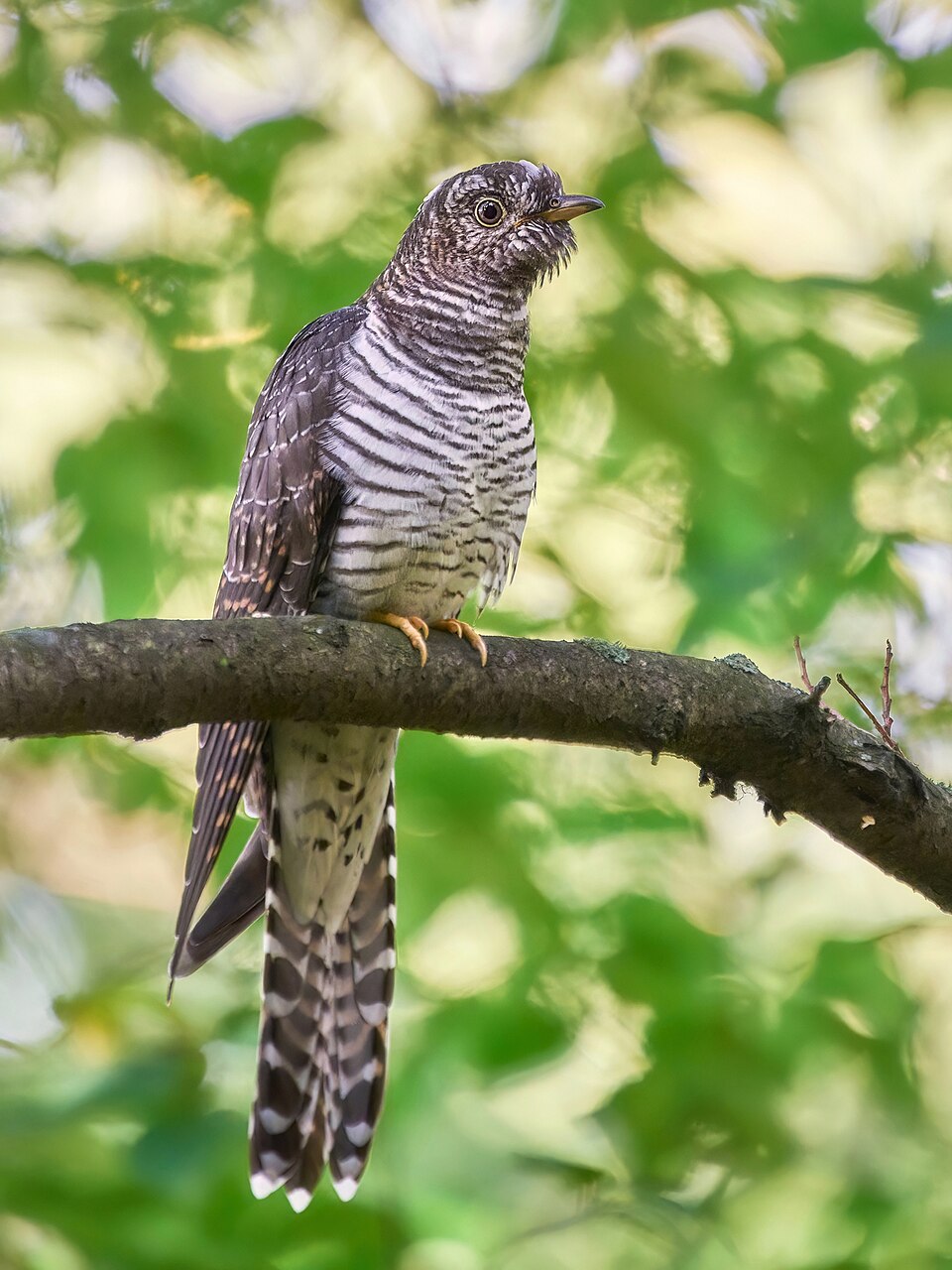
The cuckoo measures approximately 32 to 34 cm in length, with a slender build and a long graduated tail. Its blue-grey plumage on the back contrasts with a white belly barred with fine dark streaks, evoking the appearance of a sparrowhawk. The wings are pointed and allow rapid, direct flight suited to long-distance migrations.
Characteristics
Indicative values: they vary by subspecies, sex and region.
Habitat and distribution
The cuckoo inhabits a wide variety of open and semi-wooded habitats, including light forests, wetlands, meadows, and woodland edges. It avoids densely urbanized areas but may be seen on city outskirts during migration. Its presence depends largely on the availability of potential host species in a given habitat.
CURRENT RANGE
The species breeds throughout Europe and across much of temperate Asia. It winters primarily in sub-Saharan Africa, undertaking a trans-Saharan migration each year. In Tunisia, it is observed mainly during spring and autumn migration passages.
Behaviour
The cuckoo adopts a discreet and solitary behaviour, spending little time on the ground and preferring to perch at height. The male sings repeatedly to signal his presence and attract females during the breeding season. The female watches the nests of potential host species to surreptitiously lay her eggs, often taking advantage of a brief absence of the rightful parents.
Reproduction
The female cuckoo builds no nest and does not care for her young. She lays a single egg in the nest of a host species, often after removing one of the host's eggs to maintain clutch size. The cuckoo egg mimics the color of the host eggs, reducing the risk of rejection. Once hatched, the chick typically ejects the other eggs or nestlings from the nest to receive all parental feeding attention from its adoptive parents.
Peculiarities
Brood parasitism in the cuckoo is one of the most studied reproductive strategies in birds. The chick is born with an instinctive ejection behavior that drives it to expel other nest occupants within the first few days. The male's call, which inspired the species name in many languages, is traditionally used to mark the arrival of spring.
Threats and conservation
The cuckoo is affected by declining insect populations, particularly caterpillars on which it heavily depends. The reduction in potential host species, linked to the loss of natural habitats, indirectly threatens its breeding success. Climate change also disrupts the synchronization between its migration and the availability of host nests.
Numbers and trends vary across sources and regions. See the IUCN assessment for the latest reference data.
Gallery
1 documented photographs.
References
Profile updated 06 September 2026 · Reviewed by the TunisieVet editorial team.
Comments (0)
No comments yet.
CONSERVATION STATUS
Least concern (LC)
IUCN source, latest published assessment.
Species health
Documented diseases for this species.
Find a veterinarianThis information is provided for educational purposes only and is not a substitute for a veterinary consultation. If you have any concerns about your animal's health, consult a veterinarian.
To discover around: Common Cuckoo
Videos, facts, stories and records linked to this species.
Similar animals
Other species documented in Animalpedia.

TunisieVet in your pocket 📱🐾 Access your veterinary services wherever you are. [ Download the app ]
Learn more