
Presentation
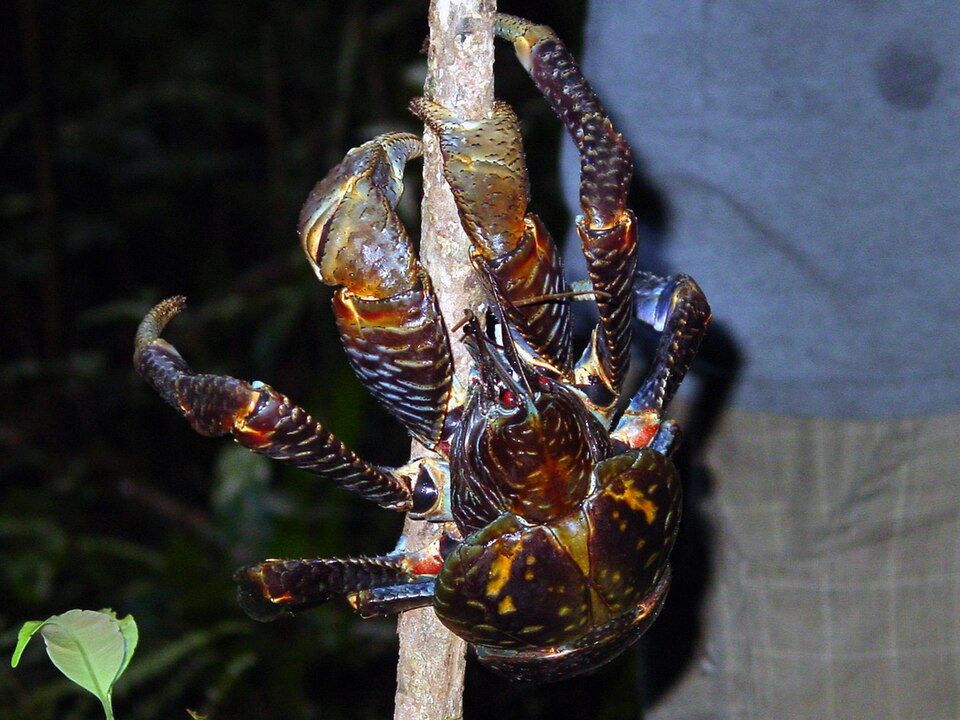
The coconut crab is the largest known land arthropod and can weigh several kilograms as an adult. It belongs to the family Coenobitidae, related to hermit crabs, though adults no longer carry a shell. Its body is protected by a robust exoskeleton, and its front legs end in powerful claws used to crack open coconuts. The species lives on tropical islands in the Indian and Pacific Oceans, where it inhabits burrows dug into soil or sand. It breathes through a modified gill organ adapted for life on land, which prevents it from remaining submerged for long periods. Nocturnal and rather solitary, it is renowned for its highly developed sense of smell, which allows it to locate food from a distance.
The species has a segmented body covered in a calcareous carapace that ranges in colour from bluish to reddish-brown depending on the population. Adults shed the protective shell they carried as juveniles and develop a hardened abdomen folded beneath their body. Their antennae and sensory legs are richly supplied with olfactory receptors, more developed than in most crustaceans.
Characteristics
Indicative values: they vary by subspecies, sex and region.
Habitat and distribution
The species inhabits coastal forests and rocky or sandy areas on tropical islands, usually near the shoreline. It needs access to the sea for breeding but lives exclusively on land as an adult. The burrows it digs provide the humid shelter essential for its survival.
CURRENT RANGE
The coconut crab is found on tropical islands throughout the Indian Ocean and western Pacific, from Madagascar to the central Pacific islands. It has disappeared from many densely populated coastal areas due to hunting and habitat loss. Today, the largest populations survive on isolated or protected islands.
Behaviour
Active mainly at night, it spends the day sheltering in burrows or rocky crevices to avoid dehydration and predators. It is capable of climbing trees, particularly coconut palms, to feed or to escape. Its behaviour is generally solitary, except during occasional gatherings around an abundant food source.
Reproduction
Breeding occurs on land, but females return to the shore to release their eggs into the ocean, where larval development takes place. The larvae spend several weeks in the marine environment before returning to land as juveniles in a borrowed shell. Sexual maturity arrives late, after several years of slow growth.
Peculiarities
This species is renowned for the exceptional strength of its claws, powerful enough to pierce coconut shells. Its sense of smell, comparable to that of certain insects, allows it to detect food sources from great distances. It cannot swim and will drown if submerged too long as an adult.
Threats and conservation
Hunting for local consumption and trade represents the main threat, as the species is considered a delicacy in several regions. The destruction of its coastal habitat and the introduction of predators on certain islands worsen its decline. Its slow growth and late maturity limit its ability to recover quickly.
Numbers and trends vary across sources and regions. See the IUCN assessment for the latest reference data.
Gallery
1 documented photographs.
References
Profile updated 19 September 2026 · Reviewed by the TunisieVet editorial team.
Comments (0)
No comments yet.
CONSERVATION STATUS
Vulnerable (VU)
IUCN source, latest published assessment.
Species health
Documented diseases for this species.
Find a veterinarianThis information is provided for educational purposes only and is not a substitute for a veterinary consultation. If you have any concerns about your animal's health, consult a veterinarian.
To discover around: Coconut Crab
Videos, facts, stories and records linked to this species.
RECORD
up to 1 m wingspan and 4 kg
The largest land arthropod
Measurement taken with legs extended in the largest adult individuals observed in the wild...
Similar animals
Other species documented in Animalpedia.

TunisieVet in your pocket 📱🐾 Access your veterinary services wherever you are. [ Download the app ]
Learn more