
Presentation
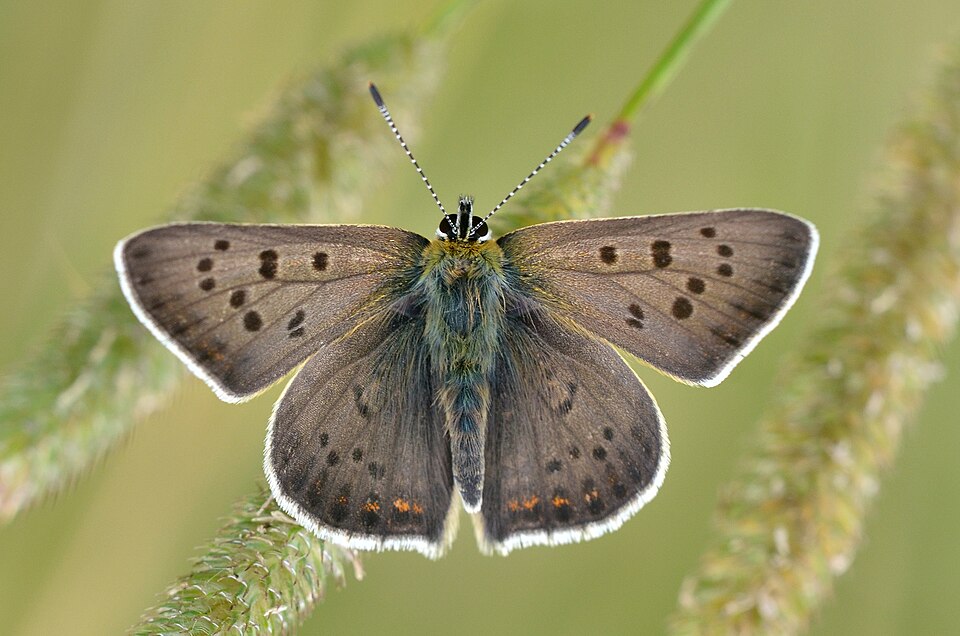
The Copper is a small day-flying butterfly belonging to the family Lycaenidae, recognizable by the coppery orange colour of its forewings marked with black spots. The hindwings often display a darker border, sometimes tinged with brown or grey depending on the species and sex. This butterfly frequents meadows, wasteland, and grassy roadsides where it forages actively. Its flight is fast and jerky, typical of small Lycaenids. It serves as a useful indicator of the health of herbaceous habitats in Europe and North Africa. Several closely related species share this common name, with similar biology.
The wingspan measures between 25 and 35 mm, with brilliant coppery orange uppersides marked by black dots. The undersides of the wings are paler, greyish-beige to orange, decorated with small black spots ringed with white. Males often display more vivid colours than females, which may show more brown. The antennae are fine and banded with black and white.
Characteristics
Indicative values: they vary by subspecies, sex and region.
Habitat and distribution
The Copper butterfly frequents moist and dry meadows, waste areas, flower-rich banks and roadsides. It favors open habitats with abundant flowering plants and docks for breeding. It is also found along forest edges and in extensive agricultural areas.
CURRENT RANGE
This group of butterflies is widely distributed across Europe, North Africa, and temperate Asia. In Tunisia, it is observed in wetlands and meadows of the northern and central regions. Its distribution depends strongly on the presence of its host plants.
Behaviour
The Copper is a territorial butterfly; males actively defend a perch against rivals. It flies mainly in sunny weather, frequently landing with wings open to warm itself. Its activity is diurnal and it remains generally close to areas where its caterpillar host plants grow.
Reproduction
The female lays her eggs singly on leaves of host plants, mainly docks (Rumex species). The green caterpillar develops through several stages before pupating at ground level or at the base of plants. Depending on the region and climate, the species may produce two to three generations per year. Overwinting typically occurs at the caterpillar or chrysalis stage.
Peculiarities
The metallic copper color of its wings, produced by the microscopic structure of scales, gives it a particular shine depending on the angle of light. Some forms display marked seasonal dimorphism between spring and summer generations.
Threats and conservation
The loss of natural meadows and agricultural intensification reduce its preferred habitats. Pesticide use affects both the caterpillars and the host plants necessary for their development. The butterfly nonetheless remains fairly common in several regions.
Numbers and trends vary across sources and regions. See the IUCN assessment for the latest reference data.
Gallery
1 documented photographs.
References
Profile updated 09 September 2026 · Reviewed by the TunisieVet editorial team.
Comments (0)
No comments yet.
CONSERVATION STATUS
Least concern (LC)
IUCN source, latest published assessment.
Similar animals
Other species documented in Animalpedia.

TunisieVet in your pocket 📱🐾 Access your veterinary services wherever you are. [ Download the app ]
Learn more