
Presentation
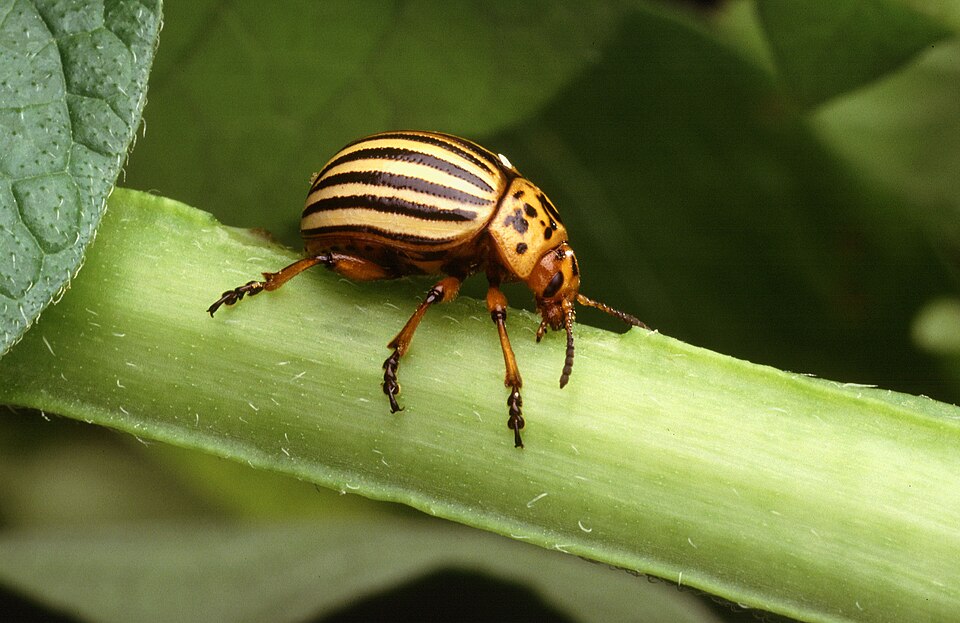
The Colorado potato beetle is a plant-eating beetle native to North America that has become a major pest of potato crops around the world. It measures roughly one centimeter long and is recognized by its yellow-orange wing cases marked with ten characteristic black longitudinal stripes. Its larva, red-orange in color with black spots on the sides, causes significant damage by devouring foliage. Accidentally introduced to Europe in the early twentieth century, it has spread across most continents where potatoes are grown. Its high reproduction rate and increasing resistance to insecticides make it a species that is difficult to control.
The oval, convex body measures 8 to 12 mm in length, with yellow wing cases striped with ten characteristic black lines. The pronotum bears irregular black spots that form a pattern varying between individual beetles. Larvae pass through four stages, growing larger and gradually darkening from bright red to dull orange.
Characteristics
Indicative values: they vary by subspecies, sex and region.
Habitat and distribution
The Colorado potato beetle primarily inhabits cultivated potato fields and other nightshade plants, as well as vegetable gardens. It tolerates a wide range of temperate to warm climatic conditions, provided its host plants are available. It is also found at the edges of crops and in periurban agricultural zones.
CURRENT RANGE
Native to the Rocky Mountains of North America, it spread to Europe, Asia, and North Africa throughout the twentieth century via agricultural trade. It is now present in most potato-producing regions of the northern hemisphere. Certain areas, such as Australia, remain officially pest-free thanks to strict quarantine measures.
Behaviour
The Colorado potato beetle is active during the day and moves by walking or flying over short distances to colonize new fields. Adults overwinter buried in the soil and emerge in spring once temperatures warm. When threatened, it can drop to the ground and play dead or secrete a repellent substance.
Reproduction
Females lay several hundred eggs clustered in yellow-orange masses on the undersides of leaves. Larvae hatch within a few days and feed actively before burrowing into the soil to pupate. Several generations can occur in a single season depending on climate, accelerating the spread of the species.
Peculiarities
Its ability to rapidly develop resistance to insecticides makes it one of the most studied agricultural pests in the world. The black and yellow striped pattern of its wing cases serves as a visual warning to predators.
Threats and conservation
The species is not threatened; on the contrary, it is considered an agricultural pest actively controlled by growers. The main pressures it faces come from insecticide treatments and integrated pest management practices implemented in crops.
Numbers and trends vary across sources and regions. See the IUCN assessment for the latest reference data.
Gallery
1 documented photographs.
References
Profile updated 11 September 2026 · Reviewed by the TunisieVet editorial team.
Comments (0)
No comments yet.
CONSERVATION STATUS
Least concern (LC)
IUCN source, latest published assessment.
Species health
Documented diseases for this species.
Find a veterinarianThis information is provided for educational purposes only and is not a substitute for a veterinary consultation. If you have any concerns about your animal's health, consult a veterinarian.
Similar animals
Other species documented in Animalpedia.
