
Presentation
The Komodo dragon is the largest living lizard in the world, endemic to a few Indonesian islands. This giant monitor lizard impresses with its size, strength and super-predator status at the top of the food chain in its island ecosystem. It combines a venomous bite and formidable mechanical power to defeat prey much larger than itself. Scientifically discovered at the beginning of the 20th century, it remains an emblematic species of Indonesian biodiversity. Its small population and limited range make it a vulnerable species that is closely monitored. It is the subject of significant ecological tourism in Komodo National Park.
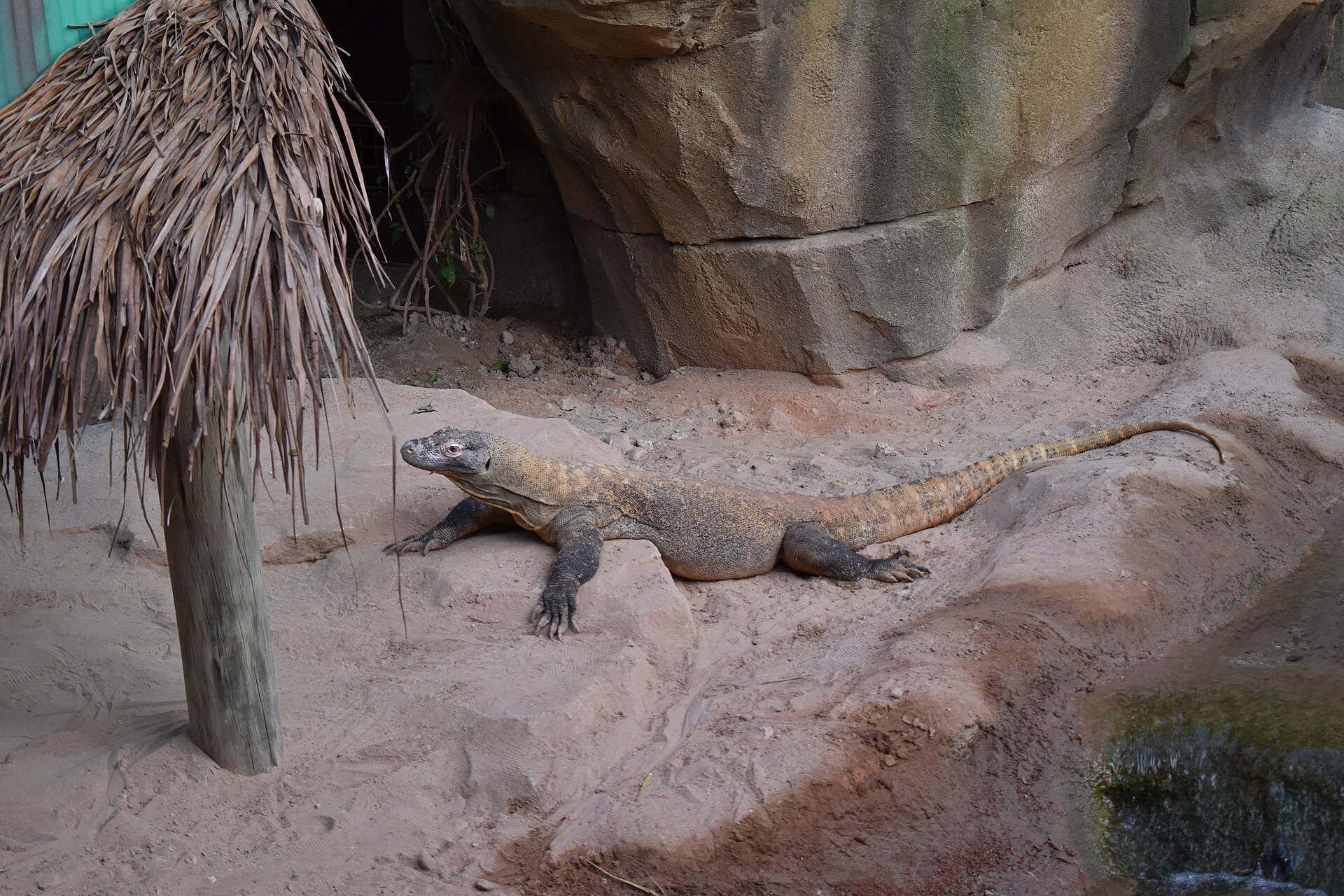
This large lizard has a massive body covered in rough grayish to reddish-brown scales, a long muscular tail, and powerful claws. Its jaw houses serrated teeth and venomous glands secreting anticoagulant toxins. Its bite combines laceration and envenomation, causing hemorrhage and shock in the prey. His hearing is limited but his sight and especially his sense of smell, via the vomeronasal organ, are particularly effective.
Characteristics
Indicative values: they vary by subspecies, sex and region.
Habitat and distribution
The Komodo dragon frequents the wooded savannahs, dry tropical forests and scrub areas of the Indonesian islands where it inhabits. It also appreciates open grassy plains suitable for hunting and the edges of temporary rivers. It can move long distances to find food or water during the dry season.
CURRENT RANGE
The species is endemic to a small number of islands in the Indonesian archipelago: Komodo, Rinca, Gili Motang, Nusa Kode and Flores. This very restricted distribution area constitutes one of the main causes of its fragility in the face of environmental changes. Most of the population lives within the boundaries of Komodo National Park, a protected area since 1980.
Behaviour
The Komodo dragon is a solitary predator, active mainly during the day, which hunts from ambush. It uses its tongue and highly developed sense of smell to spot carcasses several kilometers away. The young, vulnerable to cannibalistic adults, live in trees to avoid predation. Adults can be aggressive towards each other, especially when competing for food or mates.
Reproduction
The female lays between 15 and 30 eggs which she buries in a nest dug in the ground or in an old megapode nest. Incubation lasts about 7 to 8 months before the young emerge. The female can also resort to parthenogenesis in the absence of a male, producing only male offspring. Newborns are completely independent from birth and climb trees to escape adults.
Peculiarities
Komodo dragon is capable of parthenogenesis: some isolated females can produce viable eggs without fertilization by a male. Its exceptional sense of smell allows it to detect a carcass several kilometers away thanks to its forked tongue. It has remarkable resistance to bacteria present in its own saliva, once believed to be solely responsible for the death of prey before the discovery of its venom.
Threats and conservation
The main threat is habitat loss linked to human activity and rising sea levels on its small islands. Poaching of its natural prey also reduces its food resources. Climate change and occasional forest fires are worsening the fragmentation of its already small territory.
Numbers and trends vary across sources and regions. See the IUCN assessment for the latest reference data.
Gallery
1 documented photographs.
References
Profile updated 19 August 2026 · Reviewed by the TunisieVet editorial team.
Comments (0)
No comments yet.
CONSERVATION STATUS
Endangered (EN)
IUCN source, latest published assessment.
Species health
Documented diseases for this species.
See the 8 diseases of this species Find a veterinarianThis information is provided for educational purposes only and is not a substitute for a veterinary consultation. If you have any concerns about your animal's health, consult a veterinarian.
To discover around: Komodo dragon
Videos, facts, stories and records linked to this species.
RECORD
up to 3 m and 90 kg
The largest living lizard
Measurement carried out on wild adult specimens in Komodo National Park, Indonesia.
Similar animals
Other species documented in Animalpedia.

TunisieVet in your pocket 📱🐾 Access your veterinary services wherever you are. [ Download the app ]
Learn more