
Presentation
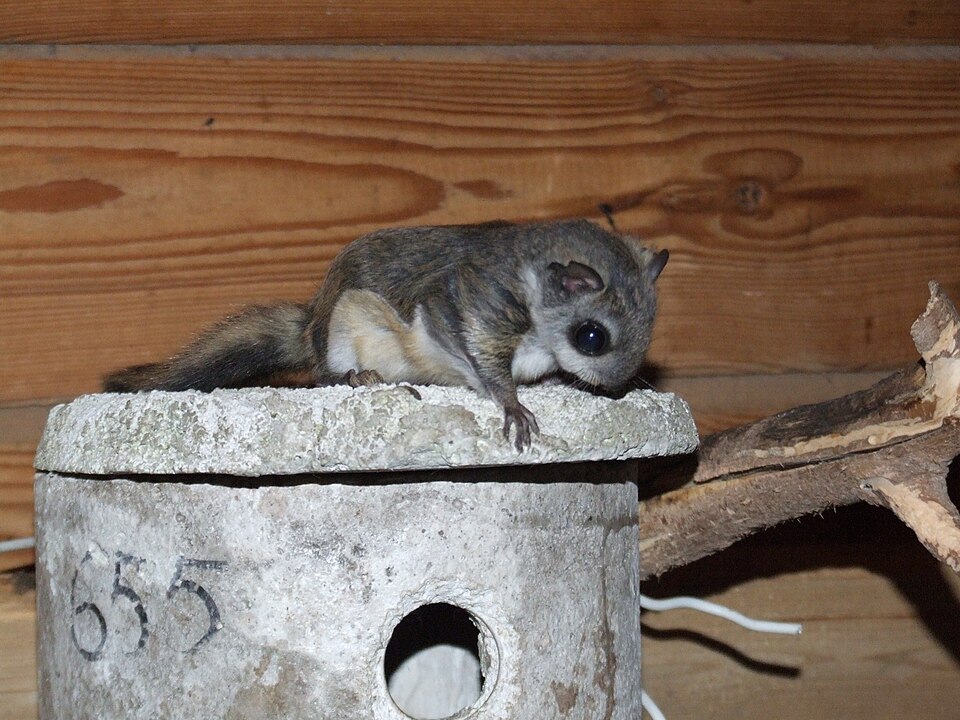
The Flying Squirrel is a small arboreal mammal capable of gliding between trees thanks to a skin membrane stretched between its limbs. It actually brings together several genera and species distributed mainly in North America and Asia. Active especially at night, it uses its large eyes to move in the darkness of forests. Its gliding ability, actually a controlled glide jump, can cover several tens of meters. It is increasingly sought after as an exotic pet in certain countries. In Tunisia, it is not present in its natural state but can be occasionally held by individuals.
The Flying Squirrel has a membrane called the patagium, stretched between the wrists and ankles, which allows it to glide. Its body is light, covered in soft, dense fur, and its flat tail serves as a rudder during gliding. Its large eyes, adapted for night vision, occupy a significant part of its face. The sharp claws make it easier to grip the trunks after landing.
Characteristics
Indicative values: they vary by subspecies, sex and region.
Habitat and distribution
The Flying Squirrel lives in temperate, mixed or tropical forests, where mature trees provide nesting cavities. It favors dense wooded areas allowing gliding jumps between branches. Certain Asian species also frequent mountain forests. It avoids open areas devoid of plant cover.
CURRENT RANGE
It is found mainly in North America, where several common species live, as well as in Asia, particularly in Siberia, China and Southeast Asia where species diversity is greatest. It is absent from Africa and western Europe in the wild, except for a relict species in Scandinavia and Russia. There is no wild population in Tunisia.
Behaviour
This animal is essentially nocturnal and crepuscular, resting during the day in tree cavities or nests. It often lives in small family groups, particularly during winter to keep each other warm. Very agile, it moves from branch to branch and uses gliding to save energy and escape predators. It communicates by high-pitched vocalizations and olfactory signals.
Reproduction
The female gives birth once or twice a year, after a gestation of approximately one month. Each litter generally has two to four young, naked and blind at birth. The young remain dependent on their mother for several weeks before learning to glide. Sexual maturity is reached around the age of one year.
Peculiarities
Contrary to its name, the Flying Squirrel does not actively fly but hovers thanks to its skin membrane. It can travel impressive distances in a single gliding jump, changing direction using its tail. Its discreet nocturnal life explains why it is rarely observed despite its sometimes abundant presence.
Threats and conservation
Deforestation and fragmentation of forest habitats constitute the main threat to several species. Competition with introduced species and the loss of old cavity trees reduce available nesting sites. Some Asian species are also threatened by the illegal pet trade.
Numbers and trends vary across sources and regions. See the IUCN assessment for the latest reference data.
Gallery
1 documented photographs.
References
Profile updated 21 August 2026 · Reviewed by the TunisieVet editorial team.
Comments (0)
No comments yet.
CONSERVATION STATUS
Least concern (LC)
IUCN source, latest published assessment.
Species health
Documented diseases for this species.
See the 7 diseases of this species Find a veterinarianThis information is provided for educational purposes only and is not a substitute for a veterinary consultation. If you have any concerns about your animal's health, consult a veterinarian.
To discover around: Flying Squirrel
Videos, facts, stories and records linked to this species.
Similar animals
Other species documented in Animalpedia.

TunisieVet in your pocket 📱🐾 Access your veterinary services wherever you are. [ Download the app ]
Learn more