
Presentation
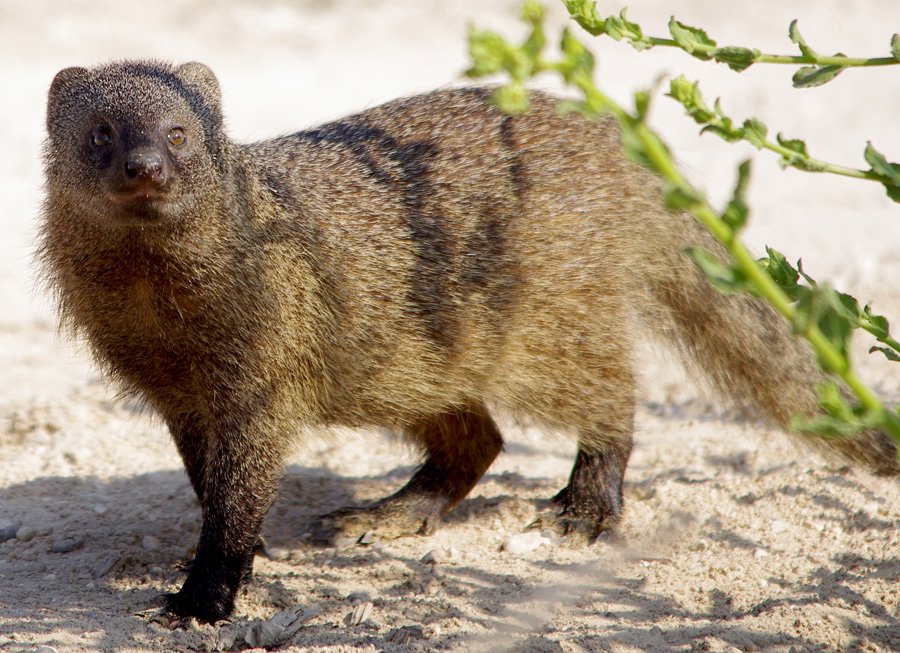
Egyptian mongoose is a small, slender carnivore belonging to the Herpestidae family. With an elongated, flexible body, it has gray to reddish-brown fur and a long, thick tail. This agile and fast animal is perfectly adapted to hunting and digging.
This mongoose is distinguished by its thin and dynamic silhouette, its short and muscular legs, and its non-retractable claws. Its triangular head has shiny black eyes and rounded ears. It has teeth adapted to its carnivorous diet, with pointed canines and sharp molars to crush the exoskeletons of its prey.
Characteristics
Indicative values: they vary by subspecies, sex and region.
Habitat and distribution
Egyptian mongoose inhabits forests, coastal wetlands, marshes and wooded areas near waterways. It appreciates environments offering good plant cover and hiding places for protection. It adapts to different types of terrain as long as they offer sufficient prey and accessible refuges.
CURRENT RANGE
This species is widely distributed in Africa, particularly in North and West Africa, as well as in East Africa. It is also present in the Middle East and southeastern Europe (Spain, Portugal). Its distribution area mainly covers the Mediterranean regions and the tropical zones of Africa.
Behaviour
The Egyptian mongoose is a mainly diurnal animal with marked territoriality. It is generally solitary or in small family groups. Very alert and curious, it moves quickly on the ground and climbs with ease. It uses various calls to communicate and is able to stand up on its hind legs to scan its surroundings.
Reproduction
Reproduction of this mongoose varies by region, but it can breed all year round in tropical areas. After a gestation of approximately 10 to 11 weeks, the female gives birth to a litter of 2 to 4 young. The young remain dependent on their mother for several months and gradually learn hunting techniques.
Peculiarities
The Egyptian mongoose is renowned for its great agility and exceptional reaction speed when hunting. She is able to fight venomous snakes using her speed and agility to dodge their attacks. Its thick and long tail plays an important balancing role during its acrobatic movements.
Threats and conservation
Although globally stable, Egyptian mongoose may be locally affected by habitat loss due to wetland and forest degradation. It can also come into conflict with humans in agricultural regions. However, the species benefits from a wide distribution area and remains not very vulnerable to current threats.
Numbers and trends vary across sources and regions. See the IUCN assessment for the latest reference data.
Gallery
1 documented photographs.
References
UICN — Liste rouge des espèces menacées
Profile updated 02 September 2026 · Reviewed by the TunisieVet editorial team.
Comments (0)
No comments yet.
CONSERVATION STATUS
Least concern (LC)
IUCN source, latest published assessment.
Species health
Documented diseases for this species.
See the 4 diseases of this species Find a veterinarianThis information is provided for educational purposes only and is not a substitute for a veterinary consultation. If you have any concerns about your animal's health, consult a veterinarian.
To discover around: Egyptian mongoose
Videos, facts, stories and records linked to this species.
Similar animals
Other species documented in Animalpedia.

TunisieVet in your pocket 📱🐾 Access your veterinary services wherever you are. [ Download the app ]
Learn more