
Presentation
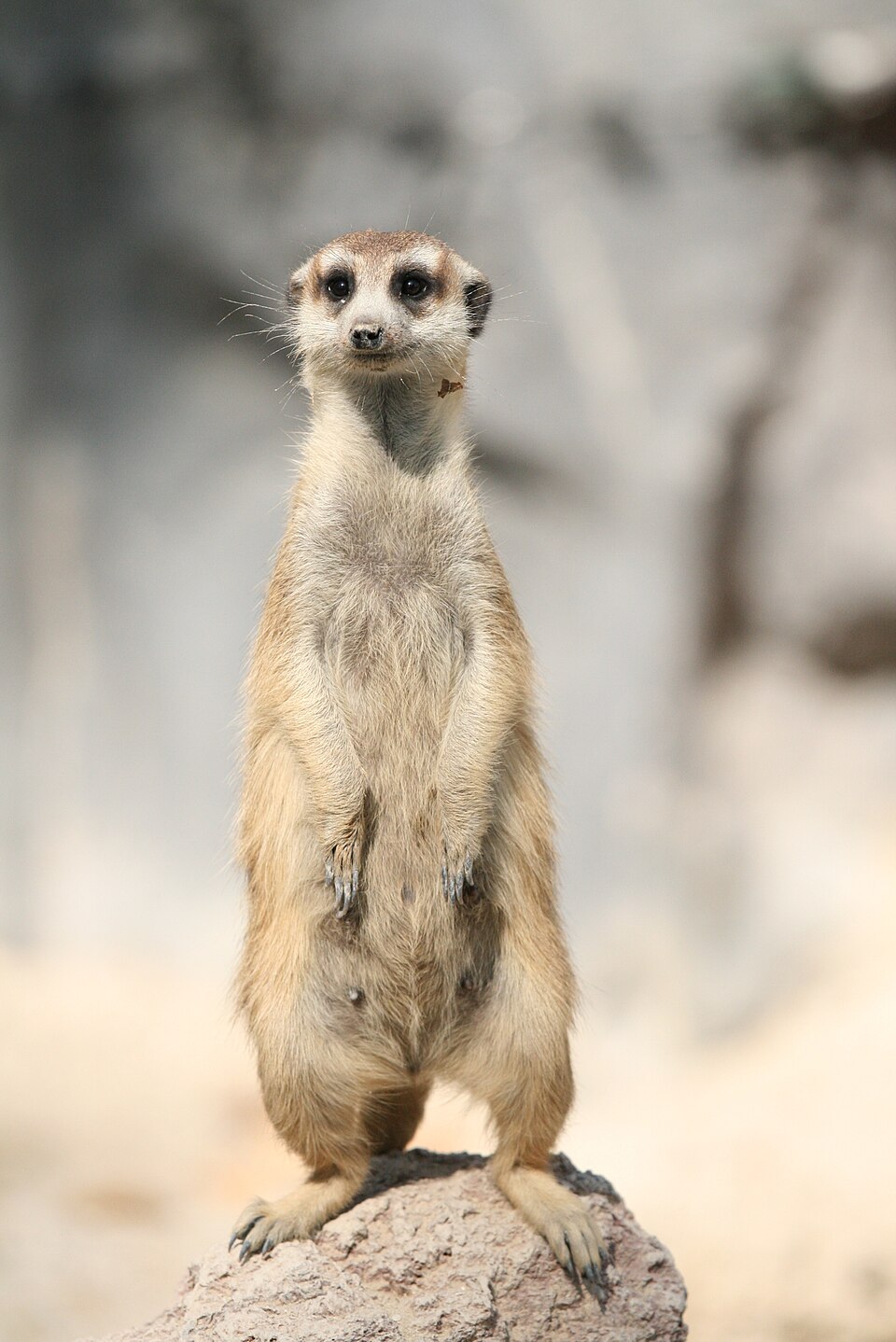
The Meerkat is a small carnivorous mammal belonging to the herpestidae family, close to mongooses. It is characterized by a slender build, a gray-brown coat with dark stripes down the back, and distinctive black markings around the eyes that reduce solar glare. Very sociable, it lives in family groups called clans which can number several dozen individuals. Its best-known behavior is standing on its hind legs to scan the horizon for predators. Native to the arid regions of southern Africa, it has adapted to life in complex burrows that it sometimes shares with other species. Its popularity among the general public has been reinforced by animal documentaries and certain works of fiction.
The Meerkat has a thin, elongated body, short limbs, and a long, tapered, non-prehensile tail. Its non-retractable, powerful and curved claws allow it to efficiently dig the ground to build burrows. Its eyes are rimmed in black, which limits the reflection of the sun and makes it easier to monitor the sky. Their sight and hearing are particularly developed, essential to the collective vigilance of the group.
Characteristics
Indicative values: they vary by subspecies, sex and region.
Habitat and distribution
The Meerkat inhabits arid and semi-arid areas of southern Africa, including dry savannahs, steppes and desert margins. It favors loose, sandy soils suitable for digging complex burrows with several entrances. These burrows, sometimes shared with other species such as ground squirrels, offer protection against intense daytime heat and nighttime cold. Its natural habitat is characterized by low and sparse vegetation facilitating visual surveillance of the territory.
CURRENT RANGE
The species occurs in southwestern southern Africa, including Namibia, Botswana, South Africa and parts of Angola. It mainly occupies desert and semi-desert areas such as the Kalahari Desert. Its distribution remains limited to this subcontinent and it does not exist naturally elsewhere in the world.
Behaviour
The Meerkat is an extremely social animal that lives in hierarchically structured clans, dominated by a breeding pair. Members of the group share tasks such as guarding, raising young and foraging, illustrating extensive cooperation. Sentinels regularly station themselves high up to monitor aerial and terrestrial predators, emitting specific alarm calls depending on the threat. The species is diurnal and spends the night grouped in underground burrows to protect itself from the cold and predators.
Reproduction
The dominant female of the clan usually breeds several times a year after a gestation of about 11 weeks, giving birth to 2 to 5 young per litter. The young are born blind and dependent, raised collectively by other members of the group who participate in their feeding and protection. Weaning occurs around two months of age, while sexual maturity is reached around one year. This cooperative breeding system promotes the survival of litters in an arid and hostile environment.
Peculiarities
The Meerkat is distinguished by its characteristic standing posture, used for collective surveillance of the territory. It has a notable tolerance to certain scorpion venoms, allowing it to attack prey that is dangerous to other predators. The system of rotating sentinels constitutes a remarkable behavioral adaptation in the face of predation pressure in an open environment.
Threats and conservation
The Meerkat is not considered globally threatened, with its population remaining generally stable and abundant throughout its natural range. It can nevertheless be locally affected by the degradation of its habitat linked to agriculture and human expansion. Some individuals are captured illegally for the exotic pet trade, a practice of concern for animal welfare.
Numbers and trends vary across sources and regions. See the IUCN assessment for the latest reference data.
Gallery
1 documented photographs.
References
Profile updated 18 August 2026 · Reviewed by the TunisieVet editorial team.
Comments (0)
No comments yet.
CONSERVATION STATUS
Least concern (LC)
IUCN source, latest published assessment.
Species health
Documented diseases for this species.
See the 8 diseases of this species Find a veterinarianThis information is provided for educational purposes only and is not a substitute for a veterinary consultation. If you have any concerns about your animal's health, consult a veterinarian.
To discover around: Meerkat
Videos, facts, stories and records linked to this species.
Similar animals
Other species documented in Animalpedia.

TunisieVet in your pocket 📱🐾 Access your veterinary services wherever you are. [ Download the app ]
Learn more