
Presentation
The European lobster is a large decapod crustacean, emblematic of the Atlantic coasts and the Mediterranean. Equipped with a robust shell and two powerful claws, it is one of the most prestigious seafood and represents a major economic importance for coastal fisheries.
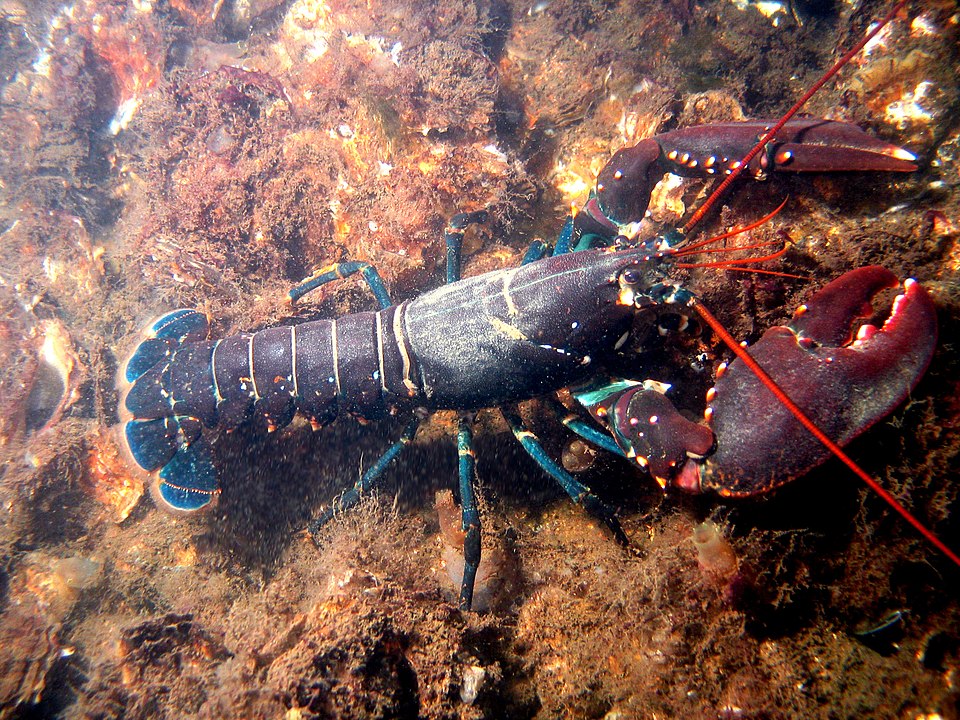
The European lobster has an elongated body covered with a brown to bluish chitinous carapace, punctuated with ocher spots. Its first two pairs of legs are transformed into imposing and uneven claws, the left being generally more massive. The compound eyes are located at the base of the long antennae.
Characteristics
Indicative values: they vary by subspecies, sex and region.
Habitat and distribution
The European lobster inhabits the rocky, sandy and silty coastal waters of the Northeast Atlantic and the Mediterranean, between the surface and 100 meters depth, sometimes up to 300 m. It prefers areas with crevices, rocks and uneven bottoms where it can dig burrows and hide.
CURRENT RANGE
European lobster is distributed along the coasts of the Northeast Atlantic, from Norway to Mauritania, including the British Isles, France, Spain and Portugal. It is also present in the Mediterranean, particularly in Italy and North Africa, although its populations are less abundant there.
Behaviour
The European lobster is a primarily nocturnal and solitary animal, hiding in burrows and rock fissures during the day. It is very territorial and aggressive towards its conspecifics, using its pincers to fight. During mating, individuals establish complex dominance hierarchies.
Reproduction
The European lobster reaches sexual maturity between 5 and 7 years of age. After mating, the female lays several thousand eggs which she carries attached under her abdomen for several months. The larvae are released into open water and go through several stages of development before settling on the seabed.
Peculiarities
The European lobster has the remarkable ability to regenerate its legs and antennae if they are lost or damaged. It can also autotomize a pincer to escape from a predator. In addition, it has copper in its blood (hemocyanin) which gives it a bluish tint, unlike the iron in vertebrates.
Threats and conservation
The European lobster faces overfishing, which has significantly reduced its natural stocks in some areas. It is also vulnerable to marine pollution, temperature changes and the destruction of coastal habitats. Despite these pressures, its current status remains stable thanks to stock management and conservation measures.
Numbers and trends vary across sources and regions. See the IUCN assessment for the latest reference data.
Gallery
1 documented photographs.
References
UICN — Liste rouge des espèces menacées
Profile updated 27 August 2026 · Reviewed by the TunisieVet editorial team.
Comments (0)
No comments yet.
CONSERVATION STATUS
Least concern (LC)
IUCN source, latest published assessment.
Species health
Documented diseases for this species.
This information is provided for educational purposes only and is not a substitute for a veterinary consultation. If you have any concerns about your animal's health, consult a veterinarian.
Similar animals
Other species documented in Animalpedia.

TunisieVet in your pocket 📱🐾 Access your veterinary services wherever you are. [ Download the app ]
Learn more